Category Archives: IBDP Biology
Definedly… maybe? Get the definitions right in your review.
Nail down those definitions
Define is a ‘simple’ objective 1 command term… but you must be precise in your answers.
Definitions are also a great start to review and build into deeper explanation of the concepts.
- Quiz yourself on the definitions, check your answers. This Sortable Syllabus might help.
- Pay attention to the markschemes – what is the importance of the underlined terms and why can’t you get marks without them?
- ‘Unpack’ the definition into its component parts – what is the relevance of each and how does it lead to more in-depth explanation of the concept?
Here’s a quiz for the define assessment statements in the SL Core and for the two options my class did this year. It’s a GoogleDoc – here’s the link.
Bad Pharma by Ben Goldacre: quick review & course connections

The Book
There’s a good chance that you’d not be here to read this without the pharmaceutical industry designing and manufacturing the vaccines and medications you’ve used during your life – but how much do we know about where they come from?
In this thoughtful, well-researched and instructive book, Ben Goldacre* (doctor, evidence-based medicine proponent and author of Bad Science) outlines how Big Pharma works, but also what the issues are and how they can be fixed. He has a TEDMED Talk on the premise of the book (below) and takes care no to write a ‘hatchet-job’ on the industry, but to shine a light on the current state of clinical research and marketing.
I recommend the book to IB Biology and IB Chemistry students and teachers – read a copy before the next teaching cycle begins – as there are many sections of direct relevance to our courses that could be used as lesson ideas or real-world contexts for what we’re learning. It would make a great addition to the reading list for students, especially those intending to pursue medical, biochemistry or pharmaceutical careers.
In each chapter, Goldacre identifies a problem and gives a clear account of why it is a problem, using systematic reviews of academic literature and specific case studies to highlight each point. He makes it clear to the reader why these problems actually are problems, but also offers concrete advice or proposals on how to solve them.
Some highlights for the IB Biology course

Click & Go
Chapter 1 gets stuck in with statistical analysis and why systematic reviews of literature, meta-analyses and careful work with data are so important. It introduces the work of the Cochrane Collaboration and works through a neat illustration of the importance of considering all the data as more studies are carried out. The Cochrane Collaboration’s logo is itself a fascinating story, and you could model this in class with a simple set of investigations in the early stages of the course (see some ideas on the Statistical Analysis page).This video is very useful – from the Testing Treatments page.
The ideas and issues come thick and fast for the rest of the book.
As you read it, you will see many potential connections to the course, as well as to Theory of Knowledge. Here are just a few ideas that might spark discussion in class:
- What is the problem with missing trial data and publishing only favourable results?
- What does this publication bias do the reliability of the information we use to make decisions?
- How are drugs designed and tested (this is super interesting, going from in-vitro and animal testing to stage 1, 2 and 3 human trials, and has an obvious link to the IB Animal Experimentation Policy).
- What are the ethical issues with human testing, in particular the ideal/ representative nature of the patients used and the incentives they receive?
- What is the impact of outsourcing trials to other countries that might have different ethical codes?
- What are the ethical issues of randomising and controlling trials with humans, particularly in cases where there is a known drug that helps compared to a new drug?
- What are the roles of drugs regulators on medicine and are they working?
- How should trials be designed to give more valid and reliable data (for example, comparing the ‘new’ drug against the current best alternative vs placebo)?
- How could we use nationwide health records to conduct larger, simpler trials to determine which treatments really are most effective?
- How do the many branches of pharmaceutical marketing affect decision-making and how can we recognise and mitigate for this?
- How can we fix it all to keep medical innovation going whilst generating reliable, cost-effective data and drugs?
TED Talk: What doctors don’t know about the drugs they prescribe
*Yeah, I know I’m a bit of a fanboy and have featured him on here a lot, but with this and Bad Science, he has produced a lot of useful content to connect to our classes.
IB Biology: Sortable Syllabus
I made this document to help my students review for their mock and final exams. It is the syllabus presented as a sortable Google Spreadsheet. There are tabs at the top for Paper 1 & 2: Core content, Paper 1 & 2: Core & AHL content, and for each subtopic.
- Go to “View –> List view”.
- Use the sort feature to target individual command terms, topics, objectives or levels.
- It also has the ability to sort by suggested TOK connections or aims.
It does not include any images from the subject guide, as these cannot be included in cells to sort, so you will need to use your own copy or the text(s).
This could be a powerful review tool if used in response to practice papers or as a formative/ self-assessment tool. If a student is identified as weak in a particular command term, they can sort their revision and set priorities. It should allow for quick and focused differentation of exam preparation.

Biology4Good Charity Focus | Hope HIV
 Thanks Kasia from Hope HIV for getting in touch and sending this video, that outlines the great work that they do with the donations people make. They focus on the idea of ‘using who you are to make a difference,’ which is perfect for IB students and teachers. Visit this page in particular to see some stories of people that they have hope in – and then if you feel like making a donation, please visit my JustGiving page for Hope HIV here.
For more resources on HIV and how it connects to our curriculum, visit the page for 6.3 Defense Against Infectious Disease here.
And this one outlines their amazing work and growth since 2000.
Biology4Good Charity Focus | Marine Conservation Society
 As a Marine Biologist by training, salty water and the things that live in it are close to my heart, which is why I’m happy to be supporting the Marine Conservation Society with their fundraising through my Biology4good project. They do great work on education, outreach, beach cleanups and campaigns. A current (har-har) area of focus is marine conservation zones, which connects neatly to Option G4: Conservation of Biodiversity.
If you like the resources here and like the work they do, please make a donation on my JustGiving page.
Your Brain: By the Numbers [Video]
Here’s a collection of interesting brain facts from PhD Comics’ YouTube Channel. Could be a useful starter for E5 Human Brain – practice with calculators to convert all the imperial values to metric.
Crash Course Ecology: 12 Videos with Hank Green
 I’ve featured Hank Green’s Crash Course Biology here a number of times and many of his videos have been embedded into the topic pages for the IB Biology course around this site. Prolific as he is, his ‘Crash Course Ecology’ series has just finished, so here are 12 episodes that pull together elements of the the Core and Option topics (as well as a lot more).
The full playlist is here: Crash Course Ecology. It’ll take about as long as Avatar to get through it all, and you’ll learn more about environmental change, impacts and solutions.
Episode 1: The History of Life on Earth
The rest of the episodes are linked after the jump.
Biology4Good Charity Focus | Tree Aid

TreeAid
Yesterday I moved my Biology4good donations to a JustGiving.com team. Since then, some of the charities have got in contact to share resources to encourage donations. First up: Tree Aid. Thanks Tom for the emails and for uploading this video to show the work they do – it is truly amazing and I am happy to be supporting them.
Serendipitously, the video focuses on the nutrional benefits of planting moringa trees to benefit communities, which ties in closely with the final unit for my own class, Option A: Human Nutrition & Health.
If you like what you see, please visit my TreeAid page and make a small donation.
Thank-you!
Periodic Table for Biologists Poster
I forgot this existed…
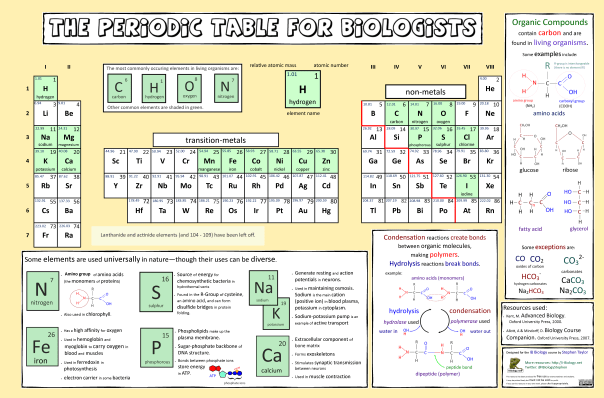
Periodic Table for Biologists poster.
This is designed to address some of the assessment statements for the Chemistry of Life unit, and to provide a clear wall-chart that is free to use and free from advertising. I recently updated it with relative atomic masses and a couple of corrections. Download the full A0 poster here: http://is.gd/iBiologyPTable.
On a related and interesting note, here’s a little video by Periodic Videos on the Japanese discovery of element 113:




 i-Biology