Category Archives: Curriculum

IB Biology Knowledge Web
New Feature added to the IB Biology Study Guide: an interactive Knowledge Web that shows connections between topics on the syllabus, for HL and SL.
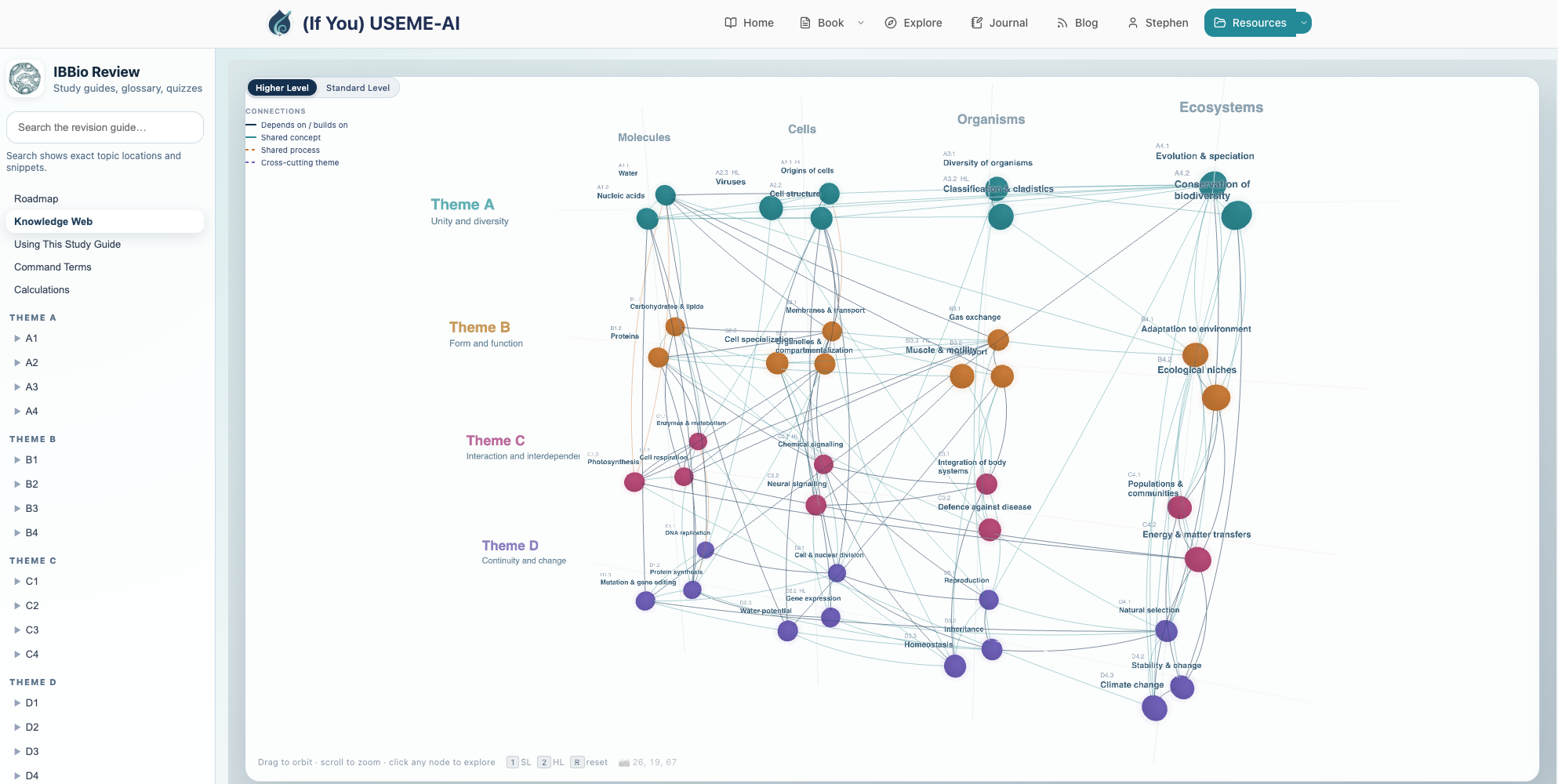
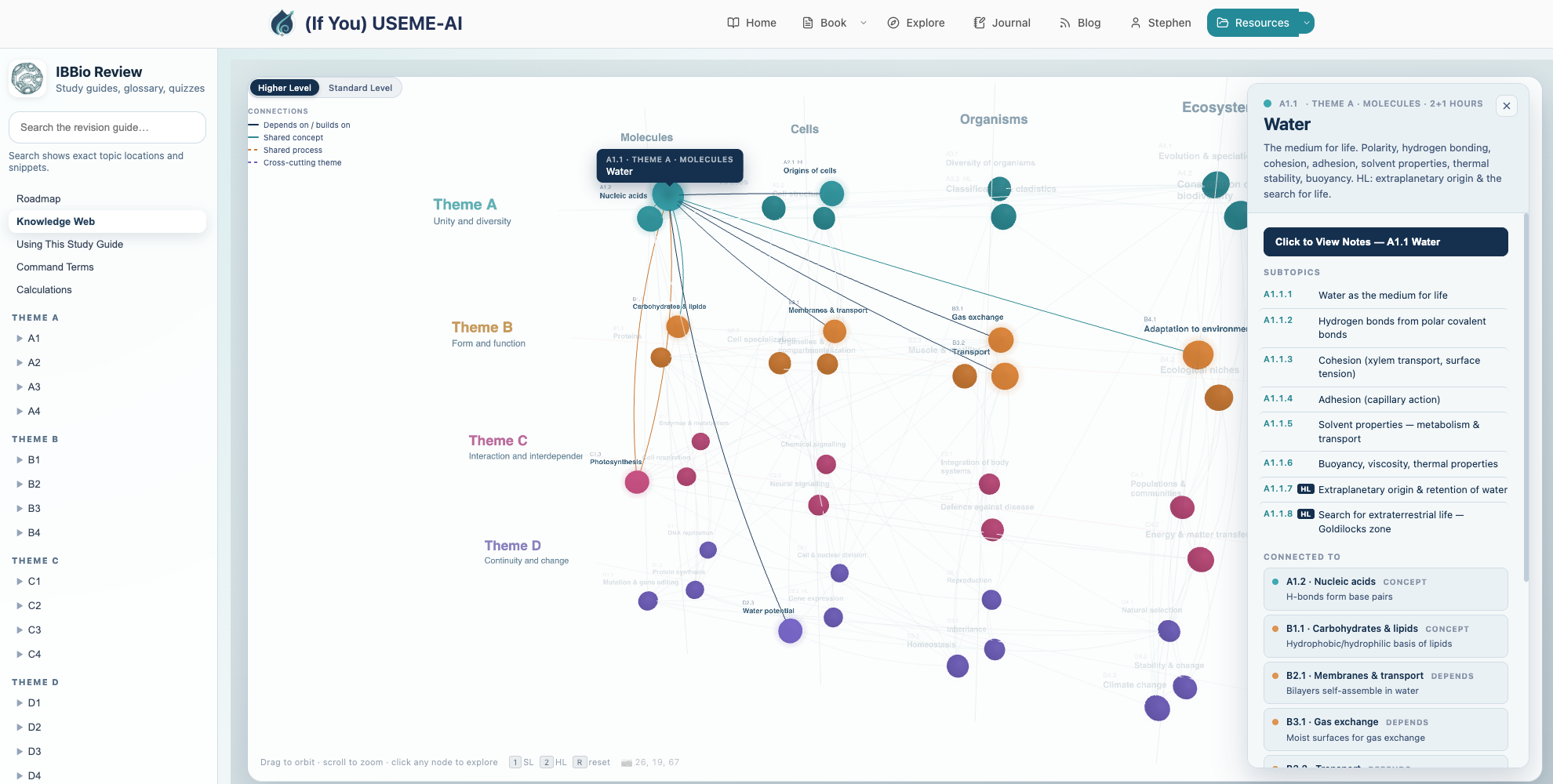
If you click on a node, it shows how it is connected to other topics:
(If You) USEME-AI: The Book
Available from April 1 2026 on Kindle, including Kindle Unlimited subscriptions. Print version is out Now too!
In the space between EdD phases, I’ve been working on a special project… writing my first full book. This has been a real labour of love over the last many months of weekends and evenings, and it’s finally out.
(If You) USEME-AI: Learning for Hope & Agency in an AI World is is a love-letter to education in a time of accelerating change. It builds on 20 years of experience in IB schools, the last 15 years on this blog, ten years of engagement with Cultures of Thinking, four years of work on AI and three years of EdD studies, all pointing in the same direction: a focus on hope, agency and co-creating futures of education that might possibly shine a light on something better. I’ve been writing about this since about 2014 and feel that we need this now more than ever. To do that we need to understand much more than the clicky-click of AI tools.
It frames the reader as a pragmatic idealist, someone who holds onto their values and vision whilst recognising the pressing challenges of now, approaching them with a level head and focus on workable solutions. Across 12 chapters it works through the elements of (If You) USEME-AI, with SideQuests on Mitigation, Adaptation & Innovation, Assessment & Feedback and the TEMPERed Learner along the way. Explore the chapters here.
As we go through the book, it connects learning theories and approaches, aiming to ensure strong foundations so that we can engage with AI with intentionality, purpose and a strong focus on protecting powerful thinking, learning, ethics and the capacities that make us uniquely human in an increasingly automated world. It challenges us to think deeply about what is important, connect new ideas and hold onto a vision of learning that is optimistic, informed and grounded. It makes many connections to UNESCO & OECD guidance and competencies. It aims to balance caution and ethical approaches with suitable applications of AI that might inspire students to do something special and help teachers develop their own practices.
Throughout the book, we spend a year at “Wayfinder International School“, with vignettes from fictional characters Ziggy, Izzy, Ozzy & Jazz, teachers and students approaching the challenges of AI from different perspectives. Meet them here.
Each chapter across the (approximately) 350 pages goes from the balcony of big ideas to the dancefloor of practical strategies, calling at the DJ booth of research. I’ve written it to be as conversational and approachable as possible, whilst connecting it to current research. There are hundreds of references across the book; pretty much everything useful I’ve read in recent years. Each chapter includes a lot of reflective questions, “try this” moments, and prompts to help model your learning as you go.
There is also an extensive, open-access support site for the book. This includes materials for each chapter, a reflective journal (hosted locally), buckets of resources, downloads and a large library of Poes and Prompts to try. The Environmental Impacts Estimator lives here too, with lessons, research and workshop materials. A few more surprises and resources are scattered across the site. The site will be updated as new research emerges or ideas pop into my head. The blog page curates posts from here related to the topics of the book.

The book cover is human-created, by my daughter Anya. It has a swirl of Ginkgo leaves over circuitry, representing connections between the enduring past (Gingko is a ‘living fossil’), the natural world and technology-mediated futures.
My fingers are aching, my brain is mush and my heart is full (I think). It exists! I hope you like it even just a fraction of how much I’ve enjoyed creating it. I think I’ve left everything on the page.
Huge thanks to my friends, family, colleagues and researchers who have inspired and supported this work.
The book will be published first on Amazon Kindle. Links here. It’s available to buy for GBP 8.99 or equivalent. That’s less than the coffee and tiramisu I ordered while writing this post. If you have Kindle Unlimited, it will be free on there for 90 days. The print version will be available very soon.
Wayfinders: Curriculum as a Compass
If you love knowing stuff, learning stuff, inquiry, imagery and Moana as much as I do, then you might like the latest post on my ideas blog: “Curriculum as a Compass?“.

The apprentice becomes a wayfinder in her own right. [gif source]
Go for the big ideas, stay for the Moana gifs.
Reflecting on the Impacts of Science: IMaGE, Global Goals & Connections in MYP Sciences.
I’ve added a new page to i-Biology.net to post resources and ideas for MYP Science Crit. D: Reflecting on the Impacts of Science. Some slides are below, but to see the full page, click here.
[IMaGE = International Mindedness and Global Engagment. To see my dissertation & resources on this, click here.]

The Environment is Interdisciplinary
Working with Eco Club and thinking about the complexities of the interactions, causes, effects and issues we need to tackle, I am often reminded of this Lovelock quote, from a 2014 interview in the Guardian. Perhaps if we can get interdisciplinary teaching and learning right in our schools, we can help students make the connections they need to truly understand the deeper causes of the problems they might need to solve.
For a more detailed post on how we’re trying to tackle IDU’s, please see my blog.
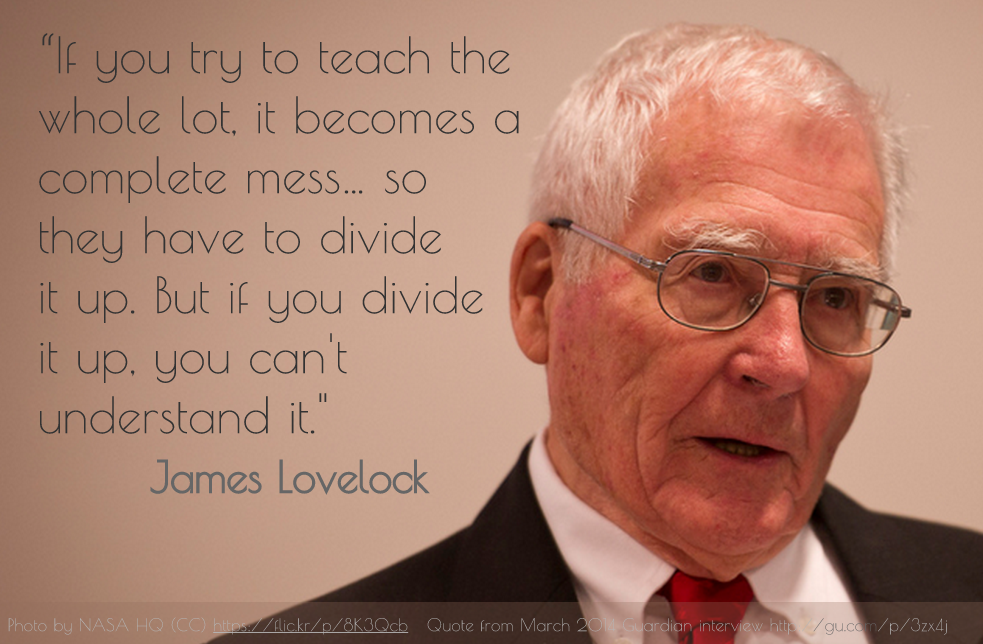
James Lovelock on the challenge of really teaching people about the environment, from this Guardian interview: http://gu.com/p/3zx4j
First Unit Reflections: Is It Working?
This is posted over from my personal reflections blog, but it is about my current IB Biology class. I love these students – they are can-do, and give really useful feedback.

Today we took the opportunity in the IBBio class to reflect on the unit we have just completed, including the tasks and assessment. As always with CA students, the results were constructive, positive and useful, with a general affirmation of the value of what we are doing as a class. The feedback included our personal GoogleSites project, with most students keen on continuing and feeling it helped them learn and with some interesting alternatives for those that it is not.
This kind of feedback is really useful once the class has settled in. They are open enough to be able to be honest, but it is early enough to change practices where needed. We will make some adjustments, though we are generally on the right track with this group. I’m really looking forward to seeing the process and products of the students who have elected to become science writers…
View original post 11 more words
IB Biology: Sortable Syllabus
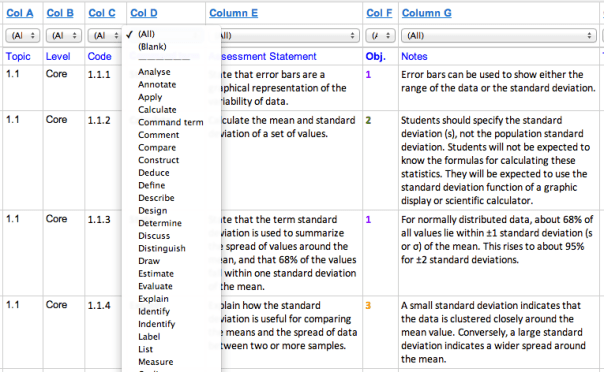
I made this document to help my students review for their mock and final exams. It is the syllabus presented as a sortable Google Spreadsheet. There are tabs at the top for Paper 1 & 2: Core content, Paper 1 & 2: Core & AHL content, and for each subtopic.
- Go to “View –> List view”.
- Use the sort feature to target individual command terms, topics, objectives or levels.
- It also has the ability to sort by suggested TOK connections or aims.
It does not include any images from the subject guide, as these cannot be included in cells to sort, so you will need to use your own copy or the text(s).
This could be a powerful review tool if used in response to practice papers or as a formative/ self-assessment tool. If a student is identified as weak in a particular command term, they can sort their revision and set priorities. It should allow for quick and focused differentation of exam preparation.
Unit Planner Sample: The Nature of Biology
I’ve been trying to do a bit of Autumn cleaning on the site, as well as working on planners and curriculum jobs as MYPCo here at school. As a result, I’ve done a lot of reading of new IB documents (Concept-based learning, Approaches to Teaching and Learning etc) and review of older or more fundamental ones (Principles to Practice and so on).
Anyway, taking all this into consideration, I figured the unit planner was due an update and wanted to make one more useful for Biology. Here is an example:
For more (and a blank template), head over to the Unit Planning page. This is not an official IB product, so please treat it with due diligence.




 i-Biology