Category Archives: IBDP Biology
Remaining Ethical in the Search for a Cure for HIV [TED Talk]
This is an interesting discussion starter and is only 11 minutes long. Boghuma Kabisen Titanji talks about the ethical dilemmas of HIV research in developing countries. What happens when the trial ends?
Some discussion ideas:
- Discuss the pros/ cons of testing pharmaceuticals in the developing world vs the ‘west’.
- Authorisation of trials
- Risk of litigation
- Willingness of populations to participate
- Potential sample size
- Ethics vs efficiency in data generation
- Cost-benefit ratio
- Outline what is meant by ‘informed consent’ in terms of clinical trials. Discuss the challenges of informed consent in trials in the developing world.
- Evaluate the suggestions Boghuma Kabisen Titanji makes about:
- Informed consent
- Standard of care provided to participants
- Ethical review of research
- Exit plan – what happens to participants once the trial has ended?
10 Amazing Illusions from Quirkology [Video]
Here is a collection of really simple illusions (including the Hermann Grid) from Richard Wiseman at Quirkology. A nice link to E2 Perception of Stimuli and TOK. Can we really trust our senses?
Rotavirus Vaccine: A Great Graph
Another great find from Twitter (follow everyone in this tweet):

Rotavirus Vaccine impact, from Forbes.com
Matthew Herper’s short article in Forbes includes this graph, which is a clear link to the efficacy of the rotavirus vaccine. You can access the full pdf from the New England Journal of Medicine here (also brief, with a better graph).
Some questions to think about, connecting this case to the curriculum (11.1 AHL: Defense Against Infectious Disease):
- How does the rotavirus infect its host?
- Why does diarrhea lead to death?
- What type of vaccine is this and how is it produced?
- What challenges are still to be overcome?
The rotavirus vaccine has been a big part of the Bill Gates Foundation’s work, and they have a short video on it here:
GoogleTrends: Exploring Patterns in Search Data [DBQs & Inquiry]
GoogleTrends allows you to plot the popularity of search terms (since 2004), by geographical region or worldwide. This could be a great way to launch inquiry on a topic in science that has seasonal trends or patterns, and could be used to set up simple DBQ practice. It is limited in the linear presentation of data, and the data are search frequencies rather than scientific data, but as the patterns raise questions, they could be followed-up with searches for more valid sources and explanations.
In the example below, Frank Swain (@SciencePunk) had put in the search term “morning after pill” for the UK and found a peak every Sunday. An interesting pattern that could set up some discussion in class based on reproduction, behaviour, risk management, ethics, hormonal control or more.
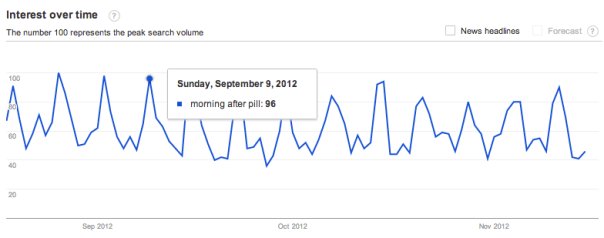
“Morning After Pill” search term on GoogleTrends http://www.google.com/trends/
This could lead to a quick (though basic) way to set up some simple data-based questions or stimulus for exploration. Here is a plot for the search term “vaccine”. Think of the questions it might raise in discussion.
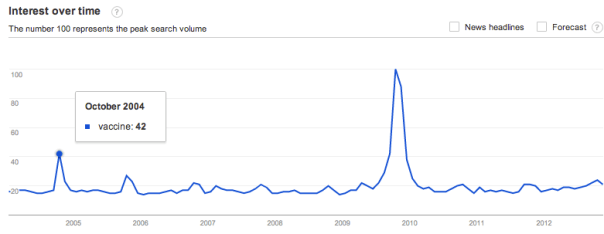
GoogleTrend Worldwide since 2004: “Vaccine” What DBQ’s could you ask?
What questions does it raise and how would it lead to further exploration? Here are some examples:
- Why does it peak each October?
- Why was traffic so high in 2009-10?
- What do you predict for the coming year?
This leads into discussion of sources of information, accessing databases and the reasons for vaccines.
One neat feature is that you can add other search terms to the graph in the same time period, though it will normalise the data. Another is the ‘headlines’ feature that shows some popular news headlines near peaks. Yet another is the ‘predict’ feature that will model the coming year based on trends and patterns. “Predict” is often asked in DBQ’s, so this might make for some good questions. Here’s what happens when we add “flu vaccine”, headlines and the forecast:
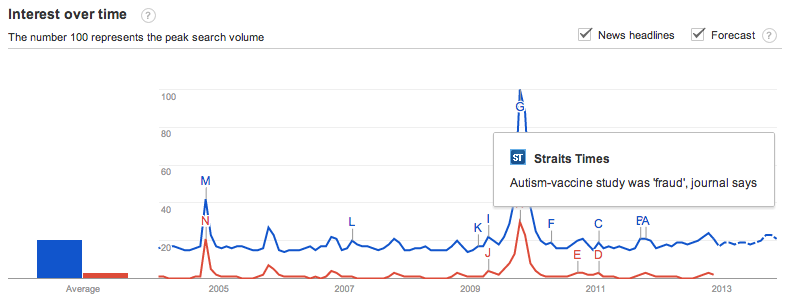
GoogleTrends: “Vaccine” and “Flu vaccine”, worldwide, 2004-present.
From this exploration, you could move onto looking at flu trends, and GoogleTrends has special sections for tracking flu and dengue fever:
……….o0O0o……….
This next one is a neat demonstration of what happens when you change the scale of the y-axis. In this case, the second dataset is added, compared to the original and the original becomes much less noticeable as a result. How many times do we tell our students to set appropriate scales on the axes and make use of the space to be able to see trends and patterns?
For another bit of fun, here’s one on “Genome”:
……….o0O0o………..
Summary:
- A quick, easy launching pad for inquiry
- Develop simple DBQs easily
- Does need to be supported by inquiry into more valid sources for the topic
- Each graph is ‘normalised’ which could lead into useful discussion of the effect of scales on data presentation
Inheritance: a short history of sex, genes and DNA
This week was the first episode of Dara O’Briain’s Science Club from the BBC. The theme: Genetics. Here’s their introductory animated clip, which gives a neat condensed history of sex, genes and DNA:
I’m looking forward to seeing the series!
How do trees move all that water all that way up? [Veritasium]
This is a great video from Derek at Veritasium on why and how trees are able to move water up 100m. It might not be the answer you think…
Links to AHL 9.2 Transport
Hank blossoms with Plant Science
 Crash Course & SciShow Hanks’s last couple of videos have been on Plant Science: transport and reproduction. Head on over to the main Plant Science AHL page for the topic for the presentations and resources.
Three World-Changing Biology Experiments
A quick overview of three experiments that helped advance Biology:
- Pasteur’s swan-neck flask, disproving spontaneous generation
- Hershey-Chase blender experiment
- Miller-Urey experiment
Unit Planner Sample: The Nature of Biology
I’ve been trying to do a bit of Autumn cleaning on the site, as well as working on planners and curriculum jobs as MYPCo here at school. As a result, I’ve done a lot of reading of new IB documents (Concept-based learning, Approaches to Teaching and Learning etc) and review of older or more fundamental ones (Principles to Practice and so on).
Anyway, taking all this into consideration, I figured the unit planner was due an update and wanted to make one more useful for Biology. Here is an example:
For more (and a blank template), head over to the Unit Planning page. This is not an official IB product, so please treat it with due diligence.




 i-Biology