Category Archives: IBDP Biology
Hattie & Yates: Visible Learning & the Science of How We Learn
This is my review of John Hattie’s new book, Visible Learning and the Science of How We Learn. If you’re interested, head over to my personal blog to read more.

Samudra, mini-me, having a good think about cognitive load.

This brief review of John Hattie and Gregory Yates’ Visible Learning & the Science of How we Learn (#HattieVLSL) is written from the multiple perspectives of a science teacher, IB MYP Coordinator and MA student. I have read both Visible Learning and Visible Learning for Teachers, and regularly refer to the learning impacts in my professional discussions and reflections. While reading the book, I started the #HattieVLSL hashtag to try to summarise my learning in 140 characters and to get more people to join in the conversation – more of this below.
EDIT: March 2017
This review was written right after the release of VLSL, in late 2013. Since then, the ideas of ‘know they impact‘ and measurement of learning impacts have really taken off in education, particularly in international schools. Critics of Hattie (largely focused on mathematics or methodology) are also easy to find, though the
View original post 2,409 more words
Conceptual Learning in IB Biology
If you’re an IB Biology teacher here’s a challenge (or perhaps not):
- List and describe the four basic biological concepts that run through the discipline of Biology.
Got it? Here they are (highlight to see):
- Structure & Function
- Universality versus Diversity
- Equilibrium within Systems
- Evolution
They are on page 40 on the subject guide.
Teachers in MYP schools will be well aware of the concept-based nature of the Next Chapter as it arrives, but in reality it may already be here in our classes. How many times do we ask students how the knowledge we have gathered in a lesson or sequence connects to other knowledge, looking for commonalities and themes? This, in a simple way, is teaching for conceptual understanding*. We want students to be able to recognise concepts in new content – the universal nature of the genetic code and the diversity it facilitates; adaptations to maintain homeostasis (equilibrium) within living systems, the relationships we see between structure and function in all living systems and the process of evolution by natural selection that underpins them all.
I want to make it a personal goal this year to be more explicit in the learning of the big ideas of Biology: the concepts. We’ll start this week with a group task for students to try to connect these concepts to their latent understandings of Biology and we’ll build from there.
Some ideas for teaching the concepts in Biology:
- Jigsaw tasks for students in different groups as we review a unit: one group for each concept who need to explain how the content of the unit feeds into that one conceptual understanding.
- Connect-extend-challenge (a visible thinking routine**). As we build a body of biological knowledge students can reflect and review based on how this connects to each of the four concepts, how they might extend their understanding with deeper questions and what they have found challenging in the unit/ lesson.
- Concept walls: spaces in different parts of the classroom where students might pin their thoughts on the topic (or post post-its).
If you have more ideas for how to use the concepts of biology to strengthen students’ understanding, please share!
……….o0O0o……….
Further Reading
* ‘Teaching the Disciplines – Nurturing big Ideas for Deeper Understanding’ is an excellent document from the MYP section of the OCC. Read the section on the sciences.
**Harvard’s Project Zero has a fantastic set of thinking routines to make thinking visible. Try them out!
What are we really learning from practical work?
As we study science, a lot of our time and resources are devoted to implementing an engaging practical scheme of work. Are we really making the most educational use of this time, these resources and the opportunities that we have?
Teachers all over the world use experiments and demonstrations to engage students in the concept being taught. But does this actually improve student learning? Two recent videos have got me thinking about this issue, and before you read on you should watch them both.
The first is from UK science teacher & communicator Alom Shaha (@alomshaha), half the brains behind the sciencedemo.org website. The video was produced for the Nuffield Foundation’s new Practical Work for Learning resource. He refers to a number of research papers in the video, and is also one of the leaders of the #SciTeachJC (science teachers journal club) twitter discussion group.
Do you recognise those labs and how do you use them? Do the labs we do really help us teach the concepts we intend them to, and how can we rethink (or at least evaluate) our use of labs.
The second video is from US Chemistry teacher Tom Stelling (@ChemistTom), on his “vRant” about students asking to “blow something up” and the dangers of ‘wow’ demos as distraction rather than education.
https://twitter.com/ChemistTom/status/332685283105587200
Note: this post rambles a bit from here on. If you want to know more, please read on. Otherwise, all the good bits were in Alom & Tom’s videos.
Personal GoogleSites: A Learning Project in #IBBio
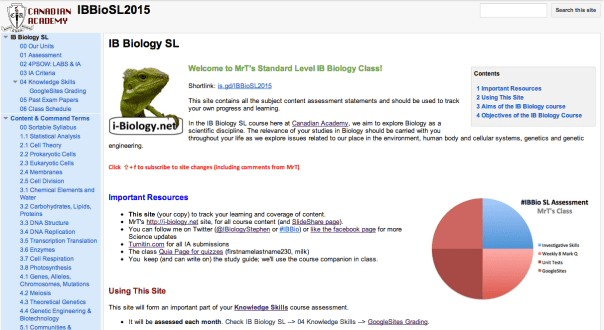
Personal GoogleSite: Click to view an example.
Although i-Biology hosts all my content resources, the main class resource students are working with is a personal GoogleSite to track their progress and reflection. Click here to find out more about how it works.
“Changing Crops for a Changing Climate” Mark Lynas & a Nature Special on GMOs
Here is Mark Lynas at Cornell University, with his speech “Time to call out the anti-GMO conspiracy theory.” It runs almost half an hour, though he does have a transcript of the speech on his blog. The connections to IB Biology Genetics & Genetic Engineering here are obvious.
What should be noted for background is Lynas’ own story. In the 1990’s he was a prominent anti-GMO activist, but has recently apologised and is now on a mission to right the wrongs he feels he has done. It has not been easy, and has generated lots of controversy.
“Allowing anti-GMO activists to dictate policymaking on biotechnology is like putting homeopaths in charge of the health service, or asking anti-vaccine campaigners to take the lead in eradicating polio.”
Powerful and provocative stuff – and a great stimulus for discussion and debate. Lynas refers to a lot of studies, claims and organisations in this speech. Students could follow this up with finding out more about each of them.
We might never be able to get students to the absolute truth on GMOs – we may find it difficult ourselves – but it is useful to give some insight into just how delicate the balancing act can be and how cloudy the discussions of ethics in science can get. The issues around GMOs are complex: scientific, political, ethical, economical, environmental. They are far more complex than a couple of short assessment statements in a Biology syllabus can really do justice.
……….o0O0o………

Rise of the Superweeds. Click-through to the Nature Special.
Also recently, a very useful Nature special edition on GM Crops: the Promise & Reality. Look in for some in-depth articles and case-studies, including the true, the false and the still unknown on GM crops.
Nature articles often have presentations of data that can be used for data-based question practice (such as the one to the right – click through to see). Follow the patterns of the DBQ’s and make up your own questions based on different articles:
- Identify…
- Describe the trend in…
- Calculate the difference in…
- Compare…
- Suggest reasons for…
- Evaluate…
Are you replacing sleep with food? DBQ practice.
https://twitter.com/scicurious/status/327240402367307776
I came across this through Ed Yong’s weekly linklist, but @SciCurious often writes really interesting posts (Neurotic Physiology) on neurobiology. This one is particularly relevant to #IBBio students for a few reasons. First, you guys are up way too late, way too often. Second, it connects directly to our course – read this blog post (based on this paper), especially students working on option A: Nutrition, or anyone reviewing hormonal control.

Click for the graphs & article at the Neurotic Physiology blog.
Finally it is ripe for data-based question practice.
These graphs click-through to the originals posted at SciCurious’s blog. Here are some DBQ-style questions you might ask:
- Calculate the difference in post-dinner snack energy intake between having a ‘normal’ 9h sleep and the sleep-deprived 5h condition.
- Compare the trend in energy expenditure throughout the day between 9h sleep and 5h sleep.
- Describe the difference between 9h sleep and 5h in terms of eating patterns.
- Evaluate the hypothesis that “when we sleep less, we eat more” based on the data provided and information in the article.
- Explain the role of the appetite control centre of the brain on appetite, and suggest how it is affected by the conditions of the experiment.
Appetite Control: from the Wellcome Trust (‘The Anatomy of Appetite’ explainer page here).
……….o0O0o……….
So there you go – you learned something.
Get to bed. And leave the snacks in the fridge.
Thrift Shop Parody: TCA (Kreb’s) Cycle Rap
Pitched just a little over HL, but very well done and super catchy, here’s Wilson Lam’s Thrift Shop Parody:
Related, of course, is Tom McFadden’s Oxidate It Or Love It:
And if all that’s too musical, here’s Hank: