Category Archives: IBDP Biology
IB Biology: Sortable Syllabus
I made this document to help my students review for their mock and final exams. It is the syllabus presented as a sortable Google Spreadsheet. There are tabs at the top for Paper 1 & 2: Core content, Paper 1 & 2: Core & AHL content, and for each subtopic.
- Go to “View –> List view”.
- Use the sort feature to target individual command terms, topics, objectives or levels.
- It also has the ability to sort by suggested TOK connections or aims.
It does not include any images from the subject guide, as these cannot be included in cells to sort, so you will need to use your own copy or the text(s).
This could be a powerful review tool if used in response to practice papers or as a formative/ self-assessment tool. If a student is identified as weak in a particular command term, they can sort their revision and set priorities. It should allow for quick and focused differentation of exam preparation.

Biology4Good Charity Focus | Hope HIV
 Thanks Kasia from Hope HIV for getting in touch and sending this video, that outlines the great work that they do with the donations people make. They focus on the idea of ‘using who you are to make a difference,’ which is perfect for IB students and teachers. Visit this page in particular to see some stories of people that they have hope in – and then if you feel like making a donation, please visit my JustGiving page for Hope HIV here.
For more resources on HIV and how it connects to our curriculum, visit the page for 6.3 Defense Against Infectious Disease here.
And this one outlines their amazing work and growth since 2000.
Biology4Good Charity Focus | Marine Conservation Society
 As a Marine Biologist by training, salty water and the things that live in it are close to my heart, which is why I’m happy to be supporting the Marine Conservation Society with their fundraising through my Biology4good project. They do great work on education, outreach, beach cleanups and campaigns. A current (har-har) area of focus is marine conservation zones, which connects neatly to Option G4: Conservation of Biodiversity.
If you like the resources here and like the work they do, please make a donation on my JustGiving page.
Your Brain: By the Numbers [Video]
Here’s a collection of interesting brain facts from PhD Comics’ YouTube Channel. Could be a useful starter for E5 Human Brain – practice with calculators to convert all the imperial values to metric.
Crash Course Ecology: 12 Videos with Hank Green
 I’ve featured Hank Green’s Crash Course Biology here a number of times and many of his videos have been embedded into the topic pages for the IB Biology course around this site. Prolific as he is, his ‘Crash Course Ecology’ series has just finished, so here are 12 episodes that pull together elements of the the Core and Option topics (as well as a lot more).
The full playlist is here: Crash Course Ecology. It’ll take about as long as Avatar to get through it all, and you’ll learn more about environmental change, impacts and solutions.
Episode 1: The History of Life on Earth
The rest of the episodes are linked after the jump.
Biology4Good Charity Focus | Tree Aid

TreeAid
Yesterday I moved my Biology4good donations to a JustGiving.com team. Since then, some of the charities have got in contact to share resources to encourage donations. First up: Tree Aid. Thanks Tom for the emails and for uploading this video to show the work they do – it is truly amazing and I am happy to be supporting them.
Serendipitously, the video focuses on the nutrional benefits of planting moringa trees to benefit communities, which ties in closely with the final unit for my own class, Option A: Human Nutrition & Health.
If you like what you see, please visit my TreeAid page and make a small donation.
Thank-you!
Periodic Table for Biologists Poster
I forgot this existed…
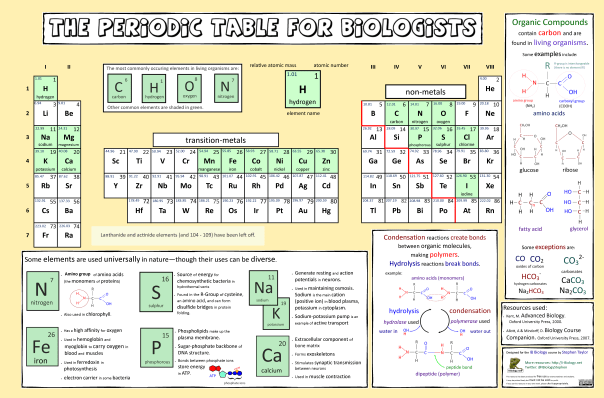
Periodic Table for Biologists poster.
This is designed to address some of the assessment statements for the Chemistry of Life unit, and to provide a clear wall-chart that is free to use and free from advertising. I recently updated it with relative atomic masses and a couple of corrections. Download the full A0 poster here: http://is.gd/iBiologyPTable.
On a related and interesting note, here’s a little video by Periodic Videos on the Japanese discovery of element 113:
Remaining Ethical in the Search for a Cure for HIV [TED Talk]
This is an interesting discussion starter and is only 11 minutes long. Boghuma Kabisen Titanji talks about the ethical dilemmas of HIV research in developing countries. What happens when the trial ends?
Some discussion ideas:
- Discuss the pros/ cons of testing pharmaceuticals in the developing world vs the ‘west’.
- Authorisation of trials
- Risk of litigation
- Willingness of populations to participate
- Potential sample size
- Ethics vs efficiency in data generation
- Cost-benefit ratio
- Outline what is meant by ‘informed consent’ in terms of clinical trials. Discuss the challenges of informed consent in trials in the developing world.
- Evaluate the suggestions Boghuma Kabisen Titanji makes about:
- Informed consent
- Standard of care provided to participants
- Ethical review of research
- Exit plan – what happens to participants once the trial has ended?
10 Amazing Illusions from Quirkology [Video]
Here is a collection of really simple illusions (including the Hermann Grid) from Richard Wiseman at Quirkology. A nice link to E2 Perception of Stimuli and TOK. Can we really trust our senses?
Rotavirus Vaccine: A Great Graph
Another great find from Twitter (follow everyone in this tweet):

Rotavirus Vaccine impact, from Forbes.com
Matthew Herper’s short article in Forbes includes this graph, which is a clear link to the efficacy of the rotavirus vaccine. You can access the full pdf from the New England Journal of Medicine here (also brief, with a better graph).
Some questions to think about, connecting this case to the curriculum (11.1 AHL: Defense Against Infectious Disease):
- How does the rotavirus infect its host?
- Why does diarrhea lead to death?
- What type of vaccine is this and how is it produced?
- What challenges are still to be overcome?
The rotavirus vaccine has been a big part of the Bill Gates Foundation’s work, and they have a short video on it here:




 i-Biology