Category Archives: #edtech #scitech
Mole & Stoichiometry Presentation
For my Grade 9 Intro Chemistry class, as we end the year. Despite the word ‘stoichiometry’ being a bit scary for some students, it can be a fun unit – a lot of logic problems! It leads to lots of questioning, whiteboarding and problem-solving. the final lab, “Investigating a factor which affects the yield of a reaction*” allows for quite a diversity of approaches and a lot of differentiation in the data processing.
As one student said, “I have to think too much in Chem class!”
Thanks to Barbara Lucas for all the support this year.
*chosen from a shortlist
One World: Formative Assessment Video Discussion Task
In this one or two-lesson task, students watch one of the videos below as an introduction to science as a solution to a problem in a global context. They then work together to produce a mind-map poster of the issue and its solution, covering the main ideas of the One World criterion.
Here are the videos:
United Nations University Our World 2.0: Plastic to Oil Fantastic
TED Talk: Michael Pritchard’s Lifesaver Bottle
One World: Coversheet, Submission Checklist and Research/ Writing Frame
This is for my MYP 4-5 classes in Chemistry, Physics and Environmental Science. The aim here is to encourage self-assessment at all stages of the research and writing process.
The front page is a standard submission coversheet, which is attached to work before it is submitted to Turnitin. Students need to self-assess their work by highlighting the statements which they feel best fit. The second page is a checklist to help them structure and present the essay or article, in 7 sections. The final two pages is something which could be given digitally or printed and blown up to A3 and used as a research/ writing frame.
Free and Cheap Science Class Apps for the iPhone [Presentation]
This year I got my first ‘smart’ phone and have been playing with free and/or really cheap apps that might be of use in Science class. Many of the students in my school have iPhones or other smart devices – at least enough to make pairs or small groups. This presentation is a selection of those I use the most or like and would like students to make use of, too.
If you have any favourite – free or cheap – apps that you make use of in Science class, let us know in the comments below.
Update: March 31 Featured on SlideShare homepage.
Textbooks or e-texts? Poll and discussion.
In a recent discussion with a colleague, we were thinking about whether to update the printed texts we have with new editions or to go entirely online. We are a 1-1 school with fast, unrestricted internet use. Expecting all students to prefer the online mode, we were surprised to see them choose printed texts.
So what would you prefer? If you want to, give some of your reasons or experiences in the comments.
Making ATP: Core content concept maps
 In tomorrow’s class we’ll be reviewing our Making ATP unit (enzymes, cell respiration, photosynthesis and the greenhouse effect) with a couple of concept mapping activities. The first, cell respiration core, is made using the really useful free concept mapping tool from IHMC CMap tools. This is a freeware package for most computing platforms – very easy to use and might be a help in your revision!
In the second activity, build your own concept map making as many annotated connections between concepts as you can. Surrounding this, add and annotate the relevant graphs and diagrams.
So is the Earth full or is abundance our future? #TED2012
TED 2012 is underway and they have been posting some of the talks to their website. Here is a pair of talks which showcase different views of where we are in the world right now – each of them linking to our units on Environmental Science. You can also follow them on the Guardian’s liveblog.
In the first, Paul Gilding states that “The Earth is full,” but that it takes times of real crisis for us to create solutions and climb out of the hole we have dug for ourselves.
In this one, Peter Diamandis argues that we are living in a time of abundance and that human ingenuity will get us out of our problems.
……….o0O0o……….
EDIT – 4th March
These talks which have also been published are relevant to the issues we are studying in class. Have fun watching them!
Daniel Pauly: The ocean’s shifting baseline
Paul Snelgrove: A census of the ocean
Scale of the Universe: Zoom right in, whizz right out (online app)
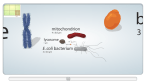
Learn.Genetics Size
This is what you get when you take the Learn.Genetics Cell Size visualiser and give it beans. Cary and Michael Huang at htwins.net have produced this great tool, which lets you zoom all the way into the smallest sizes and then out into the universe. You can click on each item to learn more.
It can be quite the time-suck as you whizz through inner and outer space.
Have a go!
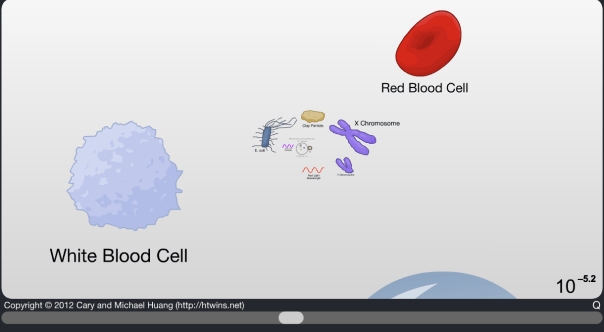
Scale of the Universe App by Cary and Michael Huang (Click to play!)
Are you still here? Well then Morgan Freeman can give you a tour in this Powers of Ten clip from Cosmic Voyage.
Thanks to @AdamRutherford for tweeting the link to this.
Inspired for 2012 by these Young Scientists!
Set aside 17 minutes to listen to Lauren Hodge, Naomi Shah and Shree Bose give their TED Talk on their experiences as winners of the 2011 Google Global Science Fair. These three young scientists are each winners of their age groups (13-14, 15-16 and 17-18 respectively), with Shree winning the grand prize of a $50,000 scholarship and a trip to the Galapagos and an internship at CERN! Wow.
Of course Naomi and Lauren also picked up some great prizes and they all got the opportunity to present at TEDx Women:
If you have a great scientific question burning in your mind, why not enter this year’s competition? Head on over to the Google Science Fair 2012 website for all the information you could need. Here’s a quick video below.
Just remember to get it all in by April 1st!
Thanks to Julie Lemley for the link.
Video: Word Citation Tool to make life easier
On the final day of MoVember (please donate), here is a short Movember-themed tutorial video on how to make the citation manager in Word work for you. There are more tutorial and lab videos on my YouTube Channel.



 i-Biology