Category Archives: #edtech #scitech
15 year-old develops effective, cheap test for pancreatic cancer [TED Audition]
Wow. Here’s Jack Andraka’s TED Audition for a talk on his work developing a carbon nanotube and antibody-based test for pancreatic cancer.
Jack won the 2012 Gordon E. Moore Award ($75,000) at the Intel International* Science and Engineering Fair for the same work:
Read more about him, his work and the work he built it on here on Forbes.com.
*Yup – you can have a go too.
Boson the Fourth of July
Yesterday was a big day for science, and luckily the internet was on hand to give us a live stream of reliable information and the CERN press conference (which is more than CNN could manage).
Why is it important? Here are some really useful Higgs links:
- What is the Higgs boson? Guardian video by Ian Sample
- CERN press release “CERN experiments observe particle with long-sought Higgs boson“
- Now the real work begins – Guardian roundup of what happens next
……….o0O0o……….
This whole exercise is a great example of internationalism in science and is probably the world’s biggest group 4 project. It showcases the scientific method perfectly, as Adam Rutherford tweeted:
After the PR disaster of the EU’s hopelessly patronising Science: It’s a Girl Thing campaign, it was great to see a real inspiration to girls and boys take the stage – Fabiola Gianotti.
Four Fundamental Forces in Six Videos [Crash Course]
Here’s Hank, giving a run-down of the fundamental forces. Might be useful for a flipclass intro or review for older students.
Strong Force
IB Science Weekly Magazine – Get involved!
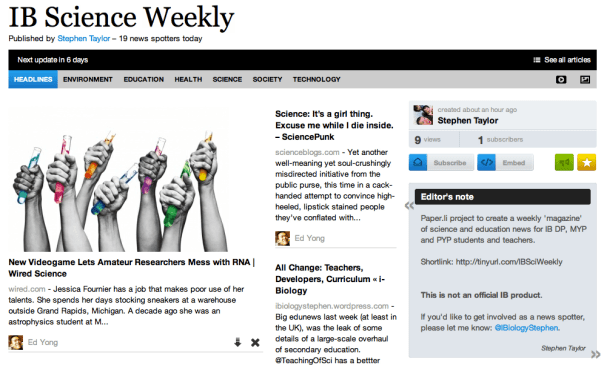
IB Science Weekly Magazine – do you want to be a news spotter?
I kept seeing these paper.li posts in Twitter, so after a quick exhange with Adrienne Amichetti (@amichetti) decided to give it a go. There are lots of paper.lis out there, especially it seems in the ed-tech world. It was quick and easy to set up, though a bit of a fiddle to work out how posts were categorised and filtered (still not sure how it works).
The aim of this project is to provide a weekly publication which pulls in the current science and education news, for use in MYP, DP and PYP classrooms.
If you would like to get involved and be an IB Science or Science Education news spotter, please head on over to Twitter and let me know. If you see some worthy news, simply tweet it with a link and a description, along with the hashtag #IBSciWeekly. The paper.li elves will see it and it should appear in the finished product. I will be able to curate the posts as they are published each week. If you think that everything you (or someone you recommend) is gold, I can include their Twitter handle or blog url as a source.
The details:
- Address: http://tinyurl.com/IBSciWeekly
- Hashtags: #IBSciWeekly, #MYP, #IBDP, #IBBio, #IBChem, #IBPhysics
- Published: Weekly, on a Tuesday (I think)
- NewsSpotters: IB Teachers and Students
Of course, things are bound to go wrong at first! I would love to find a way to share the editing jobs.
And here is a lovely video of a murmuration of starlings:
Extended Essay Frame and Word Citation Tool

IB Store
Here’s a document we are using in my Extended Essay group. The intention is that students set it up from day 1, keeping all of their reading and research in a section at the end which will allow them to build their citations database. This section of notes will be deleted before final submission, unless any of the resources they save are worthy of an appendix.
By this point, students have read the examiners’ reports for their subject area EE’s, looked at some excellent examples (on sale in the IB store) and have read carefully through the EE guide, noting the subject-specific guidance for each criterion.
At the end of the document is a set of rubrics for self-assessment, which they should refer to on a regular basis. I have set it up so that they can add their own checkboxes above each rubric, listing what is most important for them to achieve.
There is a screencast below the document which gives a very quick introduction to using the Word citation manager.
Check out these great resources from Purdue’s OWL project on APA citation.
What I would love to see
If I could make one request of the IB, it would be that rolled into our programme fees for DP we could have access to university-style academic searches and journals. Wouldn’t it be great if the IB subscribed to the journals and schools could access them through Athens or Springerlink (or something else), to use in EE’s and research?
QR Code Orienteering: Describing Displacement

Mr Robbo, PE Geek
I’ve been wanting to find an excuse to do this for ages, since reading about the idea on Jarrod Robinson’s PE Geek blog.
Today in one of our last classes, some students in my Intro Physics & Environmental Science class have been using a GoogleMap view of the area around our school to plan an orienteering course. The aim is to use this as one of the very first lessons with next year’s class as an introduction to scalars and vectors, as well as methods of describing displacement. By scanning a QR code at each location, runners will be given a description in the form of components or direction and magnitude, which they then locate on their map and run to.
 When they return to school, the plan is to use their map to calculate distance vs displacement between points, as well as add some directed line segments for vectors.
I’ve made up some orange and white flags, which will be laminated. The QR codes will be taped on, giving flexibility to make up new courses around the school and to extend the activity by allowing students to design courses.
…………o0O0o…………
Free apps used:
- i-Nigma QR code reader
- quikQR.com free QR code maker
- GoogleEarth (I set up the grid and printed it)
Here are the planning sheets/ maps:
Last Lesson Shenanigans: Cork Cannons
Here’s a bit of fun for the last lesson of the year, with a sensible Chemistry or Physics class. The aim is to use the gas produced in the reaction between baking soda and dilute HCl (or vinegar) to propel a cork over a wall and into a beaker. Lots of fun with testing methods, hypothesising and problem solving.
Obvious safety issues: use low concentrations, keep washing hands and/or use gloves and keep goggles on at all times. Students must be sure to aim away from the body and each other.

Aligning IBDP Biology and SAT Biology subject tests. Any takers?
This weekend is SAT Biology subject tests, which will be fun for a handful of kids in our IBDP school. I spent some time today with some IBSL year 1 students who needed help covering the content. We had fun with the respiration, photosythesis and DNA replication, but it made me realise I don’t know how and where the two testing systems overlap.
Are you experienced in teaching both and do you want to help out? If so, please open this GoogleDoc and add the relevant SL/HL subtopics in line with the SAT Bio subject test topics. If you really want to, add the links to the relevant i-Biology pages.
Let’s see how this works!
Learning Science by Doing Science | Frank Noschese at TEDxNYED
This is the way we’ve been going in Physics class, and here is why:
Updated Turnitin GradeMark QuickMarks
Here’s a new set of Turnitin GradeMark QuickMarks I have saved to Box.net. More IA resources on the IA pages here.

My QuickMarks – click to download
They correspond to the self-assessment codes in the rubric and checklists I use with students, and will only work if your school subscribes to the full Turnitin WriteCycle suite. Each comment has a check or cross, a title and some guidance or further description in the box. You can add your own comments individually to each as you use them in student work.
- IA Grades (Simple “6 CCC” and “5 PCP” comments in various combinations)
- Academic Honesty & Presentation




 i-Biology