Free and Cheap Science Class Apps for the iPhone [Presentation]
This year I got my first ‘smart’ phone and have been playing with free and/or really cheap apps that might be of use in Science class. Many of the students in my school have iPhones or other smart devices – at least enough to make pairs or small groups. This presentation is a selection of those I use the most or like and would like students to make use of, too.
If you have any favourite – free or cheap – apps that you make use of in Science class, let us know in the comments below.
Update: March 31 Featured on SlideShare homepage.
The Missing Link to Renewable Energy? Donald Sadoway at TED2012
“We need to think big, we need to think cheap… Let’s invent to the price point of the electricity market. If you want to make something dirt cheap – make it out of dirt. Preferably dirt which is locally sourced!”
This is an entertaining and erudite TED Talk from MIT’s Materials Engineer Donald Sadoway which outlines our current problem of grid-level electricity storage, describes how batteries work and goes on to explain where we could go with molten metal batteries. He describes his passion as science and service to society, which is a great sentiment.
This is a good link to our units on Chemistry, Physics and Environmental Science and would make a fine starting point for a One World project. How can science positively impact the world?
Textbooks or e-texts? Poll and discussion.
In a recent discussion with a colleague, we were thinking about whether to update the printed texts we have with new editions or to go entirely online. We are a 1-1 school with fast, unrestricted internet use. Expecting all students to prefer the online mode, we were surprised to see them choose printed texts.
So what would you prefer? If you want to, give some of your reasons or experiences in the comments.
Making ATP: Core content concept maps
 In tomorrow’s class we’ll be reviewing our Making ATP unit (enzymes, cell respiration, photosynthesis and the greenhouse effect) with a couple of concept mapping activities. The first, cell respiration core, is made using the really useful free concept mapping tool from IHMC CMap tools. This is a freeware package for most computing platforms – very easy to use and might be a help in your revision!
In the second activity, build your own concept map making as many annotated connections between concepts as you can. Surrounding this, add and annotate the relevant graphs and diagrams.
Excel StatBook for MYP Intro Chemistry [Resource]
Shortlink: bit.ly/2NMgLzN
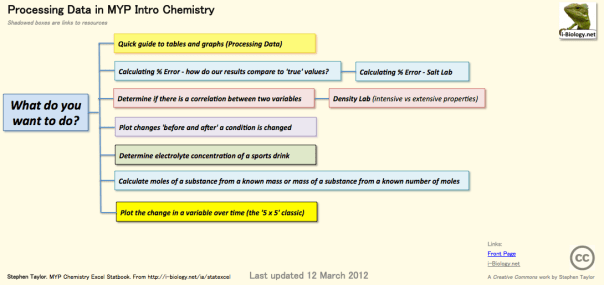
This Excel workbook is built upon the IBDP Bio Excel Statbook I made in 2011. It is designed to make life easier as we work through labs in Grade 9 Intro Chem and to help you find your way around some Excel tricks.
It is saved in GoogleDrive – don’t open in it in GoogleDocs. Download and open in Excel.
I’ve been hearing interesting things about GeoGebra recently, so might have to give it a go when I get some free time.
Biology Crash Course | Entertaining 12-min Bio brain dumps!
 CrashCourse Biology is a new(ish) and definitely more entertaining and engaging alternative to Khan Academy. Hank Green follows his brother John’s example (World History) and is producing some pretty funny, fast-paced and visual presentations for key concepts in Biology. One feature I like is the short ‘history of the idea‘ section in each video.
Here’s an example on the properties of water:
Another feature I like is that the video description has links to sections within the video, making review easier. He also includes a set of citations (more like links to follow to find out more). So although they can be embedded, you are much better off watching them on his channel.
Hank also has another channel, SciShow, which has short, sharp videos on science – whatever the topic. Here are a couple of examples from his playlist.
FoldIt (MrT’s favourite game):
And this on Mendeleev’s Periodic Table:
……….o0O0o……….
I first heard about these channels via Fractus Learning, but didn’t get a chance to look until this weekend, searching for periodic table resources and Lewis Dots. When Crash Course popped up again, I figured it was time to have a look.
So is the Earth full or is abundance our future? #TED2012
TED 2012 is underway and they have been posting some of the talks to their website. Here is a pair of talks which showcase different views of where we are in the world right now – each of them linking to our units on Environmental Science. You can also follow them on the Guardian’s liveblog.
In the first, Paul Gilding states that “The Earth is full,” but that it takes times of real crisis for us to create solutions and climb out of the hole we have dug for ourselves.
In this one, Peter Diamandis argues that we are living in a time of abundance and that human ingenuity will get us out of our problems.
……….o0O0o……….
EDIT – 4th March
These talks which have also been published are relevant to the issues we are studying in class. Have fun watching them!
Daniel Pauly: The ocean’s shifting baseline
Paul Snelgrove: A census of the ocean
Anthony Atala: Printing a human kidney [TED Talk]
With links to stem cells, genetic engineering and biotechnology, homeostasis and the kidney, the current science outlined in this TED Talk by Anthony Atala is amazing. It includes a demonstration of a real kidney being printed and a student who has an engineered bladder and now lives a normal life. Wow.
With huge numbers of people waiting for kidney transplants, is this the future of transplant medicine?
Thinking of kidneys, the Guardian has a link to an AP article: Mystery illness kills thousands in South America.
Scale of the Universe: Zoom right in, whizz right out (online app)
Learn.Genetics Size
This is what you get when you take the Learn.Genetics Cell Size visualiser and give it beans. Cary and Michael Huang at htwins.net have produced this great tool, which lets you zoom all the way into the smallest sizes and then out into the universe. You can click on each item to learn more.
It can be quite the time-suck as you whizz through inner and outer space.
Have a go!
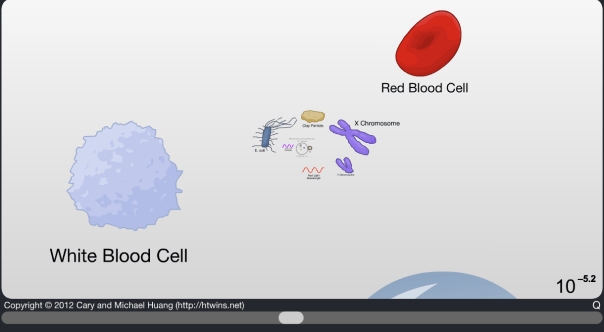
Scale of the Universe App by Cary and Michael Huang (Click to play!)
Are you still here? Well then Morgan Freeman can give you a tour in this Powers of Ten clip from Cosmic Voyage.
Thanks to @AdamRutherford for tweeting the link to this.