Wade Davis – “The Plants Talk To Us” (TOK)
[Note: I wrote this in 2010 after seeing Wade Davis speak, and was reminded of it as I wrote Curriculum as a Compass?. I still love these stories – the ayahuasca one blows my mind. Stephen.]
……….o0O0o……….
I saw Wade Davis speak at the 2008 IB Regional conference, and he was brilliant. He gave an extended version of this talk from TED, and the focus on disappearing languages and cultures was brilliant. He really ventured into TOK, especially with the different ways of knowing demonstrated by various cultures.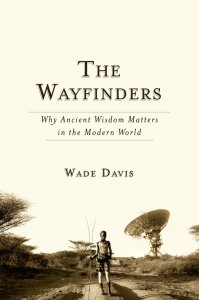
There is a great example in the talk below of an amazonian shaman who makes a powerful psychoactive preparation of Ayahuasca, from a vine. Tryptamines are the active component and are similar to tryptophan (our famous amino acid/ end product inhibition example – animation). They act as neurotransmitters and include serotonin, which regulates mood. It is broken down by enzymes bound to the plasma membrane of cells in the digestive tract called monoamine oxidase (MAO), so can’t be taken orally. The amazing thing is the shaman uses a preparation from another plant that inhibits this enzyme, so that the potion can be ingested and is effective. This is amazing knowledge, gleaned from a totally alternative scientific method to the one we are used to, and demonstrates an advanced naturalistic intelligence.
When he asked how they knew this and were able to combine these two extracts from the thousands available, they answered “The plants talk to us.”
……….o0O0o……….
Discussion and questions:
1. In what ways can this specific example link the elements of the IB Biology course together?
Think about cells, membranes, amino acids, neurotransmitters, innate vs learned behaviour, reward pathways, evolution, enzymes and inhibition, genetics and the universality of the genetic code, ecology and conservation.
2. Think about the statement “other people, with their differences, can also be right” (from the IBO’s mission statement). To what extent is the ancient knowledge of indigenous cultures an example of this? What further questions does this inspire?
3. To what extent are these ways of knowing demonstrated in the contrast between modern scientific understanding of the effects of the active ingredients and the ancient wisdom of the shaman: sense perception, reason and emotion.
4. Discuss the impacts of disappearing cultures on scientific knowledge and understanding. How could modern science & technology be used to help preserve cultures and wisdom?
If you liked this, find out more about becoming an ethnobotanist!
Oceans: Disney’s Earth Day Super-doc
Following last year’s Earth, Disney are releasing Oceans on Earth Day. Loaded with symbolism and lovely shots, though unlikely to be as informative as the brilliant Blue Planet series, it might just inspire more people to take care of the oceans and be aware of their importance to us. I hope it hits the big screens here in Indonesia!
Here’s an idea Disney – if you’re serious about sending the message, why not give the tickets away to schools for free?
We’re almost there, Grade 12!
Almost there Grade 12!
Content completed, IA’s done. You can sign off your 4PSOW on Tuesday and from now on it’s revise, revise, revise.
Tomorrow we’ll set up our revision folders, and I’ll release the first two past papers. These are your tasks to complete each week, and are to be done to the best of your ability, without cheating!
We will mark each week’s papers using the markschemes.Learn from your mistakes and highlight areas of weakness.
Remember:
1. Do not print the papers – read them as pdf. Conserve paper!
2. I’ll give you copies of MC answer grids to use.
3. You can print only the pages with diagrams and measurements, and stick them in your notes.
4. Write all your answers on lined paper.Practice completing the exam in the allotted time.
5. Look for trends in favourite question topics.
6. If you hit a topic you don’t understand, use it as an opportunity to revise – check those notes and make sure your essential biology library is complete.
7. Take care to erase questions from older papers that don’t apply to our syllabus – you should be able to cross-check them with the assessment statements.
8. Go through your handbook again, and check off all the assessment statements. Rip out the pages for options we’re not studying. Recycle them.
9. Build libraries of the following:
– definitions and key terms (the marks are in the correct use of language, as shown by the markschemes)
– diagrams and labels
– calculations and examples
10. Pace yourself. Leaving your work until the last minute will not work. Just 6 weeks to go!
11. Teach each other, but do not be a parasite to your friends. If you can explain concepts to others and lead them to understand it, you are doing well.
12. Check out some review skills here.
13. Evaluate your revision techniques – just because you like it does not mean it works.
14. Don’t waste forever colouring in nice pictures of things you already know. Tackle the hard stuff. Learn!
Good luck!
E6 (HL) Further Studies of Behaviour
Final topic for the HL Students!
Class Presentation:
–
Essential Biology E6: Further Studies of Behaviour
–
Animations and Resources:
Inside the Hive (PBS): Colony structure
–
EO Wilson: Lord of the Ants (PBS)
–
Altruism
Richrad Dawkins explains the Selfish Gene:
–
Rhythmical Behaviours
Turtles rely on lunar cycles for nesting:
–
Seasonal cycles can be affected by climate change:
–
Circadian rhythms are daily cycles:
Tutorial from WHFreeman
Hamsters will self-select optimal light conditions
Sleep/ wake patterns are genetic in basis:
–
Colony collapse Disorder (non-syllabus)
Readers:

- Worker, Queen and Drone
“No one villian behind honey-bee colony collapse” from Science News
– What causes CCD? from Bayer CropScience
–
Video: Collapse of the Honeybee, by Rowan Jacobsen
Beau Lotto: Optical Illusions Show How We See
The TED train rolls on, although this is from last year. Goes well with E2 Perception of Stimuli:
Click on over to Beau Lotto’s Lotto Lab for more brainy fun.
Transcription and Translation: AHL
Additional Higher Level:
–
Work through these tutorials from BioCoach online: Transcription – Translation
Essential Biology: 7.3 & 7.4 Transcription & Translation AHL
—————————————————————————————————————————————————
Further resources:
–
Transcription Details (fits DP Bio HL very well)
Translation Details (fits DP Bio HL very well)
MrHardy’s Wikispace (original author unknown):
Transcription (great for HL)
Translation (great for HL)
John Kyrk: (visit the parent site at www.johnkyrk.com – excellent)
Transcription (fits DP Bio HL very well)
Translation (fits DP Bio HL very well)
St. Olaf College
Transcription (clear and simple)
Translation (clear and simple)
WH Freeman
RNA Splicing tutorial (HL only)
Bio3400
Translation with a genetic code dictionary (shows position in the ribosome)
Some more in-depth animations (newly added):
Translation from Wiley Interscience
Translation from LSU Medschool
Translation from The Chinese University in Hong Kong
Protein targeting from Rockefeller University
–
Blame it on the DNA, from the Stanford Students:
Transcription and Translation (Core)
Start at the Learn.Genetics Firefly overview.
Core (AHL to follow):
Click on the shadowed images for animations and tutorials.
–
Essential Biology: 3.5 Transcription and Translation (SL/ Core Only)
–
More basic animations:
Learn.Genetics @ Utah
Transcribe and Translate (good, basic, interactive)
How do fireflies glow? (puts it in context)
University of Nebraska:
Pawan Sinha: How the Brain Learns to See (TED 2010)
Perfect timing for our Neurobiology unit, and a real showcase for the interdisciplinary nature of science and humanitarian work – here is Pawan Sinha talking about how the brain learns to see, and how we can help the children who are born blind in India. Find out more about Sinha’s work and Project Prakash at his university website (MIT).




 i-Biology