Category Archives: IBDP Biology
Honey to the Bee
Here’s a Nature video podcast special on bees and their social structure:
Here’s a focus on the waggle dance as a means to locate food:
Here’s a focus on the waggle dance, though embedding has been disabled.
Nature again, with their importance to science and agriculture:
DNA Replication: linklist
There are stacks of DNA replication animations on the internet. Here are a few good ones.
John Kyrk (HL, very detailed and good)
New Century College (simple, clear) This school sounds interesting.
Biology 7th edition from McGraw Hill
Bioteach (cartoony, but has it all)
Remember – DNA replication is NOT Protein Synthesis – it doesn’t involve transcription and translation!
JoVE – Journal of Visualised Experiments – Update
 Sounds like JoVE is moving up in the world and making real headway in validating the video format as a legitimate format for publishing experimental protocols and results. Since my first post about them, they have (according to a recent email) been in process with PubMed and may become their first peer-reviewed video journal. They have also added RSS feed, email subscription and bookmarks (Digg, del.ici.ous, stumbleupon) to readers’ capabilities.
Most importantly, though, is that these resources are visual and well-explained. Instead of just reading about complicated protocols, we can see what is being done and it may allow more to understand the steps involved and the reasons behind the research.
Here is a nice clip (12mins) about derivation of stem cells from embryos. Hopefully, they’ll let me embed it on the blog.
Pathways of Cancer
From DNAtube, this section of an animation outlines the chain reaction of events that lead to uncontrolled cell growth.
HyperHeart – da dumpf, da dumpf, da dumpf
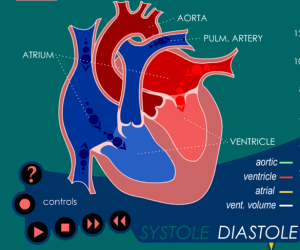 Thanks again to bogstandardcomp from the TES Boards.
This Shockwave app shows the full cycle of the heart beat and can be paused at any point. It includes ‘live’ ECG and blood pressure graphs and some tutorials (though I had difficulty getting them to work). Conveniently, it can also be saved using Firefox or Flashcatcher, to be used on the whiteboard.
Derryclare also posted a great link:
How to Build Tricky Compounds and Make a Cup of Tea
 Have a go at this demo from Presence Multimedia, aimed at A-Level students. It can be saved, is a bit of a challenge and works on the SMART Board.
A simple hunt around their site reveals other educational gems, such as ‘How to Wire a Plug‘, a ‘Personal MOT (good for ATL), and ‘How to Make a Cup of Tea‘.
Yes, you read that correctly – there is a Flash app on the internet to teach you how to make a cup of tea.
A new year, a new beginning (of all life on Earth)
 Two short clips of Miller-Urey’s experiments demonstrating the formation of amino acids from water, ammonia and hydrogen (with a little help from lightning). The evidence produced by this experiment supported the hypothesis of chemical evolution – the formation of organic compounds from inorganic molecules.
Thanks to Hilary Rimbi from the IB’s OCC for posting this link. 
A quick Google search turned up this short clip of Stanley Miller describing the experimental set-up.
If you click here, you can also try a simulation of the experiment (can be saved with Flashcatcher). This little Flash was produced by the University of California at San Diego’s TV channel. I haven’t had time to search through their site, but there may be more useful nuggets of Science gold there.
Skinner’s Rats – rats with wings.
Here are a couple of clips from YouTube about Skinner’s experiments on operant conditioning.
A shorter clip of the pigeon turning in a circle to gain food is after the jump.
Pavlov’s Dog – The Office style
One of Jim’s pranks on Dwight:
After the jump there’s a clip from an Eddie Izzard about Pavlov’s cats:




 i-Biology