Category Archives: IBDP Biology
Sex, Lies and Cigarettes
I came across this video via Steve Harton’s Hartonline Bio website and clicked on it because of the Indonesia connection. I’m glad I did, though it made me quite angry.

Aldi
Having spent most of the last eight years in Indonesia, I have long been concerned about the ubiquity of the tobacco industry and the all-pervasive nature of the advertising. Everything – literally everything – is sponsored by tobacco. From TV and movies to sports (!), some schools (!!) and music concerts. There is no escaping the message that smoking is cool, good for you and leads to an exciting life.
So how did it get this way when the developed world is shunning the dangers of smoking?
This 40-minute documentary by Vanguard puts it all in context. From the viral video sensation of Aldi the smoking baby, to the simple, ruthless economics of exploiting a developing country and targeting their children as an emerging market, the film-makers lay it out clearly and passionately. It focuses too on the work of an anti-smoking action group who face the huge challenge of taking on big tobacco in a country where so much depends on it – it’s a major cash crop and source of income.
This video is a YouTube upload, but there are clips and resources on the official Vanguard page.
I loved the bit where the Miss Indonesia contestants help the film-maker crash the World Tobacco Asia conference!
Some questions and thoughts to consider when watching the movie:
- Near the end of the movie, there is a quote from Warren Buffett: “I’ll tell you why I like the cigarette business. It costs a penny to make. Sell it for a dollar. It’s addictive. And there’s fantastic brand loyalty.” Although he has changed his stance on tobacco, it neatly illustrates the bottom-line ethos of business.
- As a publicly-owned company, your main responsibility is to the shareholder – you must maximise profits. Discuss the ethics of targeting children in emerging economies as a market.
- Accepted science states that tobacco is addictive and harmful to human health. Why then has this not been recognised by the Indonesian government?

For more good documentaries, have a look at Vanguard's website.
King Corn – we are what we eat, drink and cook with

King Corn
This film came out about a year ago, but I saw it for the first time on the History Channel a couple of days ago. A very enlightening view of the omnipresence of corn and corn-products in our food. From corn-fed beef to corn-starch and high-fructose corn syrup (boo!), industrial production of corn is in all facets of our diet.
In the film, two friends set out to produce an acre of corn and track how it grows and where is goes. Inspired by the Omnivore’s Dilemma and in tune with other recent super-docs (Super Size Me, Food Inc., The End of the Line), King Corn is a sensitive and educational film that manages not to stray into anti-industry polemic.
This extended clip from PBS shows the first 20-minutes of the movie:
It’s amazing to see that the corn farmers can’t even feed themselves with the corn they grow – it is not fit to be eaten! Instead it is bred and grown for maximum starch output. If you get a chance, watch it.
One impactful scene explains how high fructose corn syrup came to be and how it is made. Something to surely make you think twice about the contents of the processed foods we eat. Here’s a challenge – check the labels in the supermarket and see how may products contain it.
How We’ll Stop Polio for Good

This TED Talk by Bruce Aylward is amazing – watch it! Particularly important for HL Biology students.
Find out more about the work of the Global Polio Eradication Initiative. You can donate through Rotary International or click on the map below to track their progress.

2006 Map of Global Polio, from the Global Polio Eradication Initiative.
i-Biology: Illuminating Science!
Here’s a cool little TED video of bioluminescence in action.
https://ted.com/talks/view/id/1149In case you forgot, bioluminescence is the end-result of transcription and translation, with enzymes being produced to catalyse light-emitting reactions. Try it here at Learn.Genetics (What makes a firefly glow?). A beautiful real-world example of this semester’s content in action.
 i-Biology.net Domain upgrade
You might have noticed a new domain name and shorter URLs here – I got a new domain! It is domain-mapped through WordPress.com, so you shouldn’t need to update your bookmarks (but you might). Four years ago, this site started out as ‘Science Teachers’ Video Resources‘ but has evolved into something much more focused.
So here it is: i-Biology.net. Short and easy to remember.
The main focus of the site is IB Biology, but there will continue to be lots of videos and interactives linked for other sciences – especially as I will be moving soon to teach MYP science in Japan.
The “i-” could be “international” or even “I-love-” Biology. It’s up to you. I quite like “illuminate”.
With all the resources here now, “i-” should really mean “independent“. If you can support your own learning as a student by using this site, then great! What I really hope is that it will keep you “inspired” to continue Science beyond school.
As always, constructive comments and charity donations via Biology4Good are welcome.
Biology4Good – please help make a difference.
 What a week – over 20,000 visitors around the IB Biology exams! I hope it went well for you all, especially my awesome BIS kids!
If you’re a student or teacher who has been using these resources and they have helped you, please consider making a charity donation through my Biology4Good gifts list. Donations are secure and 100% of the value is given to charity.
Please take a couple of minutes to look through this presentation. Pass it on to your friends and teachers and please make these efforts worthwhile. There is more information about Biology4Good here:
Check out this for a post-exam stat-slump:
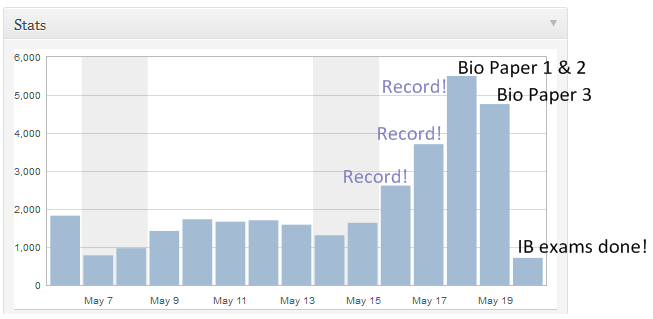 Apologies for two very similar posts in a week – I wanted to catch you before you left and perhaps never came back to the site now that IB exam stress is done!
MrT
Pay It Forwards – Please!
I hope Paper 1 and 2 went well for all you May-sessioners today. I can see from the stats that many have been busy on this site, and I’ve had three record-breaking days in a row. Many of you may never come here again once IB is done, so I wanted to catch you before you left!
Please take a couple of minutes to look through this presentation. Pass it on to your friends and teachers and please make these efforts worthwhile. There is more information about Biology4Good here:
Good luck for tomorrow. Put today out of your brain and look only at your Options work. Pay attention to command terms and don’t foolishly think you can do an Option that you didn’t do in school.
For many of you, tomorrow marks the end of the IB Diploma Programme. I sincerely hope that it has helped you grow into decent human beings – compassionate, knowledgeable and motivated to make a positive impact on the world.
BIS students – I am proud to have been your teacher.
Everyone else – thanks for the comments!
MrT




 i-Biology