Category Archives: IBDP Biology
Good Luck for Tomorrow!

Sleep tonight, not during the exam.
After all your work, you should be well prepared, but there are always last-minute strategies that you can take on board.
1. Get some sleep. Zombies are generally rubbish at Bio exams. Scientists are yet to determine whether this is because of changes to their brains or if they just can’t hold a pen. I’ll see you in the morning for any panic questions.
2. Pay attention to the Command Terms! We’ve been over this, so don’t forget.Don’t make the mistake of writing a beautiful answer to the wrong question!
3. Make good use of the reading time in paper 2 and 3. This is an opportunity to think about which question(s) to choose in section B and how you are going to structure the answers. Knowing what’s coming up will help you pace yourself.
4. Stay inside the boxes on paper 2. It will be scanned and the bits in the boxes sent to the examiner – who cannot mark what he/she can’t see!
5. Write clearly and use language appropriately. Make it easy on the examiners – they could have hundreds of copies of the same question to mark, so get your ideas across succinctly.
When you’re done, get some rest and focus on Thursday’s Options. You know it, so be confident.
Dihybrid Crosses and Genes Relinked
Updated presentation for 2011.
Link to more class resources here: 10.2 Dihybrid Crosses and Gene Linkage
If you want to download an editable version of the file, please make a donation to one of my charities at Biology4Good. Click here for more information.
Polygenic Inheritance Refertilised
Updated presentation for 2011.
Link to more class resources here: 10.3 Polygenic Inheritance
If you want to download an editable version of the file, please make a donation to one of my charities at Biology4Good. Click here for more information.
Theoretical Genetics Recombined
Updated for 2011, here’s the presentation:
Find more links and resources on the page for 4.3 Theoretical Genetics.
If you want to download an editable version of the file, please make a donation to one of my charities at Biology4Good. Click here for more information.
Draw the Core – exam skills presentation
Biologists need to be able to draw, but don’t confuse it with a colouring-in competition. If you look through the syllabus you will find many examples of assessment statements for draw, label or annotate, as well as others for which a diagram would be a great benefit.With limitations of time and using black pencil (no colours) in the exams, you will need to make them quick, clear and simple.
Draw the Core is a draft presentation for these syllabus items – for the Core content of the course only. This is a real work in progress and will be updated every now and then (when I get some free time). For now, you might find it useful. Later I plan to extend it for the AHL content too.
How could you use it in your revision?
- Flash up the command term slide and race to draw the diagram – then compare it with the next slide.
- Show up the diagrams and try to label them.
- Annotate the diagrams to explain or outline the processes in which they are involved.
- Think about ‘links across the curriculum’ for each of the diagrams.
You can find its permanent home on the Exam Skills page.The diagrams I have drawn in the presentation are Creative Commons, so use them if you will, but cite and link back to this site. Over time, I will add some of these to the Flickr page. I have used a simple USB graphics tablet for the diagrams and Powerpoint for the labels and annotations.
If you have a good, simple, home-made and clear diagram that you would like to donate to the presentation, please let me know in the comments.
Genetic Engineering & Biotechnology Update
Here is the updated presentation for 4.4 Genetic Engineering and Biotechnology. There are some new slides and clearer explanations, as well as a new visual identity. It should also be downloadable as a pptx file.
For many more resources go to the page for 4.4 Genetic Engineering and Biotechnology.
Are we ready for neo-evolution?
An entertaining and informative TED talk by medical ethicist Harvey Fineberg on the future of human evolution and the ethics surrounding the decisions that we may soon be able to make regarding our children and our health. With strong links to the Human Genome Project, evolution, ethics, genetic engineering, stem cells and TOK, this is a great video to watch and stimulate discussion and thought in the Genetics unit.
What do you think?
Meiosis Updates
An updated version of the presentation for the HL students, with more focus on random orientation vs independent assortment. for more resources and links, zip over to the 10.1 Meiosis page.
Random orientation refers to the behaviour of chromosomes in metaphase:
Independent Assortment refers to the alleles of unlinked genes:
You’ve got to love Tom McFadden’s Meiosis rap:
Deeply Dipity About Interactive Timelines
 Create interactive timelines online for free with Dipity. This would be a great tool for revision of historical topics and it can be shared and embedded.
Ed Yong has a neat example on his NotExactlyRocketScience blog, of the timeline of reprogrammed (induced pluripotent) stem cell research:
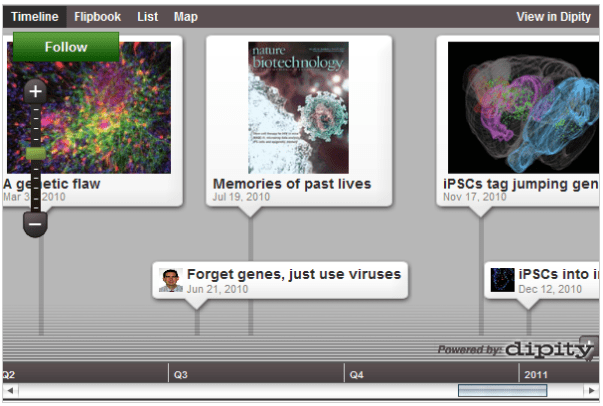
Reprogrammed stem cells on Dipity
Why use this?
- It’s free, visual, quick and easy
- Images, links and videos can be inserted
- You can connect it with facebook for easy logins (like SlideShare)
- Sharing is easy, embeds are possible (though not WordPress.com, again)
What could it be used for?
- Book or topic reports, such as a timeline of Darwin’s life and work.
- Mapping any time-related topic. History of the Universe, anyone?
Of course, if you’re studying History, Economics or current affairs, it would be an ideal tool.




 i-Biology