What are we really learning from practical work?
As we study science, a lot of our time and resources are devoted to implementing an engaging practical scheme of work. Are we really making the most educational use of this time, these resources and the opportunities that we have?
Teachers all over the world use experiments and demonstrations to engage students in the concept being taught. But does this actually improve student learning? Two recent videos have got me thinking about this issue, and before you read on you should watch them both.
The first is from UK science teacher & communicator Alom Shaha (@alomshaha), half the brains behind the sciencedemo.org website. The video was produced for the Nuffield Foundation’s new Practical Work for Learning resource. He refers to a number of research papers in the video, and is also one of the leaders of the #SciTeachJC (science teachers journal club) twitter discussion group.
Do you recognise those labs and how do you use them? Do the labs we do really help us teach the concepts we intend them to, and how can we rethink (or at least evaluate) our use of labs.
The second video is from US Chemistry teacher Tom Stelling (@ChemistTom), on his “vRant” about students asking to “blow something up” and the dangers of ‘wow’ demos as distraction rather than education.
https://twitter.com/ChemistTom/status/332685283105587200
Note: this post rambles a bit from here on. If you want to know more, please read on. Otherwise, all the good bits were in Alom & Tom’s videos.
Personal GoogleSites: A Learning Project in #IBBio
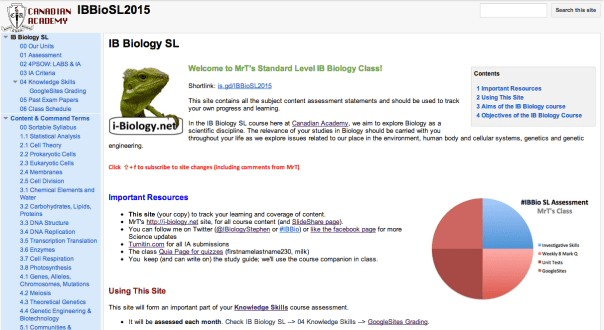
Personal GoogleSite: Click to view an example.
Although i-Biology hosts all my content resources, the main class resource students are working with is a personal GoogleSite to track their progress and reflection. Click here to find out more about how it works.
Student Science Writers: Environmental Issues
As we finish our Exploring Environments student-designed units, students have published blog posts for the science communication assessed task. In this task, assessed for Communication in Science, they had to pick a case study or current news item of interest and direct connection to their group’s unit. Using guidance, models of good science writing, GoogleDocs drafting (and for some, pointers from professional science writer Andy Revkin), they wrote short articles on their case study.
There’s no point writing for an audience of one, so…
..here they are!
If you do visit and feel like posting a comment, remember that these are school students, and that your comments must be appropriate, constructive and positive.
- Maggie’s post on fighting Aricanized bees with… more bees!
- Heather’s post on invasive mussels and their damaging impacts.
- Parina’s post on 13 oils spills in 30 days (!)
- Joanna’s post on Australia burning.
- Kyoko’s post on painting the roof white to cool the town.
- Rohan’s post on the cost of shark finning.
- Sanam’s post on the end of the reign of the king of butterflies.
- Stephanie’s post on cell phones and honeybees.
- Mahya’s post on Australia’s new colour on the temperature chart.
- TaeHyun’s post on spring floods and the Gulf of Mexico dead zone.
- Yota’s post on Sea Shepherd vs Japan.
- Aili’s post on bluefin tuna being worth too much dead to be allowed to live.
- Cedric’s post on the mystery of the dead pigs in China.
- Mikka’s post on the shrinking Antarctic ozone hole.
- Haruki’s post on the highest global temperatures in 4,000 years.
Good Luck May 2013!
Good luck to all students in the May 2013 exam session!
As always, this time of year drives a spike in views at i-Biology.net. If you have found the resources and presentations here useful (as a student, teacher or study group), then please consider making a donation to one of my chosen charities through Biology4Good, my JustGiving team. All donations go to the charity chosen.
 Donations can be given to:
- AfriKids
- WaterAid
- Mines Advisory Group
- Save the Children
- Medecins Sans Frontiers (Doctors Without Borders)
- Hope HIV
- Save the Rhino
- Tree Aid
I hope your hard work pays off and that you have learned something along the way that will come in useful during your life.
“Changing Crops for a Changing Climate” Mark Lynas & a Nature Special on GMOs
Here is Mark Lynas at Cornell University, with his speech “Time to call out the anti-GMO conspiracy theory.” It runs almost half an hour, though he does have a transcript of the speech on his blog. The connections to IB Biology Genetics & Genetic Engineering here are obvious.
What should be noted for background is Lynas’ own story. In the 1990’s he was a prominent anti-GMO activist, but has recently apologised and is now on a mission to right the wrongs he feels he has done. It has not been easy, and has generated lots of controversy.
“Allowing anti-GMO activists to dictate policymaking on biotechnology is like putting homeopaths in charge of the health service, or asking anti-vaccine campaigners to take the lead in eradicating polio.”
Powerful and provocative stuff – and a great stimulus for discussion and debate. Lynas refers to a lot of studies, claims and organisations in this speech. Students could follow this up with finding out more about each of them.
We might never be able to get students to the absolute truth on GMOs – we may find it difficult ourselves – but it is useful to give some insight into just how delicate the balancing act can be and how cloudy the discussions of ethics in science can get. The issues around GMOs are complex: scientific, political, ethical, economical, environmental. They are far more complex than a couple of short assessment statements in a Biology syllabus can really do justice.
……….o0O0o………

Rise of the Superweeds. Click-through to the Nature Special.
Also recently, a very useful Nature special edition on GM Crops: the Promise & Reality. Look in for some in-depth articles and case-studies, including the true, the false and the still unknown on GM crops.
Nature articles often have presentations of data that can be used for data-based question practice (such as the one to the right – click through to see). Follow the patterns of the DBQ’s and make up your own questions based on different articles:
- Identify…
- Describe the trend in…
- Calculate the difference in…
- Compare…
- Suggest reasons for…
- Evaluate…
Crash Course: How to Speak “Chemistrian”
In our Grade 9 Chemistry class we think of the subject as a great puzzle, leveling-up as we add new concepts. The key to the puzzle is the periodic table: learning your way around – and how describe what you know and interpret the descriptions of others.
In this video, from the Crash Course Chemistry series, Hank goes over:
Hanging Out with Andy Revkin
“How do we head through nine billion people by around 2050 without really screwing up too much?”
Andy Revkin writes the DotEarth blog for the New York Times, and has been writing about the environment for almost thirty years. His topics are diverse (and his Twitter stream rich with links) and connected to much of what our students have chosen to explore in our current Environmental Sciences unit in Grade 10 (MYP5).*
He very kindly agreed to G+ Hangout with some students before school, to discuss science writing in general and how he masters his craft on the environment beat. We learned a lot from Andy, and loved his assertion that he is not a ‘doom and gloom’ writer, but that the environment is different, and more complex than we first thought.
……….o0O0o……….
Here are links to some of the ideas & issues he mentioned in the chat:
- His ‘Postcards’ series, snapshots of science and environmental research
- Psychology & the environment
- Schools and syllabuses designed with the environment in mind
- Twitter in the classroom
- Obama and the National Academy of Sciences
- Will we have fewer, more dangerous hurricanes?
- The Burning Season book: the murder of Chico Mendez
……….o0O0o……….

Andy chatting with the early arrivals on G+ Hangouts.
*As part of our current Grade 10 Environmental Science unit, students have broken into groups depending on their interests and IBDP Sciences choices. They have designed their own unit content, though assessment types are common – a lab they design, a test we’ll write based on their chosen assessment statements and a piece of science writing. I’ll dedicate a whole post to how the unit worked once we’re done.
For the science writing task, students are asked to find real-life articles, case-studies or stimulus materials that will provide a context for some of their content. We showed them some models, of great science writing, but I realised my Twitter lists were light on environment writers.
A quick tweet (and some follow-up emails) fixed all that:
https://twitter.com/ferrisjabr/status/322324597791916032
Thanks again to Andy for chatting to us – it was a great opportunity to talk to a real pro.
It is also evidence, once again, that Twitter can be an amazing tool for classes and professional development.
Are you replacing sleep with food? DBQ practice.
https://twitter.com/scicurious/status/327240402367307776
I came across this through Ed Yong’s weekly linklist, but @SciCurious often writes really interesting posts (Neurotic Physiology) on neurobiology. This one is particularly relevant to #IBBio students for a few reasons. First, you guys are up way too late, way too often. Second, it connects directly to our course – read this blog post (based on this paper), especially students working on option A: Nutrition, or anyone reviewing hormonal control.

Click for the graphs & article at the Neurotic Physiology blog.
Finally it is ripe for data-based question practice.
These graphs click-through to the originals posted at SciCurious’s blog. Here are some DBQ-style questions you might ask:
- Calculate the difference in post-dinner snack energy intake between having a ‘normal’ 9h sleep and the sleep-deprived 5h condition.
- Compare the trend in energy expenditure throughout the day between 9h sleep and 5h sleep.
- Describe the difference between 9h sleep and 5h in terms of eating patterns.
- Evaluate the hypothesis that “when we sleep less, we eat more” based on the data provided and information in the article.
- Explain the role of the appetite control centre of the brain on appetite, and suggest how it is affected by the conditions of the experiment.
Appetite Control: from the Wellcome Trust (‘The Anatomy of Appetite’ explainer page here).
……….o0O0o……….
So there you go – you learned something.
Get to bed. And leave the snacks in the fridge.
Thrift Shop Parody: TCA (Kreb’s) Cycle Rap
Pitched just a little over HL, but very well done and super catchy, here’s Wilson Lam’s Thrift Shop Parody:
Related, of course, is Tom McFadden’s Oxidate It Or Love It:
And if all that’s too musical, here’s Hank:
Electronics Bathed in Blood & Destruction
Although George Monbiot’s fruitless search for an ethical smartphone has ended with the discovery of tin for parts being sourced through child labour on the Bangka Islands in Indonesia, it has turned up a lot of useful resources that could form great prompts for an MYP Sciences, Design and Economics inter-disciplinary unit on life cycles of electronics.
Some ideas that could be pitched at different levels for students:
- What is life cycle analysis and what do we mean by ‘designed for the dump’?
- How can we create resources that help us appreciate what we have, rather than feeling the ‘need’ to pick up the latest and greatest?
- Design a campaign or project based on one of the 8 R’s (below).
- Analyse and evaluate the data in the Short Circuit report. Write a case study or investigative piece one one og highlight facts, issues, problems or potential solutions.
- Collect and analyse community data on perceptions of need, rate of purchase and disposal of electronics. Do people know what is in them, where their dangers are and where they end up?
One of the resources shared by Monbiot was this fantastically detailed document called the Short Circuit Report, produced by the Gaia Foundation & Friends of the Earth’s Make It Better campaign. It is packed with information, data and images. One in particular stood out as a discussion starter on choices and design:

How would the 8 ‘R’s change your approach to consumption and design? Please read the full Short Circuit report for this diagram in context. Click the image to view.
The Story of Electronics is another video introduction that might hook students into finding out more about these shiny gadgets that are permanently attached to our bodies.
For more resources and ideas, have a look at this Storify:





 i-Biology