30-Minute Inquiry: Base-substitution mutations
This has worked well (and been fun) as a topic review, way to make use of databases (ICT in IBBio requirement) and make connections as we.
Question: What do HBB, PAH, PKD1, NF1, CFTR, Opn1Mw and HEXA have in common?
Concepts: Structure vs Function; Universality & Diversity.
The set-up:
- Assign groups by handing out cards with the codes above (we had already studied HBB, so didn’t include it) and asking them to find each other.
- Give them the instructions – to produce a simple poster & 1-minute overview of their disorder, using the guidance in the image below.
- Go. Lots of discussion, lots of questioning. If students get stuck, they need to look it up, evaluate their sources and keep on going.
- Students will need to use the NCBI gene database to get going: http://www.ncbi.nlm.nih.gov/gene
Check they’re on the right track: HBB (sickle cell), PAH (PKU), PKD1 (polycystic kidney disease), NF1 (neurofibromatosis), CFTR (cystic fibrosis), Opn1Mw (medium-wave sensitive colour-blindness), HEXA (Tay-Sachs disease). They are all disorders causes by base-substitution mutations.
After 30 minutes:
- Groups present to the class what they have found.
- As the class sharing continues, ask questions based on connections:
- What similarities and differences do we see?
- What are the normal functions of these genes and how does this connect to our understanding of proteins, channels, pumps, etc.

Three Million Views on i-Biology!
i-Biology.net recently passed three million views!

Biology4Good: click to find out more.
Thank-you everyone for the support over the last six and a half years, and especially to those who have been showing your appreciation by making donations to my chosen charities through the Biology4Good lists on JustGiving; we have raised GB£3,415.86 so far (US$5626.95), which is great and helps all this work make a difference beyond the classroom.
If you want to make a donation, please visit the Biology4Good page for more information. 100% of all donations go to the charity (not to me), and the donation can be enhanced with GiftAid if you are a UK taxpayer.
With best wishes for 2014 to all i-Biology.net users,
Stephen.
Amazing T. rex Illusion
This illusion rocks. See if you can work out how they did it before you see the ‘reveal’.
For more amazing illusions, see the archive of winners and entries in the ‘illusion of the year‘ contest.
Making Feedback Visible: Four Levels Experiment
I’ve recently been trying to update and enhance teaching practices through a more careful consideration of Hattie’s learning impacts and through the MYP assessment criteria. This is an experiment in giving feedback in a more evidence-based manner.

This quick brain-dump is based on ideas from Hattie’s Visible Learning for Teachers, Wiliam’s Embedded Formative Assessment and the pdf of The Power of Feedback (Hattie & Timperley) linked below.
I spent much of today trying to grade a large project (Describing the Motion of the Rokko Liner, our local train), which was assessed for MYP Sciences criteria D, E, F. Based on some of our Student Learning Goal work on helping students cope with data presentation and interpretation, the lab had been broken into stages (almost all completed in-class), spread across A4 and A3 paper and GoogleDocs in Hapara.
The result: a lot of visible learning in that I could keep track of each student, see their work in progress and comment where needed. A lotof verbal feedback was given along the way, with some worked examples for students. Breaking the large assignment into stages helped keep…
View original post 1,055 more words
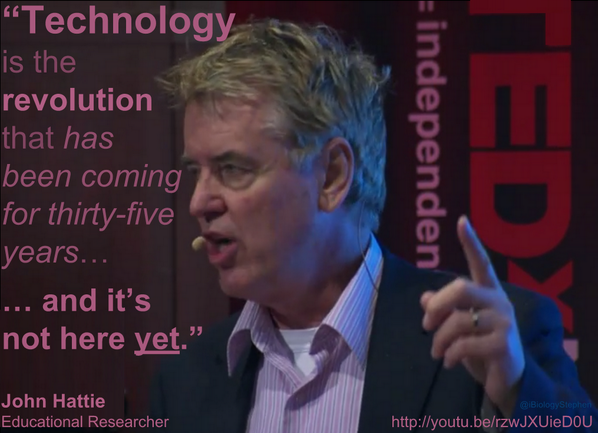
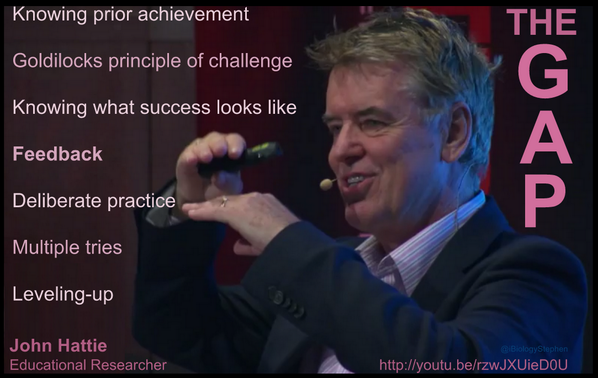
Hattie TEDx Talk: Why are so many schools & teachers successful?
This is an excellent TED Talk in which Hattie gives a solid overview of the Visible Learning impacts. Teachers should watch it. Students might get something out of it, too.
This is worth sharing as a neat overview of Hattie’s research and the learning impacts. With Visible Learning as the basis for our Teacher Learning Communities at CA, it makes for a timely resource.
View original post 18 more words
Hattie & Yates: Visible Learning & the Science of How We Learn
This is my review of John Hattie’s new book, Visible Learning and the Science of How We Learn. If you’re interested, head over to my personal blog to read more.

Samudra, mini-me, having a good think about cognitive load.
This brief review of John Hattie and Gregory Yates’ Visible Learning & the Science of How we Learn (#HattieVLSL) is written from the multiple perspectives of a science teacher, IB MYP Coordinator and MA student. I have read both Visible Learning and Visible Learning for Teachers, and regularly refer to the learning impacts in my professional discussions and reflections. While reading the book, I started the #HattieVLSL hashtag to try to summarise my learning in 140 characters and to get more people to join in the conversation – more of this below.
EDIT: March 2017
This review was written right after the release of VLSL, in late 2013. Since then, the ideas of ‘know they impact‘ and measurement of learning impacts have really taken off in education, particularly in international schools. Critics of Hattie (largely focused on mathematics or methodology) are also easy to find, though the
View original post 2,409 more words
First Unit Reflections: Is It Working?
This is posted over from my personal reflections blog, but it is about my current IB Biology class. I love these students – they are can-do, and give really useful feedback.
Today we took the opportunity in the IBBio class to reflect on the unit we have just completed, including the tasks and assessment. As always with CA students, the results were constructive, positive and useful, with a general affirmation of the value of what we are doing as a class. The feedback included our personal GoogleSites project, with most students keen on continuing and feeling it helped them learn and with some interesting alternatives for those that it is not.
This kind of feedback is really useful once the class has settled in. They are open enough to be able to be honest, but it is early enough to change practices where needed. We will make some adjustments, though we are generally on the right track with this group. I’m really looking forward to seeing the process and products of the students who have elected to become science writers…
View original post 11 more words
Conceptual Learning in IB Biology
If you’re an IB Biology teacher here’s a challenge (or perhaps not):
- List and describe the four basic biological concepts that run through the discipline of Biology.
Got it? Here they are (highlight to see):
- Structure & Function
- Universality versus Diversity
- Equilibrium within Systems
- Evolution
They are on page 40 on the subject guide.
Teachers in MYP schools will be well aware of the concept-based nature of the Next Chapter as it arrives, but in reality it may already be here in our classes. How many times do we ask students how the knowledge we have gathered in a lesson or sequence connects to other knowledge, looking for commonalities and themes? This, in a simple way, is teaching for conceptual understanding*. We want students to be able to recognise concepts in new content – the universal nature of the genetic code and the diversity it facilitates; adaptations to maintain homeostasis (equilibrium) within living systems, the relationships we see between structure and function in all living systems and the process of evolution by natural selection that underpins them all.
I want to make it a personal goal this year to be more explicit in the learning of the big ideas of Biology: the concepts. We’ll start this week with a group task for students to try to connect these concepts to their latent understandings of Biology and we’ll build from there.
Some ideas for teaching the concepts in Biology:
- Jigsaw tasks for students in different groups as we review a unit: one group for each concept who need to explain how the content of the unit feeds into that one conceptual understanding.
- Connect-extend-challenge (a visible thinking routine**). As we build a body of biological knowledge students can reflect and review based on how this connects to each of the four concepts, how they might extend their understanding with deeper questions and what they have found challenging in the unit/ lesson.
- Concept walls: spaces in different parts of the classroom where students might pin their thoughts on the topic (or post post-its).
If you have more ideas for how to use the concepts of biology to strengthen students’ understanding, please share!
……….o0O0o……….
Further Reading
* ‘Teaching the Disciplines – Nurturing big Ideas for Deeper Understanding’ is an excellent document from the MYP section of the OCC. Read the section on the sciences.
**Harvard’s Project Zero has a fantastic set of thinking routines to make thinking visible. Try them out!