IB Biology Orientation
Welcome to the 2013-14 School Year!
Here is a quick overview of i-Biology.net for new and returning users – teachers and students – and I wish you all the best in your studies. Please note that this is not an official IB product and so should be treated with due caution. I do my best to keep it current and accurate, and appreciate constructive feedback.
I am active on Twitter, sharing ideas and resources using the #IBBio hashtag.
The purpose of this site

Follow me on Twitter
This was designed as a support site for my own students, and hosts all of our class resources: presentations, links, videos and more. It is intended to allow for more student-focused teaching in that we do not go through every presentation as a lecture, this resource acts more as a student text and set of provocations for discussion and inquiry. Having said that, we are preparing for a terminal examination, so there is significant content to prepare students.
I have students keep track of their progress in their own personal GoogleSites and we have focused sessions on some topics and subtopics where needed. We use Quia extensively for pre-assessment and practice, and all tasks are based around model exam questions, data analysis, discussion and lab work. There is a high degree of cooperative learning in the class. Students have their own copy of Allott’s Study Guide and we have some Course Companions in the class.
Content
By using the tabs at the top of the site you will find pages for all Core subtopics and all of the options and HL topics that I have taught. I do not have (nor plan to have) content for the remaining options.
Support resources:
- Command terms & sortable syllabus
- Exam skills – drawing, calculations, etc
- IA & 4PSOW support, including a student-facing unpacked coversheet for self-assessment
- Resources to support ICT in IB Biology
- Lots of lesson ideas for TOK Connections in IB Biology
Blog
The front page of this site is a blog, which is periodically updated with resources, news or discussion of science and education. Follow it, if you wish. I appreciate comments and sharing through Twitter.
Creative Commons
This work has been shared in a spirit of Creative Commons. I am happy for it to be shared and used in classes, but it is not acceptable to re-host it on other public servers or adapt it to sell. Find out more here.
Biology4Good Charity Donations

Pay It Forward
This work is open and shared so that others can benefit and save time, focusing on good teaching and learning instead of having to reinvent the wheel. I do not charge for access, though I really appreciate it when people make small donations to one of my chosen charities through my JustGiving page Biology4Good. Pay it Forward – please estimate the time and money you have saved by using this and give a small proportion to charity. Find out more here. Donors giving GBP20 or more (and leaving their email address) will be given access to a DropBox folder with more editable powerpoint files.
Comments
I moderate all comments. This is a site for students, so please behave accordingly. I do appreciate questions and suggestions for corrections.
Enjoy!
Processing Data: A Department Student Learning Goal
In the 2012-13 school year, our science department worked on a collaborative Student Learning Goal to improve student performance in Criterion E: Data Processing. Click here to find out more about the process, outcomes and next steps.
Think Global, Act Local: Give One World a Chance.
The One World criterion in MYP Sciences can get a bad rap and I think it is because it has been misinterpreted as being unscientific or too ‘soft’ for a science class. Sure, you don’t want to spend the whole semester doing One World essays, but we can make much better use of its potential. It can be a good showcase of student writing and ethical discussion, as well as an authentic connection between research and real world.
Here are a few pieces of recent work from students that give some idea of how engaging it can be. All are from the same class, with the prompt “Think Global, Act Local“.
- Aili’s investigation into the one-to-one programme and paper use.
- Sanam also uncovered some shocking facts on paper use and printing.
- Maggie’s post, “Make your meals healthier, even after you’ve finished.“
- Joanna’s post on e-waste and if we really need that new phone.
- Kyoko on balancing paper towels with hand dryers.
- Parina’s idea for a vegetarian challenge to reduce our meat consumption.
……….o0O0o……….
I think for One World to be successful it needs to have the following elements:
- An audience. I hate that students write for me alone, so the more that we can blog, the better: especially when it is community-related. The blogs allow us to include images, videos, links and mirror more closely the work of real science writers. I do need to get better at getting students and others to comment on their work.
- An authentic purpose. In the examples above, part of the purpose was to highlight that our own actions as a school have consequences, but also to give some inspiration for CAS projects. Connecting One World to other subjects or global issues might help students see the purpose of their research and writing.
- Differentiation. Of course it’s boring when 20 students write the same response to the same question. A good unit question might be all the stimulus it takes to get many different ideas, all connected to the significant concepts. We should help students pick questions of personal interest.
- Enough guidance to help those in need, but not enough to stifle the students’ voice. The criterion is complex, and it is easy to break it into a checklist or paragraph-by-paragraph pro-forma. For students that need this level of support, that is fine, but for some it is like a straitjacket. I like to give students the guidance, but encourage them to take their own path, if they can.
- Time. It is very easy to set these kinds of tasks as homework and be done with it, but that doesn’t do the students or the task justice. If it is a summative assessment task, it should be mostly completed in school; if it is valuable to count in the report, it is valuable to… value with time.
- Feedback and self-assessment. Drafting in GoogleDocs makes for easy, timely and directed feedback to students during the process.
What other suggestions do you have for successful One World work?Do you have examples of great student One World work you’d like to share? If so, please do so in the comments.
Here’s a little presentation that might be useful for a formative or introductory task:
Exploring Environments: Student-Designed Units & Hapara
Click here for a summary of our recent student-designed Grade 10 (MYP5) Environmental Sciences unit that we planned for students to design and implement. I used this project as my trial for Hapara, a GoogleDocs dashboard system.
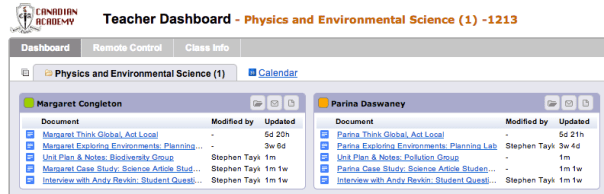
Hapara Dashboard: screenshot well after the project has finished, but you get the idea. Green = Bio, Orange = Chem. Click on the image for the post about the project, including some sample documents.
In summary, using this as a management tool allowed for a smooth and highly differentiated, student-led inquiry unit in MYP 5 Environmental Science. Find out more.
What are we really learning from practical work?
As we study science, a lot of our time and resources are devoted to implementing an engaging practical scheme of work. Are we really making the most educational use of this time, these resources and the opportunities that we have?
Teachers all over the world use experiments and demonstrations to engage students in the concept being taught. But does this actually improve student learning? Two recent videos have got me thinking about this issue, and before you read on you should watch them both.
The first is from UK science teacher & communicator Alom Shaha (@alomshaha), half the brains behind the sciencedemo.org website. The video was produced for the Nuffield Foundation’s new Practical Work for Learning resource. He refers to a number of research papers in the video, and is also one of the leaders of the #SciTeachJC (science teachers journal club) twitter discussion group.
Do you recognise those labs and how do you use them? Do the labs we do really help us teach the concepts we intend them to, and how can we rethink (or at least evaluate) our use of labs.
The second video is from US Chemistry teacher Tom Stelling (@ChemistTom), on his “vRant” about students asking to “blow something up” and the dangers of ‘wow’ demos as distraction rather than education.
https://twitter.com/ChemistTom/status/332685283105587200
Note: this post rambles a bit from here on. If you want to know more, please read on. Otherwise, all the good bits were in Alom & Tom’s videos.
Personal GoogleSites: A Learning Project in #IBBio
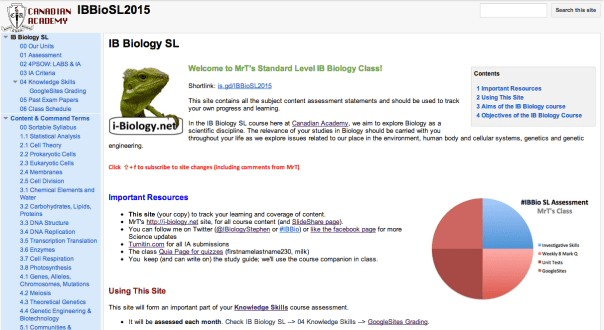
Personal GoogleSite: Click to view an example.
Although i-Biology hosts all my content resources, the main class resource students are working with is a personal GoogleSite to track their progress and reflection. Click here to find out more about how it works.
Student Science Writers: Environmental Issues
As we finish our Exploring Environments student-designed units, students have published blog posts for the science communication assessed task. In this task, assessed for Communication in Science, they had to pick a case study or current news item of interest and direct connection to their group’s unit. Using guidance, models of good science writing, GoogleDocs drafting (and for some, pointers from professional science writer Andy Revkin), they wrote short articles on their case study.
There’s no point writing for an audience of one, so…
..here they are!
If you do visit and feel like posting a comment, remember that these are school students, and that your comments must be appropriate, constructive and positive.
- Maggie’s post on fighting Aricanized bees with… more bees!
- Heather’s post on invasive mussels and their damaging impacts.
- Parina’s post on 13 oils spills in 30 days (!)
- Joanna’s post on Australia burning.
- Kyoko’s post on painting the roof white to cool the town.
- Rohan’s post on the cost of shark finning.
- Sanam’s post on the end of the reign of the king of butterflies.
- Stephanie’s post on cell phones and honeybees.
- Mahya’s post on Australia’s new colour on the temperature chart.
- TaeHyun’s post on spring floods and the Gulf of Mexico dead zone.
- Yota’s post on Sea Shepherd vs Japan.
- Aili’s post on bluefin tuna being worth too much dead to be allowed to live.
- Cedric’s post on the mystery of the dead pigs in China.
- Mikka’s post on the shrinking Antarctic ozone hole.
- Haruki’s post on the highest global temperatures in 4,000 years.
Good Luck May 2013!
Good luck to all students in the May 2013 exam session!
As always, this time of year drives a spike in views at i-Biology.net. If you have found the resources and presentations here useful (as a student, teacher or study group), then please consider making a donation to one of my chosen charities through Biology4Good, my JustGiving team. All donations go to the charity chosen.
Donations can be given to:
- AfriKids
- WaterAid
- Mines Advisory Group
- Save the Children
- Medecins Sans Frontiers (Doctors Without Borders)
- Hope HIV
- Save the Rhino
- Tree Aid
I hope your hard work pays off and that you have learned something along the way that will come in useful during your life.
“Changing Crops for a Changing Climate” Mark Lynas & a Nature Special on GMOs
Here is Mark Lynas at Cornell University, with his speech “Time to call out the anti-GMO conspiracy theory.” It runs almost half an hour, though he does have a transcript of the speech on his blog. The connections to IB Biology Genetics & Genetic Engineering here are obvious.
What should be noted for background is Lynas’ own story. In the 1990’s he was a prominent anti-GMO activist, but has recently apologised and is now on a mission to right the wrongs he feels he has done. It has not been easy, and has generated lots of controversy.
“Allowing anti-GMO activists to dictate policymaking on biotechnology is like putting homeopaths in charge of the health service, or asking anti-vaccine campaigners to take the lead in eradicating polio.”
Powerful and provocative stuff – and a great stimulus for discussion and debate. Lynas refers to a lot of studies, claims and organisations in this speech. Students could follow this up with finding out more about each of them.
We might never be able to get students to the absolute truth on GMOs – we may find it difficult ourselves – but it is useful to give some insight into just how delicate the balancing act can be and how cloudy the discussions of ethics in science can get. The issues around GMOs are complex: scientific, political, ethical, economical, environmental. They are far more complex than a couple of short assessment statements in a Biology syllabus can really do justice.
……….o0O0o………

Rise of the Superweeds. Click-through to the Nature Special.
Also recently, a very useful Nature special edition on GM Crops: the Promise & Reality. Look in for some in-depth articles and case-studies, including the true, the false and the still unknown on GM crops.
Nature articles often have presentations of data that can be used for data-based question practice (such as the one to the right – click through to see). Follow the patterns of the DBQ’s and make up your own questions based on different articles:
- Identify…
- Describe the trend in…
- Calculate the difference in…
- Compare…
- Suggest reasons for…
- Evaluate…
Crash Course: How to Speak “Chemistrian”
In our Grade 9 Chemistry class we think of the subject as a great puzzle, leveling-up as we add new concepts. The key to the puzzle is the periodic table: learning your way around – and how describe what you know and interpret the descriptions of others.
In this video, from the Crash Course Chemistry series, Hank goes over: