BioNinja: App & Website

Click to visit BioNinja
BioNinja is website and app for review in IB Biology that you might find useful. It has some summary notes, tutorials and songs and quizzes on the free app.
For other review resources for the IBBio exams:
- This site (i-Biology.net) has presentations, links and review sheets.
- Click4Biology.info has good summary notes, with depth
The Future of i-Biology
 This post is in response to a number of emails, comments and other messages I’ve received recently regarding plans to update the site.
A new IB Biology guide has been released for first teaching in summer 2014 and first examinations May 2016. It outlines significant changes to the course, especially in terms of internal assessment and examinations and the prescriptive nature of the content coverage has shifted to be more open-ended.
Much of the content-based work on here will remain useful, though will need to be reorganised (eventually). I will leave the IA support stuff up here for the coming year and will work over the coming academic year to update the site as far as possible. I will likely remove a lot of IA-related content, as we are to expect significant teacher support material on the OCC, and that is where teachers should be making their first stop for reliable documentation.
Personally, my load has shifted a lot in recent years. It has taken about seven years to build this site and all of its assets, and I am happy to continue to share them freely. However, most of my time is now taken up with being an MYP Coordinator and teaching MYP science classes, as well as being HOD for science and having larger groups of students with no lab support. My IB Biology class are currently in IB1, and I will keep them next year on the current guide. I also have family, MA studies and other commitments, so will not likely be able to revamp the presentations in the immediate future. Please give it time and use your judgment as to what is useful and valuable if you are starting teaching of the new guide this summer.
Update: October 15 2016
My load has shifted again, and I am now Director of Learning and MYP Coordinator, still at Canadian Academy, Kobe. With no teaching load and being stretched very thin for time, I am less likely than before to make any major updates to the site. I will keep paying for site hosting as long as it proves useful to teachers and students. I will start to prune some pages where possible.
……….o0O0o……….
Biology4Good Charity Project Update
 We have now passed
 3.4 5 million views on the site, with over £4 5,000 in charity donations made through Biology4Good. If you donate £20 or more, you can have access to a folder of all the editable resources I still have. These donations and the ability to support a selection of my favourite charities are significant motivators for continuing to update this site, so thank-you for the ongoing support.
……….o0O0o……….
Update: June 7 2014
It was sad to see John Burrell’s announcement that he plans to close Click4Biology, as he has given a great service to students and teachers through his online notes over the last decade. However, his reasoning is sound – the change in the subject guide to move away from such defined assessment statements makes producing these resources more challenging. At the same time, the text resources, such as Allott & Mindorrf’s Course Book, with it’s online edition, have really upped the quality of what is available to students from the publishers.
Looking at this year’s statistics on i-Biology.net, there was the usual big spike around the May exams (around 10,000 on peak day, compared to 2,000-4,000 on regular days), but it was far below the record of over 20,000 last year. From the discussions around #IBBio on twitter, it seems that much of the review traffic has swung towards BioNinja’s apps and notes that are set up for mobile learning and review. Again, this is a great service to students, and there is little point trying to replicate that.
I will think carefully over the coming year about how this site will continue, and it will likely be more streamlined in terms of course content but with more organised ideas for teaching and ed-tech.
If you have any suggestions, please leave them in the comments below, or find me on Twitter (@sjtylr).
The Great Barrier Reef: An Obituary
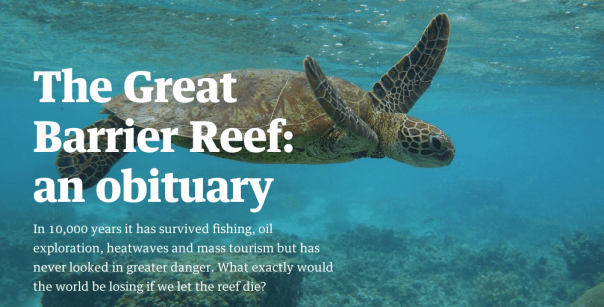
The Great Barrier Reef: An Obituary. This haunting multimedia Guardian piece could be a perfect provocation for a unit.
In the current age of environmental destruction it can be difficult to keep paying attention to the news. But some stories stand out as being real alarm bells, and this very sad piece on the iconic barrier reef highlights a lot of purely human-caused issues. To add to the misery, now the reef is under further threat from destructive dredging and dumping… to make way for shipping lanes for coal mining in Australia. #EpicFail.
MrT’s students: note the image above has a caption and links back to the original source, not to an image hosted on my WordPress. Make sure your writing does the same.
Ed Yong’s TED Talk: Suicidal crickets, zombie roaches and other parasite tales
“Are there any parasites that are influencing our behaviour without us knowing it?”
When I started this blog back in 2007, Ed Yong was a fledgling science writer gaining an audience with his Not Exactly Rocket Science wordpress blog; clear and engaging online articles that opened up primary research to a wider audience. You’ll find many links to his writing throughout this site, connecting the concepts of the IB Biology course to current science and ‘the wow beat’. He has since had a book and is resident at NatGeo’s Phenomena Salon, after moving through Science Blogs and Discover.
He continues to inspire me as a writer and this week he gave his TED Talk, a funny and fact-packed tour of the sinister side of parasites. Enjoy! You will even be able to find some links out to further reading and references.
If you don’t already, you should subscribe to the Phenomena blogs, and if you’re a teacher or student whose schedule are as packed a mine, I highly recommend Ed’s weekly ‘Missing Links‘ roundup of science news and writing – they make for my Sunday morning reading!
Can you solve this?
Have a go at this – pause at 1:30 and get chatting before moving on! Another great video by Derek Muller (@veritasium), and will be useful in discussions of the scientific method, hypothesis testing and the nature of science.
A no is usually more useful than a yes…
Getty Image Library has been set free
This is big news this week for teachers and students who need media for their online projects. Getty, the giant photo agency, have opened up their library for free use as long as you use their embed tool.
This is timely as we think more carefully about Approaches to Learning in the MYP and DP, in particular Media and Information Literacy clusters and the skills of accessing and appropriately using information from other sources.
Here’s an example:
Cool!
Infested! Living with Parasites
Check this out, from the BBC. Dr Michael Mosley has himself infected with various parasites, including this big tapeworm, for our edutainment.
Full episode on BB iPlayer (limited time): Here.
Here’s a leech, for fun.
Socrative Space Race (beta)
Quick update to the Socrative Space Race page: some new cards to use with the beta version.

Updated space race cards for beta.socrative.com