Hattie TEDx Talk: Why are so many schools & teachers successful?
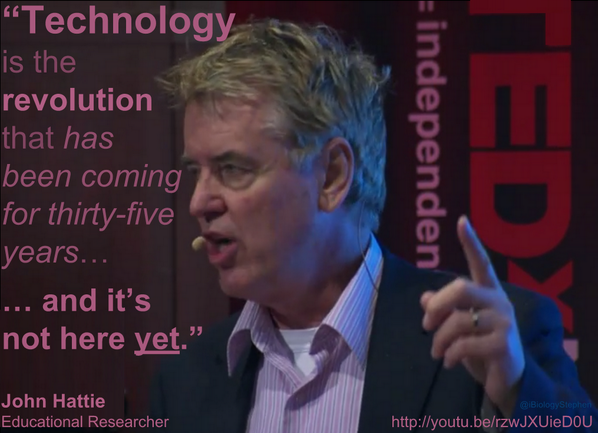
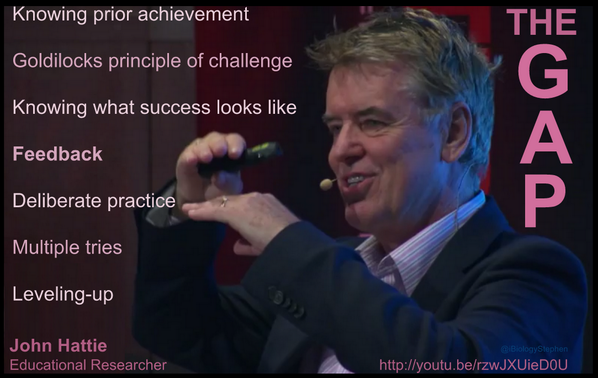
This is an excellent TED Talk in which Hattie gives a solid overview of the Visible Learning impacts. Teachers should watch it. Students might get something out of it, too.

This is worth sharing as a neat overview of Hattie’s research and the learning impacts. With Visible Learning as the basis for our Teacher Learning Communities at CA, it makes for a timely resource.
View original post 18 more words
Hattie & Yates: Visible Learning & the Science of How We Learn
This is my review of John Hattie’s new book, Visible Learning and the Science of How We Learn. If you’re interested, head over to my personal blog to read more.

Samudra, mini-me, having a good think about cognitive load.
This brief review of John Hattie and Gregory Yates’ Visible Learning & the Science of How we Learn (#HattieVLSL) is written from the multiple perspectives of a science teacher, IB MYP Coordinator and MA student. I have read both Visible Learning and Visible Learning for Teachers, and regularly refer to the learning impacts in my professional discussions and reflections. While reading the book, I started the #HattieVLSL hashtag to try to summarise my learning in 140 characters and to get more people to join in the conversation – more of this below.
EDIT: March 2017
This review was written right after the release of VLSL, in late 2013. Since then, the ideas of ‘know they impact‘ and measurement of learning impacts have really taken off in education, particularly in international schools. Critics of Hattie (largely focused on mathematics or methodology) are also easy to find, though the
View original post 2,409 more words
First Unit Reflections: Is It Working?
This is posted over from my personal reflections blog, but it is about my current IB Biology class. I love these students – they are can-do, and give really useful feedback.
Today we took the opportunity in the IBBio class to reflect on the unit we have just completed, including the tasks and assessment. As always with CA students, the results were constructive, positive and useful, with a general affirmation of the value of what we are doing as a class. The feedback included our personal GoogleSites project, with most students keen on continuing and feeling it helped them learn and with some interesting alternatives for those that it is not.
This kind of feedback is really useful once the class has settled in. They are open enough to be able to be honest, but it is early enough to change practices where needed. We will make some adjustments, though we are generally on the right track with this group. I’m really looking forward to seeing the process and products of the students who have elected to become science writers…
View original post 11 more words
Conceptual Learning in IB Biology
If you’re an IB Biology teacher here’s a challenge (or perhaps not):
- List and describe the four basic biological concepts that run through the discipline of Biology.
Got it? Here they are (highlight to see):
- Structure & Function
- Universality versus Diversity
- Equilibrium within Systems
- Evolution
They are on page 40 on the subject guide.
Teachers in MYP schools will be well aware of the concept-based nature of the Next Chapter as it arrives, but in reality it may already be here in our classes. How many times do we ask students how the knowledge we have gathered in a lesson or sequence connects to other knowledge, looking for commonalities and themes? This, in a simple way, is teaching for conceptual understanding*. We want students to be able to recognise concepts in new content – the universal nature of the genetic code and the diversity it facilitates; adaptations to maintain homeostasis (equilibrium) within living systems, the relationships we see between structure and function in all living systems and the process of evolution by natural selection that underpins them all.
I want to make it a personal goal this year to be more explicit in the learning of the big ideas of Biology: the concepts. We’ll start this week with a group task for students to try to connect these concepts to their latent understandings of Biology and we’ll build from there.
Some ideas for teaching the concepts in Biology:
- Jigsaw tasks for students in different groups as we review a unit: one group for each concept who need to explain how the content of the unit feeds into that one conceptual understanding.
- Connect-extend-challenge (a visible thinking routine**). As we build a body of biological knowledge students can reflect and review based on how this connects to each of the four concepts, how they might extend their understanding with deeper questions and what they have found challenging in the unit/ lesson.
- Concept walls: spaces in different parts of the classroom where students might pin their thoughts on the topic (or post post-its).
If you have more ideas for how to use the concepts of biology to strengthen students’ understanding, please share!
……….o0O0o……….
Further Reading
* ‘Teaching the Disciplines – Nurturing big Ideas for Deeper Understanding’ is an excellent document from the MYP section of the OCC. Read the section on the sciences.
**Harvard’s Project Zero has a fantastic set of thinking routines to make thinking visible. Try them out!
IB Biology Orientation
Welcome to the 2013-14 School Year!
Here is a quick overview of i-Biology.net for new and returning users – teachers and students – and I wish you all the best in your studies. Please note that this is not an official IB product and so should be treated with due caution. I do my best to keep it current and accurate, and appreciate constructive feedback.
I am active on Twitter, sharing ideas and resources using the #IBBio hashtag.
The purpose of this site

Follow me on Twitter
This was designed as a support site for my own students, and hosts all of our class resources: presentations, links, videos and more. It is intended to allow for more student-focused teaching in that we do not go through every presentation as a lecture, this resource acts more as a student text and set of provocations for discussion and inquiry. Having said that, we are preparing for a terminal examination, so there is significant content to prepare students.
I have students keep track of their progress in their own personal GoogleSites and we have focused sessions on some topics and subtopics where needed. We use Quia extensively for pre-assessment and practice, and all tasks are based around model exam questions, data analysis, discussion and lab work. There is a high degree of cooperative learning in the class. Students have their own copy of Allott’s Study Guide and we have some Course Companions in the class.
Content
By using the tabs at the top of the site you will find pages for all Core subtopics and all of the options and HL topics that I have taught. I do not have (nor plan to have) content for the remaining options.
Support resources:
- Command terms & sortable syllabus
- Exam skills – drawing, calculations, etc
- IA & 4PSOW support, including a student-facing unpacked coversheet for self-assessment
- Resources to support ICT in IB Biology
- Lots of lesson ideas for TOK Connections in IB Biology
Blog
The front page of this site is a blog, which is periodically updated with resources, news or discussion of science and education. Follow it, if you wish. I appreciate comments and sharing through Twitter.
Creative Commons
This work has been shared in a spirit of Creative Commons. I am happy for it to be shared and used in classes, but it is not acceptable to re-host it on other public servers or adapt it to sell. Find out more here.
Biology4Good Charity Donations

Pay It Forward
This work is open and shared so that others can benefit and save time, focusing on good teaching and learning instead of having to reinvent the wheel. I do not charge for access, though I really appreciate it when people make small donations to one of my chosen charities through my JustGiving page Biology4Good. Pay it Forward – please estimate the time and money you have saved by using this and give a small proportion to charity. Find out more here. Donors giving GBP20 or more (and leaving their email address) will be given access to a DropBox folder with more editable powerpoint files.
Comments
I moderate all comments. This is a site for students, so please behave accordingly. I do appreciate questions and suggestions for corrections.
Enjoy!
Processing Data: A Department Student Learning Goal
In the 2012-13 school year, our science department worked on a collaborative Student Learning Goal to improve student performance in Criterion E: Data Processing. Click here to find out more about the process, outcomes and next steps.
Think Global, Act Local: Give One World a Chance.
The One World criterion in MYP Sciences can get a bad rap and I think it is because it has been misinterpreted as being unscientific or too ‘soft’ for a science class. Sure, you don’t want to spend the whole semester doing One World essays, but we can make much better use of its potential. It can be a good showcase of student writing and ethical discussion, as well as an authentic connection between research and real world.
Here are a few pieces of recent work from students that give some idea of how engaging it can be. All are from the same class, with the prompt “Think Global, Act Local“.
- Aili’s investigation into the one-to-one programme and paper use.
- Sanam also uncovered some shocking facts on paper use and printing.
- Maggie’s post, “Make your meals healthier, even after you’ve finished.“
- Joanna’s post on e-waste and if we really need that new phone.
- Kyoko on balancing paper towels with hand dryers.
- Parina’s idea for a vegetarian challenge to reduce our meat consumption.
……….o0O0o……….
I think for One World to be successful it needs to have the following elements:
- An audience. I hate that students write for me alone, so the more that we can blog, the better: especially when it is community-related. The blogs allow us to include images, videos, links and mirror more closely the work of real science writers. I do need to get better at getting students and others to comment on their work.
- An authentic purpose. In the examples above, part of the purpose was to highlight that our own actions as a school have consequences, but also to give some inspiration for CAS projects. Connecting One World to other subjects or global issues might help students see the purpose of their research and writing.
- Differentiation. Of course it’s boring when 20 students write the same response to the same question. A good unit question might be all the stimulus it takes to get many different ideas, all connected to the significant concepts. We should help students pick questions of personal interest.
- Enough guidance to help those in need, but not enough to stifle the students’ voice. The criterion is complex, and it is easy to break it into a checklist or paragraph-by-paragraph pro-forma. For students that need this level of support, that is fine, but for some it is like a straitjacket. I like to give students the guidance, but encourage them to take their own path, if they can.
- Time. It is very easy to set these kinds of tasks as homework and be done with it, but that doesn’t do the students or the task justice. If it is a summative assessment task, it should be mostly completed in school; if it is valuable to count in the report, it is valuable to… value with time.
- Feedback and self-assessment. Drafting in GoogleDocs makes for easy, timely and directed feedback to students during the process.
What other suggestions do you have for successful One World work?Do you have examples of great student One World work you’d like to share? If so, please do so in the comments.
Here’s a little presentation that might be useful for a formative or introductory task:
Exploring Environments: Student-Designed Units & Hapara
Click here for a summary of our recent student-designed Grade 10 (MYP5) Environmental Sciences unit that we planned for students to design and implement. I used this project as my trial for Hapara, a GoogleDocs dashboard system.
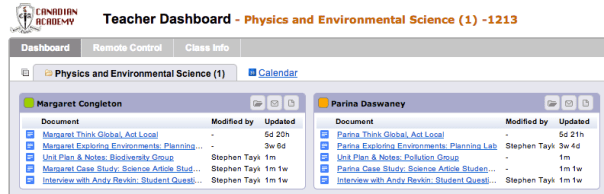
Hapara Dashboard: screenshot well after the project has finished, but you get the idea. Green = Bio, Orange = Chem. Click on the image for the post about the project, including some sample documents.
In summary, using this as a management tool allowed for a smooth and highly differentiated, student-led inquiry unit in MYP 5 Environmental Science. Find out more.




 i-Biology