Hybrid Hearts: Stem Cell Transplants 2.0
 “Can we use stem cells to make a new heart/eye/lung/liver etc?”
This is the predictable and perennial question that comes up from at least one student when we are looking at stem cells, genetic engineering, cell differentiation and transplanting. Until now, the answer has (perhaps in an oversimplified way) been ‘no’.
We can use stem cell transplants to treat lymphoma. Recently a young woman had a trachea transplant based on stem cell technology. Skin grafts from a patient’s own cultured cells are also possible, as are stem cell-based bladders. However, these are all rather simple technologies.
To treat lymphoma, bone marrow cells are replaced, and are all the same. The trachea transplant was a pre-existing trachea simply coated in the patient’s stem cells to prevent immune rejection. Skin transplants are basically sheets of epidermis that cover a wound, yet do not have the intricate functions of original skin: temperature regulation, secretion, senses. The bladder is a bag.
The challenge with using stem cells to transplant a more complex organ, such as a heart, is that it is not a simple sheet made of one type of cell. It is complex 3D structure, with a range of cells performing specific tasks within the organ. These cells have differentiated to perform their functions: cardiomyocytes (beating cells), vascular endothelial cells (smooth internal surfaces) and smooth muscle cells (blood vessel walls).
How can we get the stem cells to become the right type of cell, in the right position?
The answer to this question could be the key to opening up new doors in the search for viable transplantable organs in medicine, and bears much in common with the trachea case. It also marks a return to form for the NewScientist YouTube channel, who have this short clip of the new hearts in action:
A full article to accompany the footage is here.
In a nutshell:

Decellularised pig heart: the scaffold (NewScientist)
1. Find a suitable transplant organ, such as a pig’s heart.
2. Strip of all cells and DNA, using a detergent. Only the collagen ‘scaffold’ remains, as in the image of the decellularised heart to the right.
3. Coat the scaffold with the recipient’s stem cells.
4. Ensure that the blood supply is adequate and will provide the right signals for differentiation.
What is amazing in this case is how the cells ‘knew’ what specialised cells to become. The leader of the research group, Dr. Doris Taylor, puts it down to the mechanical stimulus of the pressure of the blood in the vessels and chambers and chemical signals from growth factors and peptides that remained on the stripped heart structure.
They even went as far as replacing a healthy rat’s heart with one of these new hybrid hearts. The rat survived for the trial, but she says they need to focus on producing more muscular hearts in order to ensure long-term survival of transplant recipients.
Food for thought:
Read the whole article and some of the links within it. Discuss these questions:
1. What are the potential uses for this kind of transplant technology?
2. What are the current limitations of this method and how might they be overcome?
3. What are the ethical issues related to using hybrid (pig-human) organs in medical transplants? How would you feel if you were the patient?
4. Who are the various stakeholders in this technology and what are their viewpoints?
Useful Sources:
Dr Doris Taylor’s research page from the University of Minnesota
NewScientist Article: Hybrid hearts could solve transplant problem
BioAlive stem cells links and resources
Can stem cells repair a damaged heart? from the NIH
Research reveals how stem cells build a heart, from Harvard news.
Periodic Table for Biologists
Shortlink to this page: http://is.gd/iBiologyPTable

Click on this link to go to the periodic table page and download the A0 poster: http://is.gd/iBiologyPTable
Biotech: The Musical (re-up)
Science + music + YouTube = awesome.
Here are some comedy highlights:
Bio-Rad are the leaders when it comes to making silly music videos to promote their products. The classic ‘PCR Song‘ is great for the Genetic Engineering and Biotechnology topic:
–
And you’ve got to love their follow up, GTCA So Fast – touting enzyme supermixes for the PCR process – this would fit in the DNA Replication section:
–
Mass Spec-tacular for the chemists (Reach that Peak):
More musical mayhem after the jump…
Defence Dynamics: Ministry of Defence Multimedia Science Resources

click for Science resources
There is also a section for students to access, with access to some of the multimedia resources in the teachers’ area.
End of Year Exams: Online Revision Tools

Quia.com: go to the shared area for free quizzes and games
It’s that time of year again: Middle and High School semester exams. Make sure you know what is going to be covered in your exams and study effectively. Here are some links to help make your study more fun.They are for free and online services only. Don’t forget all of the resources we have on the school network.
–
Quizzes and Vocabulary:
Quia.com/shared for lots of games for all subjects, including ‘Rags to Riches’ (Who Wants to be a Millionaire). The Grade 8 Chinese students had fun here.There are lots of vocab and flashcard activities for ESL/CAT students.
FlashcardExchange is a huge resource of flashcards for students to study keywords and terms. Some sets are based on diagrams and images, such as in Science. You can test yourself, play memory games and keep track of your progress. Awesome. If that’s not enough, you can make your own sets.
Quizlet.com has more flashcards and an interesting game called scatter for each set. Free and online, so try it!
–
Mind Mapping online
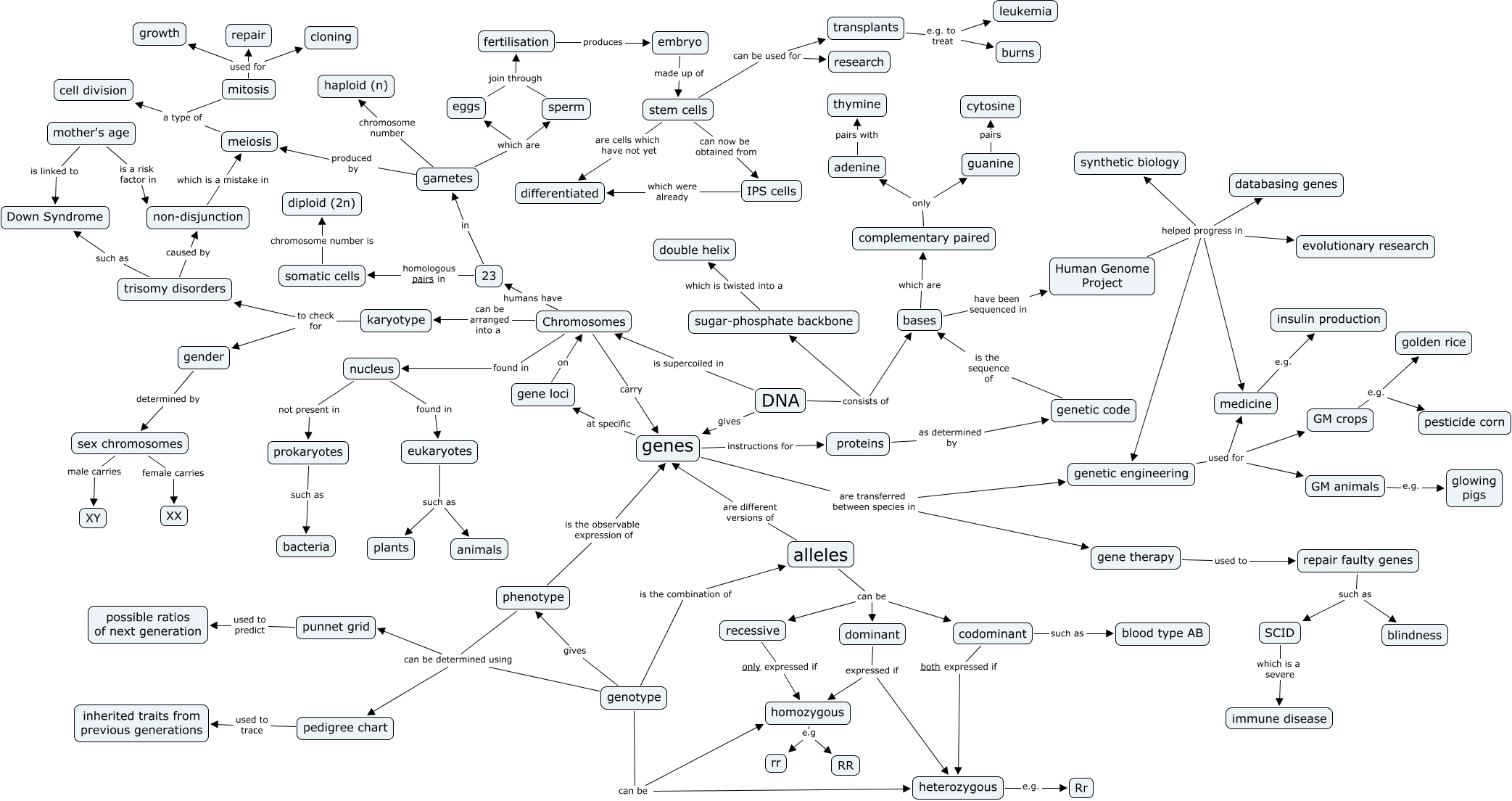
Genetics Concept Map - made in CMap tools
bubbl.us is my favourite (and easiest to use) online mind-mapper. Have a go (no sign-up needed)!
BBC Bitesize also have one which is online and free, but can be a bit frustrating.
Mindomo works well and can be used collaboratively. It looks good, but requires a sign-up.
The best for concept mapping (we describe each relationship on the connector) is CMap tools, which is free but needs to be downloaded and installed. It is excellent, though. This Genetics review was made using it. For the answers, click here.
–
OK, get to work!
Pandemic II: Educational Flash Game

Pandemic II: Spread the World
Thanks to the excellent NotExactlyRocketScience blog for posting the link to this game. Pandemic II is a complex flash game based on strategy, evolution (though more like design) and the spread of disease. The premise is simple – take a pathogen (bacteria, virus or parasite), and watch its spread across the globe. Along the way you can alter the pathogen to change its properties, making it more infectious, more lethal or less noticeable. The aim of the game is to wipe out the population of the world.
It is easy to save using Firefox add-ons.
Check out the game here: http://www.crazymonkeygames.com/Pandemic-2.html
And the tutorials here:
Is it better than the addictive Magic Pen Game or Foldit?
Have a go!
MOLO: The Molecular Logic Project
 The Molecular Logic Project aims “to improve the ability of all students to understand fundamental biological phenomena in terms of the interactions of atoms and molecules”. They achieve this with an extensive database of online java-based simluations and models for students to use. The animations are simple, and there are a lot of activities to choose from. To make it work, you’ll need to install their software.
–
Some highlights for IB Bio:
How do mutations affect protein folding?

How does gene mutation affect protein folding?
And loads more here: Biology, Molecular Biology (Chem of life), Physics/Chemistry.
Why is Science Important?
The most important question any science teacher should ask themself – because if we don’t have a good answer, what are we doing in the classroom? I heard about this after listening to the Guardian’s Science Weekly podcast. Alom Shaha, a science teacher and film-maker, went into the pod to promote and discuss his project: “Why is Science Important?”
The result of his efforts is a website full of great answers to the question, along with a 30-minute film.
Watch the full film here:
Why is Science Important? from Alom Shaha on Vimeo.
Or if your connection can’t hack it, it’s broken into chunks here:
–
So… Why is Science important?
Scientific American Frontiers
Thanks to bogstandardcomp from the TES Forums for this one.

Click Here
PBS have a series on their archives called Scientific American Frontiers. Although the last episode posted there was a couple of years ago, they have full episodes online and allow easy navigation within clips. There are also teaching resources and notes to go along with each one.
For some highlights have a look at:
– Make Up Your Mind (brain development and neuroscience)
– Hot Planet, Cold Comfort (climate change)
– Going Deep (ALVIN and deep-sea exploration)
– The Gene Hunters (Genetics and a few good resources)




 i-Biology