Category Archives: IBDP Biology
Biology4Good – Please pay it forwards!
Biology4Good!
So it’s D-Day for the Bi-ologists!
There has been a run of new site records here this week, with 6,941 views on 16 May, 11,709 on May 17 and 15,982 on May 18. That’s cool and thanks for the support of the site. Now before you go (and many of you never visit the site again once the exams are done), please take a minute to flick through the presentation below and think about making a donation to one of my chosen charities.
The resources here are free, though take many many hours of work. If you feel they have been worth your time, please think about donating the cost of a revision guide. All the money goes to the charities – I do not collect any.
Best of luck, and try to get some sleep between papers 2 and 3!
MrT
Joshua Foer: Feats of Memory [TED]: Just in time for exams!
 Serendipitously timed in the TED Twitter Stream, here is a talk by Joshua Foer* on feats of memory that anyone can do. In his research for this, science-writer Foer ‘accidentally’ won the US Memory Championship. If you really like his talk, he also has a book: “Moonwalking with Einstein: the Art and Science of Remembering Everything.”
IBDP Biology is quite the memory challenge in itself, so take a break from your review for 20 minutes and see what you can pick up!
“Our lives are the sum of our memories. How much are we willing to lose from our already short lives by losing ourselves in our Blackberries and iPhones, by not paying attention? […] You have to be the kind of person who remembers to remember”
Have a go at the memory palace technique here. Remember – the more outlandish the image, the better.
………o0O0o………
*He’s also the brother of Jonathan Safran Foer, author of Everything Is Illuminated, Extremely Loud and Incredibly Close and one of my favourites, Eating Animals.
Command Terms & Drawing Skills for IBDP Bio Exams
The 17th and 18th May are just around the corner! Here are some tips for your studies. Find more on this page: Exam Skills.
Do make sure you have a solid grasp of the command terms. Work through your syllabus, and realise that the objective three command terms (explain, etc), include those below.
You could also use the ‘draw’, ‘label’ or ‘annotate’ command terms as stimuli for organising your knowledge visually. If only there was an IB Bio version of Draw Something…
Somewhere, by Miadox. Beautiful timelapse of nature & industry.
Just in time for Earth Day, here’s a lovely Vimeo video by Miadox. Timelapse images of human impacts and influences, mingled with nature.
I saw this on Twitter from the QI Elves. They also posted this great clip of an eagle owl. Follow them!
Making ATP: Core content concept maps
 In tomorrow’s class we’ll be reviewing our Making ATP unit (enzymes, cell respiration, photosynthesis and the greenhouse effect) with a couple of concept mapping activities. The first, cell respiration core, is made using the really useful free concept mapping tool from IHMC CMap tools. This is a freeware package for most computing platforms – very easy to use and might be a help in your revision!
In the second activity, build your own concept map making as many annotated connections between concepts as you can. Surrounding this, add and annotate the relevant graphs and diagrams.
Biology Crash Course | Entertaining 12-min Bio brain dumps!
 CrashCourse Biology is a new(ish) and definitely more entertaining and engaging alternative to Khan Academy. Hank Green follows his brother John’s example (World History) and is producing some pretty funny, fast-paced and visual presentations for key concepts in Biology. One feature I like is the short ‘history of the idea‘ section in each video.
Here’s an example on the properties of water:
Another feature I like is that the video description has links to sections within the video, making review easier. He also includes a set of citations (more like links to follow to find out more). So although they can be embedded, you are much better off watching them on his channel.
Hank also has another channel, SciShow, which has short, sharp videos on science – whatever the topic. Here are a couple of examples from his playlist.
FoldIt (MrT’s favourite game):
And this on Mendeleev’s Periodic Table:
……….o0O0o……….
I first heard about these channels via Fractus Learning, but didn’t get a chance to look until this weekend, searching for periodic table resources and Lewis Dots. When Crash Course popped up again, I figured it was time to have a look.
Anthony Atala: Printing a human kidney [TED Talk]
With links to stem cells, genetic engineering and biotechnology, homeostasis and the kidney, the current science outlined in this TED Talk by Anthony Atala is amazing. It includes a demonstration of a real kidney being printed and a student who has an engineered bladder and now lives a normal life. Wow.
With huge numbers of people waiting for kidney transplants, is this the future of transplant medicine?
Thinking of kidneys, the Guardian has a link to an AP article: Mystery illness kills thousands in South America.
Scale of the Universe: Zoom right in, whizz right out (online app)
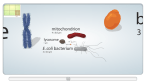
Learn.Genetics Size
This is what you get when you take the Learn.Genetics Cell Size visualiser and give it beans. Cary and Michael Huang at htwins.net have produced this great tool, which lets you zoom all the way into the smallest sizes and then out into the universe. You can click on each item to learn more.
It can be quite the time-suck as you whizz through inner and outer space.
Have a go!
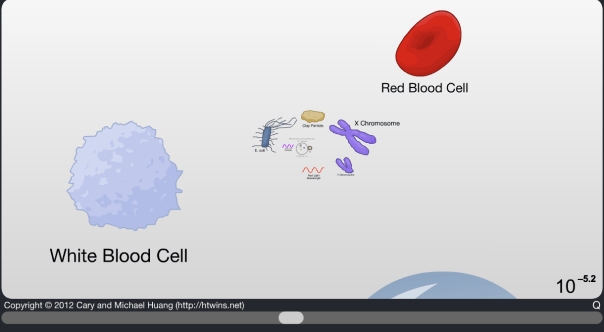
Scale of the Universe App by Cary and Michael Huang (Click to play!)
Are you still here? Well then Morgan Freeman can give you a tour in this Powers of Ten clip from Cosmic Voyage.
Thanks to @AdamRutherford for tweeting the link to this.




 i-Biology