Category Archives: IBDP Biology
Biology Crash Course | Entertaining 12-min Bio brain dumps!
 CrashCourse Biology is a new(ish) and definitely more entertaining and engaging alternative to Khan Academy. Hank Green follows his brother John’s example (World History) and is producing some pretty funny, fast-paced and visual presentations for key concepts in Biology. One feature I like is the short ‘history of the idea‘ section in each video.
Here’s an example on the properties of water:
Another feature I like is that the video description has links to sections within the video, making review easier. He also includes a set of citations (more like links to follow to find out more). So although they can be embedded, you are much better off watching them on his channel.
Hank also has another channel, SciShow, which has short, sharp videos on science – whatever the topic. Here are a couple of examples from his playlist.
FoldIt (MrT’s favourite game):
And this on Mendeleev’s Periodic Table:
……….o0O0o……….
I first heard about these channels via Fractus Learning, but didn’t get a chance to look until this weekend, searching for periodic table resources and Lewis Dots. When Crash Course popped up again, I figured it was time to have a look.
Anthony Atala: Printing a human kidney [TED Talk]
With links to stem cells, genetic engineering and biotechnology, homeostasis and the kidney, the current science outlined in this TED Talk by Anthony Atala is amazing. It includes a demonstration of a real kidney being printed and a student who has an engineered bladder and now lives a normal life. Wow.
With huge numbers of people waiting for kidney transplants, is this the future of transplant medicine?
Thinking of kidneys, the Guardian has a link to an AP article: Mystery illness kills thousands in South America.
Scale of the Universe: Zoom right in, whizz right out (online app)
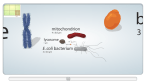
Learn.Genetics Size
This is what you get when you take the Learn.Genetics Cell Size visualiser and give it beans. Cary and Michael Huang at htwins.net have produced this great tool, which lets you zoom all the way into the smallest sizes and then out into the universe. You can click on each item to learn more.
It can be quite the time-suck as you whizz through inner and outer space.
Have a go!
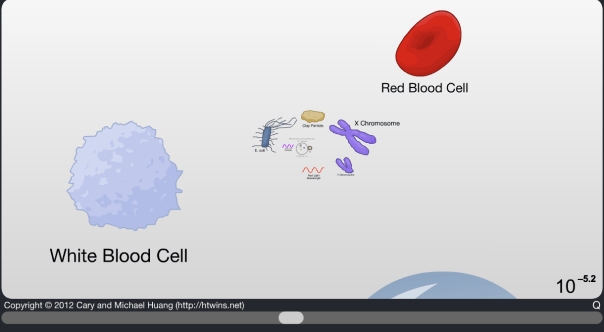
Scale of the Universe App by Cary and Michael Huang (Click to play!)
Are you still here? Well then Morgan Freeman can give you a tour in this Powers of Ten clip from Cosmic Voyage.
Thanks to @AdamRutherford for tweeting the link to this.
Teen Brain Videos and Resources
The teen brain is a funny place to live, with unique challenges and threats. There have been some excellent articles and resources produced recently on the subject – useful for students, teachers and parents.

Teen Brain from PBS
Carl Zimmer has a great piece on the teenage brain at Discover Magazine. Alison Gopnik has a similar piece at Wall Street Journal. Both explore the risk behaviour of teens. David Dobbs asks ‘Why do teens act the way they do?‘ at National Geographic. Richard Knox at NPR summarises ‘Teen brains are not fully connected yet,’ whereas John Cloud at Time reports on a PLOS One paper that suggests a link between more mature teen white matter and risky behaviour.
There are a lot of teen brain resources at PBS Frontline, including a full documentary. It is available (for now) on YouTube, but head over to their main site for more information and a ability to view the whole video by chapter.
 I don’t normally advertise on the site, but here I’ll make an exception.
Teen brains, with their unique needs, need to be looked after to optimise learning. By paying attention to current brain research, we as educators could get more from our students and help them learn. Derek Pugh, a former BIS colleague, now works with schools, students and parents on brain-based learning workshops. He has also written a series of articles and a book: The Owner’s Guide to the Teenage Brain.
Why not visit his website, (http://www.braincompatibleeducation.com/) to read more. There are articles and eBooks on sleep, classrooms, diet, water and more.
Drew Berry’s Animations of Unseeable Biology [TED Talk]
In 2011, Drew Berry’s animation of the role of breast stem cells won the Imagine Science Film Festival award for visual science (posted here). In this TED Talk, he explains how and why he and his team have put together these accurate representations of invisible cellular processes. The talk shows some examples of the animations, including a really great segment on mitosis and what is happening when spindle microtubules attach and contract.
For more excellent animations, visit the Walter and Elizabeth Hall Institute (WEHI) TV Channel: http://www.wehi.edu.au/education/wehitv/, or their YouTube channel.
The effective communication of Science is an Art.
Meet Your Brain: Royal Institution Christmas Lectures

Professor Bruce Hood explores the human brain in this series of lectures from the Royal Institution in London. The trailer is below and in time all the lectures should appear on the RI Channel Website here (Vimeo channel here).
If you can access BBC iPlayer, you can keep up with the lectures here.
The theme of the 2010 Lecture series by Mark Miodownik was “Size Matters”, again relevant to the IB Biology course and available to watch in full from the RI Channel website.
World’s Fastest Cell Race

World Cell Race 2011 - click to go to the website.
Here’s a bit of fun, with an underlying serious purpose (the video is sped-up over 24 hours):
Find out more about the World Cell Race at the Nature News Blog or the World Cell Race website.




 i-Biology