Summer Learning
Summer holidays are here!
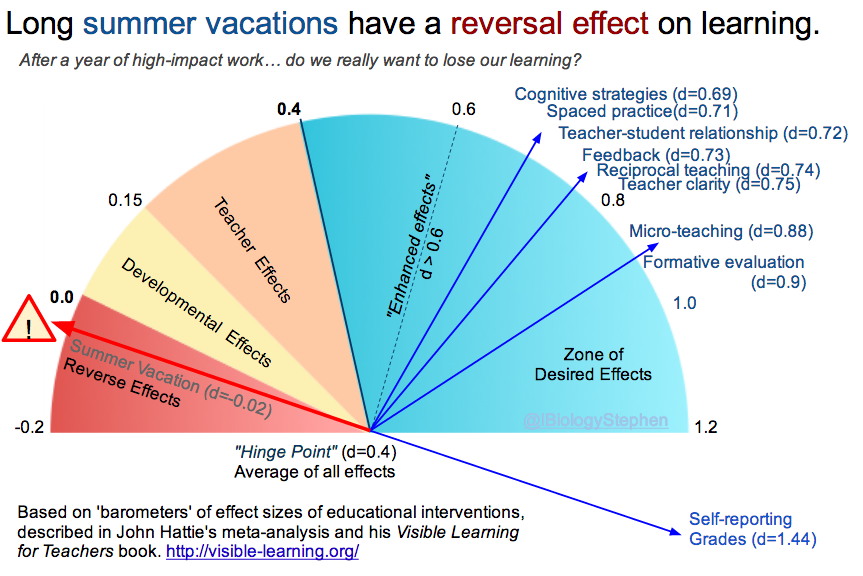
That means travel, rest, play, sun, sand, surf… and significant learning loss.
Here are some suggestions for a productive summer.
With eight weeks off, there’s a lot you can do to make next year more successful.
1. Unbroken rest.
Block out at least two full weeks with no school work. Let your mind wander, your health recover and your sleep be deep. Reset your balance, get active and maybe even try something new – and non-academic. You will feel better and be better able to focus on the challenges of next year. If you try to do a little work each day, it will always be in the back of your mind, causing stress.
2. Focused Extended Essay work
The Extended Essay is supposed to take around 40 hours of effort. That’s one full Monday-Friday working week. Set aside some time, with peace and the resources you need, to write the best draft you can. If your EE is causing you stress, get it done sooner in the break – you will be better able to enjoy the rest of your vacation.
3. Review this year’s learning
Once you have rested and recovered, set aside a full day or two to focus on Biology. Go through your notes, work on vocabulary, make connections across topics, practice questions from the book, re-read the chapters or presentations, watch (or re-watch) the CrashCourse videos, use the sortable syllabus to practice the assessment statements, practice drawing, labeling and annotating. There is a strong positive impact of spaced practice on learning, so taking the time to review will help make your foundation stronger for next year.
4. Read about science for fun
Science is far more than the list of assessment statements we study in class. It is a fast-moving pursuit of knowledge that connects ideas from around the world and across the disciplines. And there is a lot written about science every week. Dip into the science news, read longer articles or pick up a science book. You’ll enjoy it and it will help you make more connections.
As you read science, think about the following questions:
- How does this connect to what I already know?
- What vocabulary is important in this text? How much is known or unknown to me?
- What are the implications of this information for science or the wider world?
- What Theory of Knowledge questions does this connect to? What questions does it raise?
Some suggestions for summer reading:
- National Geographic’s Phenomena salon, with blogs by Ed Yong, Virginia Hughes, Carl Zimmer, Nadia Drake and Brian Switek. These are all excellent writers, bringing research to life in informative, current, mid-length articles. Ed Yong even posts a weekly ‘missing links’ collection of loads of collected articles, news items and funny bits from around the internet.
- Dip into the #IBBio stream on Twitter once in a while – teachers are posting links, resources and articles there all the time.
- TED’s Science stream has stacks of great talks that connect to our course.
- You can also hear lots of useful podcasts: The Guardian Science Weekly, Naked Scientists, Science Magazine Podcast, RadioLab and lots more listed at PopSci.com.
- For some great books you might want to check out Adam Rutherford’s Creation, Rebecca Skloot’s brilliant The Immortal Life of Henrietta Lacks, Ben Goldacre’s Bad Science and Bad Pharma, Richard Dawkins’s Selfish Gene, or The Oxford Book of Modern Science Writing for a great compendium of lots of writers.
Have a great summer.
And keep that brain Fresh…
PCR Song: Class Project & TED Ed Lesson
This song by BioRad is a funny discussion starter on the polymerase chain reaction (PCR) and biotechnology. For a full lesson plan, with editable slides for students and a complete TED Ed lesson (with quiz), visit the full page.
Click to go to the TED-Ed lesson on PCR.
Review Vocab Quizzes with Quizlet
In this task we ‘crowd-sourced’ definitions and descriptions for a lot of the (lot of) vocabulary we have learned this year. This is to reinforce that Biology is as much a language course as a science course, and that everything is connected.
- Create a google spreadsheet with tabs numbered by subtopics covered
- Assign groups of topics to groups of students, with the simple task:
- First column, keyword, correctly spelled
- Second column: definition (exactly from subject guide if it exists) or clear description
- After groups finish, peer-edit
- Does it make sense? Are there any errors?
- It the definition clear in the ‘wider sense’ of the course?
- Adapt definitions with clarifications, or starters such as ‘process’, ‘structure’, ‘hormone’ etc
In our spreadsheet, we identified 312 terms (and growing) from this year.
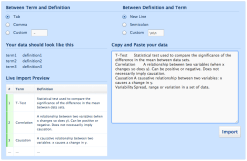
Click to start a Quizlet set
In between sessions:
- Check and edit as much as needed/possible
- Import vocab into quizlet to create the set
- Very easy: select columns and paste into the right-hand field
- Make sure ‘tab’ is set, top-left
- Hit ‘import’ if it looks right
- Create quizzes/activities
- Share quizlet codes and spreadsheet URL with students
- Get reviewing!
During classes:
- Students can review using the Quizlet activities
- Students might use the vocab list to make sure they are meeting markscheme requirements for target language – are they giving complete and correct answers?
- Students can use the vocab as a foundation for concept-maps, model responses etc.
Example (sadly Quizlet doesn’t embed to WordPress.com)
- MrT’s class, Year 1 vocab (student definitions)
……….o0O0o………
If you have any creative – and effective – review methods, let us know in the comments or on Twitter!
Better Living Through Chemistry: Student Science Writers
In this compressed semester of Grade 9 MYP Chemistry, I had students do one full-length One World piece, written for a wider online audience. We had done formative One World work earlier in the semester, and the process of this article took a good few weeks, with drafting on GoogleDocs.
Brief: write a 1,200-1,500 word article for an online audience on the prompt “Better living through Chemistry: Chemical solutions to Global Issues.”
Assessment: One World and Communication in Science
Process: Topics proposed and drafted through GoogleDocs, with students seeking feedback on writing through highlighting and comments in the GoogleDocs. In the final sessions they put the articles together in WordPress and gave peer-feedback for quality of presentation, flow and message. We aimed to use images found through CreativeCommons Search and through Getty’s free Images(though the embed widget went squiffy on some of their wordpress editors).
Teacher note: this kind of task is a great way to realise that we are all language teachers. Managing workflow through GoogleDocs/Hapara makes commenting on drafts easier, though students need to keep their work there in order to show progression. The worflow and product are similar to the Grade 10 Environmental Science task, though with more scaffolding along the way.
……….o0O0o……….
Some highlights (with a range of scores) are posted below. Please click-through, read them and leave some encouraging comments!
- Access to clean water (and the Lifesaver Bottle) proved popular topics, with some great pieces by Jocelle, Joanne, Lisa, Kayla,
- Arushi explores the use of iodine tablets in the treatment of dirty water, and Omar looks at a nano-tech teabag.
- Lily-Rose outlines how oral rehydration therapy saves lives (and money), and so does Taimu.
- Plastic trash was also a popular issue. Fred writes about biodegradable plastics here, and Ryo describes the plastic to oil machine, as does Ben.
- Juhaku finds out more about hyperthermia as a way to potentially improve the effectiveness of chemotherapy
- Shina looks at how cancer diagnosis uses radioisotopes
- Kaiki describes biofuels as an alternative to gas or oil.
- Takeharu writes about an intriguing use of nano-scale crystals – to coat and protect vaccines for transport
- Masaki outlines the potential uses of carbon nanotubes
- Sheila describes how NSAIDS are used as anti-inflammatory painkillers
- Jonathan describes how sodium nitrite is used in food preservatives.
Exploring Environments: Science Writers
Building on last year’s Exploring Environments units (G10 Environmental Science), in which students formed groups and designed their own units of inquiry, we have once again taken on the science-writing challenge.
Brief: write a 1,200-1,500 word article for an online audience highlighting a case study connected to your unit’s central ideas. The articles should be aimed at peers and smarter, and should include properly-used media and video where appropriate.
Assessment: One World and Communication in Science
Process: Topics proposed and drafted through GoogleDocs, with students seeking feedback on writing through highlighting and comments in the GoogleDocs. In the final sessions they put the articles together in WordPress and gave peer-feedback for quality of presentation, flow and message. We aimed to use images found through CreativeCommons Search and through Getty’s free Images (though the embed widget went squiffy on some of their wordpress editors).
Teacher note: this kind of task is a great way to realise that we are all language teachers. Managing workflow through GoogleDocs/Hapara makes commenting on drafts easier, though students need to keep their work there in order to show progression.
……….o0O0o……….
Some highlights (with a range of scores) are posted below. Please click-through, read them and leave some encouraging comments!
- Bottom-trawling: destroying centuries of growth, by Polina
- Nozomi asks “Should we eat bugs?“
- “The ocean is turning to blue vinegar,” according to Jay
- Saumil explores George Monbiot’s articles on “how wolves change rivers” and how rewilding might help us return nature to some semblance of its former glory.
- Nyeong-Min asks us to “protect our UV protector“
- Seung-Cheol tells a bee story, exploring colony collapse disorder
- Luke coughs his way through the Beijing air pollution and places our demand for cheap goods at the root
- Lucas gives an explainer of PM2.5 pollution and thinks about what we can do about it.
- Andy gets concerned about the effect of CO2 on our beach time
- Koh asks if fish farming is a viable alternative to overfishing
BioNinja: App & Website

Click to visit BioNinja
BioNinja is website and app for review in IB Biology that you might find useful. It has some summary notes, tutorials and songs and quizzes on the free app.
For other review resources for the IBBio exams:
- This site (i-Biology.net) has presentations, links and review sheets.
- Click4Biology.info has good summary notes, with depth
The Future of i-Biology
 This post is in response to a number of emails, comments and other messages I’ve received recently regarding plans to update the site.
A new IB Biology guide has been released for first teaching in summer 2014 and first examinations May 2016. It outlines significant changes to the course, especially in terms of internal assessment and examinations and the prescriptive nature of the content coverage has shifted to be more open-ended.
Much of the content-based work on here will remain useful, though will need to be reorganised (eventually). I will leave the IA support stuff up here for the coming year and will work over the coming academic year to update the site as far as possible. I will likely remove a lot of IA-related content, as we are to expect significant teacher support material on the OCC, and that is where teachers should be making their first stop for reliable documentation.
Personally, my load has shifted a lot in recent years. It has taken about seven years to build this site and all of its assets, and I am happy to continue to share them freely. However, most of my time is now taken up with being an MYP Coordinator and teaching MYP science classes, as well as being HOD for science and having larger groups of students with no lab support. My IB Biology class are currently in IB1, and I will keep them next year on the current guide. I also have family, MA studies and other commitments, so will not likely be able to revamp the presentations in the immediate future. Please give it time and use your judgment as to what is useful and valuable if you are starting teaching of the new guide this summer.
Update: October 15 2016
My load has shifted again, and I am now Director of Learning and MYP Coordinator, still at Canadian Academy, Kobe. With no teaching load and being stretched very thin for time, I am less likely than before to make any major updates to the site. I will keep paying for site hosting as long as it proves useful to teachers and students. I will start to prune some pages where possible.
……….o0O0o……….
Biology4Good Charity Project Update
 We have now passed
 3.4 5 million views on the site, with over £4 5,000 in charity donations made through Biology4Good. If you donate £20 or more, you can have access to a folder of all the editable resources I still have. These donations and the ability to support a selection of my favourite charities are significant motivators for continuing to update this site, so thank-you for the ongoing support.
……….o0O0o……….
Update: June 7 2014
It was sad to see John Burrell’s announcement that he plans to close Click4Biology, as he has given a great service to students and teachers through his online notes over the last decade. However, his reasoning is sound – the change in the subject guide to move away from such defined assessment statements makes producing these resources more challenging. At the same time, the text resources, such as Allott & Mindorrf’s Course Book, with it’s online edition, have really upped the quality of what is available to students from the publishers.
Looking at this year’s statistics on i-Biology.net, there was the usual big spike around the May exams (around 10,000 on peak day, compared to 2,000-4,000 on regular days), but it was far below the record of over 20,000 last year. From the discussions around #IBBio on twitter, it seems that much of the review traffic has swung towards BioNinja’s apps and notes that are set up for mobile learning and review. Again, this is a great service to students, and there is little point trying to replicate that.
I will think carefully over the coming year about how this site will continue, and it will likely be more streamlined in terms of course content but with more organised ideas for teaching and ed-tech.
If you have any suggestions, please leave them in the comments below, or find me on Twitter (@sjtylr).
The Great Barrier Reef: An Obituary
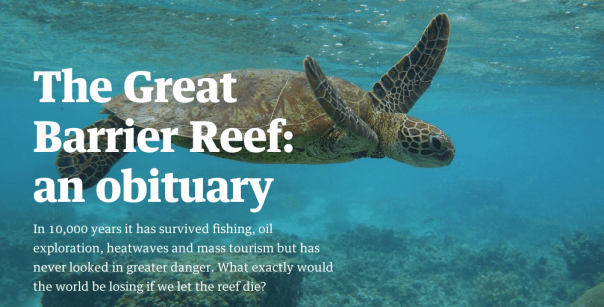
The Great Barrier Reef: An Obituary. This haunting multimedia Guardian piece could be a perfect provocation for a unit.
In the current age of environmental destruction it can be difficult to keep paying attention to the news. But some stories stand out as being real alarm bells, and this very sad piece on the iconic barrier reef highlights a lot of purely human-caused issues. To add to the misery, now the reef is under further threat from destructive dredging and dumping… to make way for shipping lanes for coal mining in Australia. #EpicFail.
MrT’s students: note the image above has a caption and links back to the original source, not to an image hosted on my WordPress. Make sure your writing does the same.




 i-Biology