Category Archives: MYP
One World: Coversheet, Submission Checklist and Research/ Writing Frame
This is for my MYP 4-5 classes in Chemistry, Physics and Environmental Science. The aim here is to encourage self-assessment at all stages of the research and writing process.
The front page is a standard submission coversheet, which is attached to work before it is submitted to Turnitin. Students need to self-assess their work by highlighting the statements which they feel best fit. The second page is a checklist to help them structure and present the essay or article, in 7 sections. The final two pages is something which could be given digitally or printed and blown up to A3 and used as a research/ writing frame.
The Missing Link to Renewable Energy? Donald Sadoway at TED2012
“We need to think big, we need to think cheap… Let’s invent to the price point of the electricity market. If you want to make something dirt cheap – make it out of dirt. Preferably dirt which is locally sourced!”
This is an entertaining and erudite TED Talk from MIT’s Materials Engineer Donald Sadoway which outlines our current problem of grid-level electricity storage, describes how batteries work and goes on to explain where we could go with molten metal batteries. He describes his passion as science and service to society, which is a great sentiment.
This is a good link to our units on Chemistry, Physics and Environmental Science and would make a fine starting point for a One World project. How can science positively impact the world?
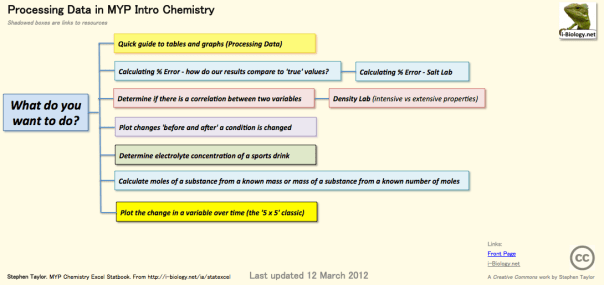
Excel StatBook for MYP Intro Chemistry [Resource]
Shortlink: bit.ly/2NMgLzN
This Excel workbook is built upon the IBDP Bio Excel Statbook I made in 2011. It is designed to make life easier as we work through labs in Grade 9 Intro Chem and to help you find your way around some Excel tricks.
It is saved in GoogleDrive – don’t open in it in GoogleDocs. Download and open in Excel.
I’ve been hearing interesting things about GeoGebra recently, so might have to give it a go when I get some free time.
So is the Earth full or is abundance our future? #TED2012
TED 2012 is underway and they have been posting some of the talks to their website. Here is a pair of talks which showcase different views of where we are in the world right now – each of them linking to our units on Environmental Science. You can also follow them on the Guardian’s liveblog.
In the first, Paul Gilding states that “The Earth is full,” but that it takes times of real crisis for us to create solutions and climb out of the hole we have dug for ourselves.
In this one, Peter Diamandis argues that we are living in a time of abundance and that human ingenuity will get us out of our problems.
……….o0O0o……….
EDIT – 4th March
These talks which have also been published are relevant to the issues we are studying in class. Have fun watching them!
Daniel Pauly: The ocean’s shifting baseline
Paul Snelgrove: A census of the ocean
UNICEF Photos of the Year 2011
Each year, UNICEF and GEO Magazine host a photography competition which aims to highlight the living conditions of children around the world. As teachers and students in the privileged setting of international schools and the IB World, we can be isolated from the realities of the lives of those around us. In many cases our schools and communities are oases of luxury, with poverty outside the school gates.
This photo, “Waste Export to Africa” by Kai Löffelbein, was this year’s winner. It links closely to my last post about the story of electronics. Do we ever really think about the final destination of our high-impact goods? In many places children are forced to work on piles of smashed-up and dangerous electronic goods, trying to recover precious metals and components.

"Waste Export to Africa" by Kai Löffelbein. Hosted at the Guardian (click for gallery)
For more photos of children’s situations around the world, visit the UNICEF Photo Essays page. They might inspire you to take your own photos or kick start some action in your own school. They also have a photo of the week page.
Hunting for the Higgs
Do you know what’s going on at the Large Hadron Collider right now? Let’s have a look in their canteen…
Or perhaps we’d better check out the news…
Find out more about the search for the Higgs boson (and what it all means) on this week’s Guardian Science Podcast.
Here’s an explanation of the Higgs field:
And this is where the Higgs field and the boson fit into the Standard Model:
Atoms & Bonding Resources
Resources for our G9 unit on our short unit on Atoms & Bonding are posted on the main page here. MrT’s class, our work is all on the GoogleSite. This will run right into our next unit on Reactions & Formulas.
Here is a BBC Documentary on Atoms, with Jim Al-Khalili:




 i-Biology