Category Archives: MYP
Three World-Changing Biology Experiments
A quick overview of three experiments that helped advance Biology:
- Pasteur’s swan-neck flask, disproving spontaneous generation
- Hershey-Chase blender experiment
- Miller-Urey experiment
One Direction Do Physics
A bit of fun for my Grade 10 group to work through as we’re on PD days…
There’s a Quia Quiz here, if you want to have a go too.
15 year-old develops effective, cheap test for pancreatic cancer [TED Audition]
Wow. Here’s Jack Andraka’s TED Audition for a talk on his work developing a carbon nanotube and antibody-based test for pancreatic cancer.
Jack won the 2012 Gordon E. Moore Award ($75,000) at the Intel International* Science and Engineering Fair for the same work:
Read more about him, his work and the work he built it on here on Forbes.com.
*Yup – you can have a go too.
IB Science Weekly Magazine – Get involved!
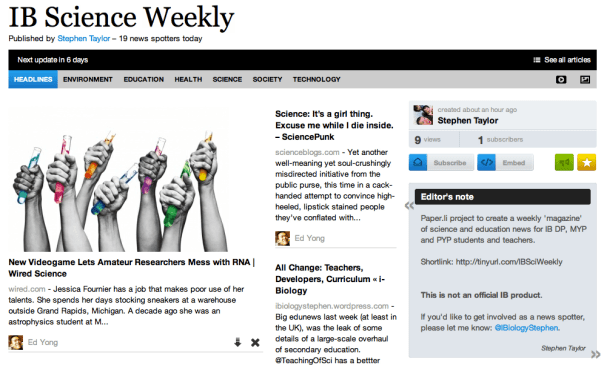
IB Science Weekly Magazine – do you want to be a news spotter?
I kept seeing these paper.li posts in Twitter, so after a quick exhange with Adrienne Amichetti (@amichetti) decided to give it a go. There are lots of paper.lis out there, especially it seems in the ed-tech world. It was quick and easy to set up, though a bit of a fiddle to work out how posts were categorised and filtered (still not sure how it works).
The aim of this project is to provide a weekly publication which pulls in the current science and education news, for use in MYP, DP and PYP classrooms.
If you would like to get involved and be an IB Science or Science Education news spotter, please head on over to Twitter and let me know. If you see some worthy news, simply tweet it with a link and a description, along with the hashtag #IBSciWeekly. The paper.li elves will see it and it should appear in the finished product. I will be able to curate the posts as they are published each week. If you think that everything you (or someone you recommend) is gold, I can include their Twitter handle or blog url as a source.
The details:
- Address: http://tinyurl.com/IBSciWeekly
- Hashtags: #IBSciWeekly, #MYP, #IBDP, #IBBio, #IBChem, #IBPhysics
- Published: Weekly, on a Tuesday (I think)
- NewsSpotters: IB Teachers and Students
Of course, things are bound to go wrong at first! I would love to find a way to share the editing jobs.
And here is a lovely video of a murmuration of starlings:
QR Code Orienteering: Describing Displacement

Mr Robbo, PE Geek
I’ve been wanting to find an excuse to do this for ages, since reading about the idea on Jarrod Robinson’s PE Geek blog.
Today in one of our last classes, some students in my Intro Physics & Environmental Science class have been using a GoogleMap view of the area around our school to plan an orienteering course. The aim is to use this as one of the very first lessons with next year’s class as an introduction to scalars and vectors, as well as methods of describing displacement. By scanning a QR code at each location, runners will be given a description in the form of components or direction and magnitude, which they then locate on their map and run to.
 When they return to school, the plan is to use their map to calculate distance vs displacement between points, as well as add some directed line segments for vectors.
I’ve made up some orange and white flags, which will be laminated. The QR codes will be taped on, giving flexibility to make up new courses around the school and to extend the activity by allowing students to design courses.
…………o0O0o…………
Free apps used:
- i-Nigma QR code reader
- quikQR.com free QR code maker
- GoogleEarth (I set up the grid and printed it)
Here are the planning sheets/ maps:
Learning Science by Doing Science | Frank Noschese at TEDxNYED
This is the way we’ve been going in Physics class, and here is why:
Atmosphere & Pollution Resources
These are for the Grade 10 Environmental Science students. More are on the topic page, here.
 Habitable Planet chapters
Mole & Stoichiometry Presentation
For my Grade 9 Intro Chemistry class, as we end the year. Despite the word ‘stoichiometry’ being a bit scary for some students, it can be a fun unit – a lot of logic problems! It leads to lots of questioning, whiteboarding and problem-solving. the final lab, “Investigating a factor which affects the yield of a reaction*” allows for quite a diversity of approaches and a lot of differentiation in the data processing.
As one student said, “I have to think too much in Chem class!”
Thanks to Barbara Lucas for all the support this year.
*chosen from a shortlist
One World: Formative Assessment Video Discussion Task
In this one or two-lesson task, students watch one of the videos below as an introduction to science as a solution to a problem in a global context. They then work together to produce a mind-map poster of the issue and its solution, covering the main ideas of the One World criterion.
Here are the videos:
United Nations University Our World 2.0: Plastic to Oil Fantastic
TED Talk: Michael Pritchard’s Lifesaver Bottle




 i-Biology