Category Archives: Free Resources
Stephen Fry and the Great American Oil Spill
“This turtle gonna go to rehab, to make its flippers go, go, go…*”
In a recent BBC documentary, Stephen Fry and Mark Carwardine head to the USA to see the damage and recovery from the Deepwater Horizon oilspill:
“Stephen Fry loves Louisiana. Four months after the BP oil spill, dubbed the worst ecological disaster in the history of America, Fry returns to the Deep South together with zoologist Mark Carwardine, to see what the impact has been on the people, the vast wetlands and the species that live there. What they find both surprises and divides the travelling duo.”
From the BBC Website (you might get it in your area)
Two more BBC YouTube clips: Has the oil really gone? and Damage to the deep-sea ecosystem.

BBC Special Report: Oil Spill
The BBC has a good set of resources on the BP Oil Spill, as do the Geographical Association and PBS News Hour Extra. More resources can be found at NewsroomAmerica and Associated Content.
The Deepwater Horizon spill would make a great foundation for an interdisciplinary science unit or Group 4 project, looking at ocean chemistry, waves and dispersal, remote sensing technologies, geological resources, ecology, marine biology and food chains, economics, politics, ethics and much more.
*Amy Winehouse, if you didn’t get it.
Creative Commons & Reasonable Use
Find out more about about Creative Commons in education… Read the rest of this entry
DrosophiLab – Genetics Simulator


- Drosophila buscki
DrosophiLab is a brilliant, free and downloadable piece of software that allows students and teachers to edit fruit flies and carry out crosses. The teacher can use the chromosome editor to set up parent flies of any genotype and there are 20 genes and traits represented, on four chromosomes. This allows for simple monohybrid crosses, sex-linkage, gene linkage and many other combinations – so the problems you set can be differentiated by level. There is also a password-protected teacher setting, to restrict students’ access to results tables and chromosome maps (so they have to work it out for themselves!).
Here are our class resources:
 Protocol sheets: DrosophiLab HL, DrosophiLab SL (pdf)
Fly files in this folder: http://www.box.net/shared/dy326rb01d
Chi-Calc (Chi-squared calculator, .xlsx)
–
How to catch and observe Drosophila:
Catch Your Own Drosophila, from Access Excellence (lots of resources there)
And this is how you tell the sexes apart:
When trying to observe the flies for real, think about the following questions:
– How are you ensuring ethical treatment of the animals?
– How long would it take to determine the phenotypes of the number of flies you have set for your investigations?
– What difficulties do you encounter when observing the flies?
– What are the limitations or sources of error that might affect the reliability of your results?
–
Why are fruit flies so important in science?
Science loves fruit flies, and there was even a fruit fly Nobel awarded in 1995 for studies in embryonic development. This links neatly to the assessment statements regarding the differentiation of cells through expression of different genes.

- Fly!
Fruit fly cells are relatively easily observed, and Drosophila makes for an ideal model organism for Mendelian genetics as it has a short life cycle, reproduces quickly and is easily phenotyped.
There is a biography of fruit flies called Fly: An Experimental Life, by Martin Brookes, and you can find out more about the Drosophila genome at http://www.fruitfly.org/.
–
Image sources:
Drosophila buscki from Journal of Endocrinology
Fruit fly graphic and DrosophiLab banner from DrosophiLab
The 11th Hour re-up: Human Impacts on Ecosystems
In 2007, Leonardo DiCaprio released his environmental call-to-arms, The 11th Hour. And it’s very good. It really knocks home the old proverb that we are not inheriting the Earth from our ancestors, but borrowing it from our children.
Update 2009: the whole film is available on GoogleVideo (as all good documentaries should be):
The movie contains contributions from the likes of Stephen Hawking, Nobel-winner Wangari Maathai and David Suzuki. Particularly useful is Gloria Flora‘s sentiment that we all vote, every day – even those who are too young to cast a ballot – by making informed choices about what we consume, spend our money on and throw away.

Watch It!
The first half of the movie is a talking-heads and imagery look at our impacts on the Earth, with plenty of soundbites and starting-points for further discussion. The political middle section describes how economic growth and interests are driving destruction. The final act is a great collection of ideas and hope – a call to arms and a realisation that the environmental movement is growing quickly and strongly. But is it going to be in time to save our species and the thousands that we drive to extinction each year?
–
–
Now here’s Leo’s video message (including the ‘vote’ quote from Gloria Flora):
For some further reading, go to the 11th hour Action website.
–
IB Biology students:
Here is a quick question sheet for the movie, linking some of the topics to the Ecology and Conservation option.
Higher Level students: pay attention to the parts about the role of trees in the environment, in particular through water-uptake. Also, do you understand how mycofiltration (using fungal mycelia) could be used to clean polluted soils?
–
For good measure, here’s Linkin Park’s accompanying music video, What I’ve Done :
Periodic Table for Biologists
Shortlink to this page: http://is.gd/iBiologyPTable

Click on this link to go to the periodic table page and download the A0 poster: http://is.gd/iBiologyPTable
Defence Dynamics: Ministry of Defence Multimedia Science Resources

click for Science resources
There is also a section for students to access, with access to some of the multimedia resources in the teachers’ area.
End of Year Exams: Online Revision Tools

Quia.com: go to the shared area for free quizzes and games
It’s that time of year again: Middle and High School semester exams. Make sure you know what is going to be covered in your exams and study effectively. Here are some links to help make your study more fun.They are for free and online services only. Don’t forget all of the resources we have on the school network.
–
Quizzes and Vocabulary:
Quia.com/shared for lots of games for all subjects, including ‘Rags to Riches’ (Who Wants to be a Millionaire). The Grade 8 Chinese students had fun here.There are lots of vocab and flashcard activities for ESL/CAT students.
FlashcardExchange is a huge resource of flashcards for students to study keywords and terms. Some sets are based on diagrams and images, such as in Science. You can test yourself, play memory games and keep track of your progress. Awesome. If that’s not enough, you can make your own sets.
Quizlet.com has more flashcards and an interesting game called scatter for each set. Free and online, so try it!
–
Mind Mapping online
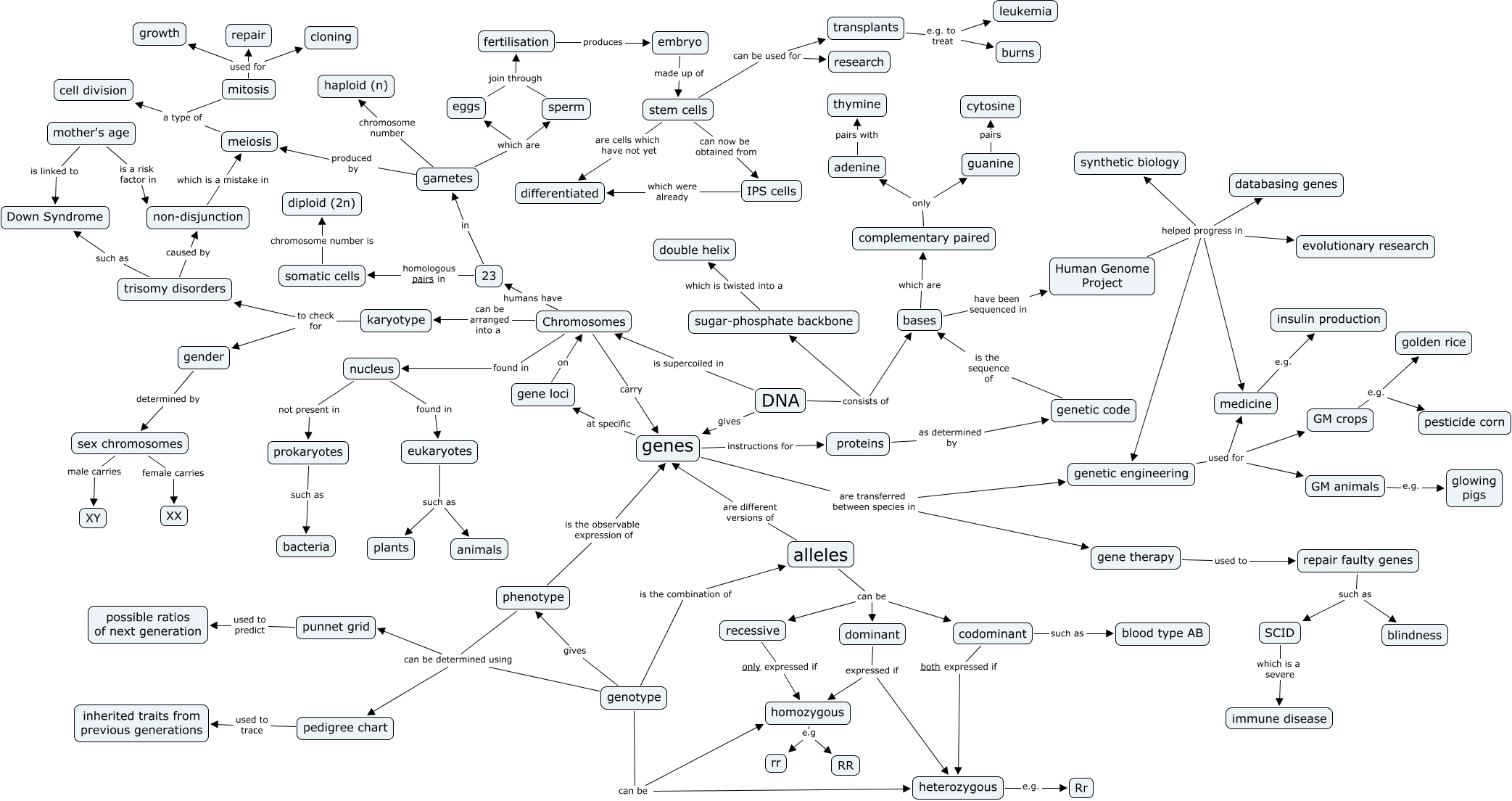
Genetics Concept Map - made in CMap tools
bubbl.us is my favourite (and easiest to use) online mind-mapper. Have a go (no sign-up needed)!
BBC Bitesize also have one which is online and free, but can be a bit frustrating.
Mindomo works well and can be used collaboratively. It looks good, but requires a sign-up.
The best for concept mapping (we describe each relationship on the connector) is CMap tools, which is free but needs to be downloaded and installed. It is excellent, though. This Genetics review was made using it. For the answers, click here.
–
OK, get to work!
Pandemic II: Educational Flash Game

Pandemic II: Spread the World
Thanks to the excellent NotExactlyRocketScience blog for posting the link to this game. Pandemic II is a complex flash game based on strategy, evolution (though more like design) and the spread of disease. The premise is simple – take a pathogen (bacteria, virus or parasite), and watch its spread across the globe. Along the way you can alter the pathogen to change its properties, making it more infectious, more lethal or less noticeable. The aim of the game is to wipe out the population of the world.
It is easy to save using Firefox add-ons.
Check out the game here: http://www.crazymonkeygames.com/Pandemic-2.html
And the tutorials here:
Is it better than the addictive Magic Pen Game or Foldit?
Have a go!
MOLO: The Molecular Logic Project
 The Molecular Logic Project aims “to improve the ability of all students to understand fundamental biological phenomena in terms of the interactions of atoms and molecules”. They achieve this with an extensive database of online java-based simluations and models for students to use. The animations are simple, and there are a lot of activities to choose from. To make it work, you’ll need to install their software.
–
Some highlights for IB Bio:
How do mutations affect protein folding?

How does gene mutation affect protein folding?
And loads more here: Biology, Molecular Biology (Chem of life), Physics/Chemistry.
Scientific American Frontiers
Thanks to bogstandardcomp from the TES Forums for this one.

Click Here
PBS have a series on their archives called Scientific American Frontiers. Although the last episode posted there was a couple of years ago, they have full episodes online and allow easy navigation within clips. There are also teaching resources and notes to go along with each one.
For some highlights have a look at:
– Make Up Your Mind (brain development and neuroscience)
– Hot Planet, Cold Comfort (climate change)
– Going Deep (ALVIN and deep-sea exploration)
– The Gene Hunters (Genetics and a few good resources)




 i-Biology