Category Archives: Channels & Publishers
JoVE – Journal of Visualised Experiments – Update
 Sounds like JoVE is moving up in the world and making real headway in validating the video format as a legitimate format for publishing experimental protocols and results. Since my first post about them, they have (according to a recent email) been in process with PubMed and may become their first peer-reviewed video journal. They have also added RSS feed, email subscription and bookmarks (Digg, del.ici.ous, stumbleupon) to readers’ capabilities.
Most importantly, though, is that these resources are visual and well-explained. Instead of just reading about complicated protocols, we can see what is being done and it may allow more to understand the steps involved and the reasons behind the research.
Here is a nice clip (12mins) about derivation of stem cells from embryos. Hopefully, they’ll let me embed it on the blog.
Pathways of Cancer
From DNAtube, this section of an animation outlines the chain reaction of events that lead to uncontrolled cell growth.
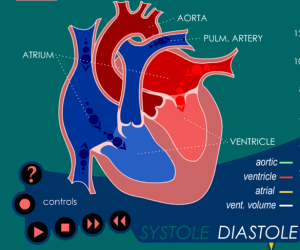
HyperHeart – da dumpf, da dumpf, da dumpf
 Thanks again to bogstandardcomp from the TES Boards.
This Shockwave app shows the full cycle of the heart beat and can be paused at any point. It includes ‘live’ ECG and blood pressure graphs and some tutorials (though I had difficulty getting them to work). Conveniently, it can also be saved using Firefox or Flashcatcher, to be used on the whiteboard.
Derryclare also posted a great link:
Skinner’s Rats – rats with wings.
Here are a couple of clips from YouTube about Skinner’s experiments on operant conditioning.
A shorter clip of the pigeon turning in a circle to gain food is after the jump.
Pavlov’s Dog – The Office style
One of Jim’s pranks on Dwight:
After the jump there’s a clip from an Eddie Izzard about Pavlov’s cats:
“You might as well face it – it’s resistant to base”
Very funny parody of Addicted to Love. Thanks to madcat for posting it to the TES Boards. It’s produced by scottkj on YouTube.
Full lyrics after the jump:
The New Scientists playing with food
Two experiments from the New Scientist book ‘How to Fossilise Your Hamster‘.
In the first, we find out how to extract iron from breakfast cereal (perhaps we could use it to make a hammer to deal with the presenter):
In the second, we see how to extract casein (as an example of a polymer) from milk, using just vinegar and a stove. They keep saying ‘plastic’ here, but I’m pretty sure it’s not a plastic. Plastics are polymers, but casein is a protein (though still a polymer). Correct me if I’m wrong. Either way, it might be a good trick to introduce the proteins topics in DP Bio.
John Kyrk – Cell Biology Animation
 This guy has spent a lot of time and effort on these animations, and they are brilliant.
]
Visit his main page at www.johnkyrk.com and you’ll find all you need for IB Bio HL Cells and Chemistry of Life.
Protein Synthesis: Transcription and Translation linklist
There are many decent Flash animations and the like on the internet, but the majority cannot be embedded. Below this YouTube video, there are some direct links to resources, some of which can be easily saved.
Learn.Genetics @ Utah
Transcribe and Translate (good, basic, interactive)
How do fireflies glow? (puts it in context)
University of Nebraska:
Protein Synthesis overview (Good enough for SL)
Transcription Details (fits DP Bio HL very well)
Translation Details (fits DP Bio HL very well)
John Kyrk: (visit the parent site at www.johnkyrk.com – excellent)
Transcription (fits DP Bio HL very well)
Translation (fits DP Bio HL very well)
St. Olaf College
Transcription (clear and simple)
Translation (clear and simple)
WH Freeman
RNA Splicing tutorial (HL only)
Bio3400
Translation with a genetic code dictionary (shows position in the ribosome)
Some more in-depth animations (newly added):
Translation from Wiley Interscience
Translation from LSU Medschool
Translation from The Chinese University in Hong Kong
Protein targeting from Rockefeller University




 i-Biology