Biology4Good Charity Focus | Mines Advisory Group
Hesty, Stephen & Cockermouth
 Mines Advisory Group (MAG) started in a caravan in my hometown of Cockermouth in the UK, and has blossomed over the last two decades into a major worldwide organisation dedicated to making war-torn areas safer by surveying and removing landmines and unexploded ordnance. They were co-recipients of the Nobel Peace Prize in 1997 for their work on the International Campaign to Ban Landmines and are well-deserving of all the funds we can raise.
Here is a 23-minute film, “Surviving the Peace“, which focuses on Laos and outlines how they work and the lasting impacts their work has on the lives of survivors of war. If you want to support them, please make a donation via my Biology4Good page for MAG, on JustGiving.
Updated for International Mines Awareness Day 2013 (4 April), here is a new video on “Surviving the Peace: Angola“:
From the MAG Website:
“After more than 27 years of civil war (1975-2002), Angola is one of the most landmine-affected countries in the world.
These deadly weapons don’t discriminate between soldiers and civilians, nor between adults and children.
They:
• cause death and injury to people carrying out their everyday activities;
• deny communities access to their farming land and water sources;
• cause food insecurity and poverty;
• deny movement, leaving communities socially and economically isolated;
• prevent refugees and internally displaced people returning home;
• hamper rehabilitation and post-conflict reconstruction;
• leave populations living in fear.
MAG is removing the threat of injury and death in Angola, and helping to alleviate economic devastation.”
Make a donation here.
Crash Course Ecology: 12 Videos with Hank Green
 I’ve featured Hank Green’s Crash Course Biology here a number of times and many of his videos have been embedded into the topic pages for the IB Biology course around this site. Prolific as he is, his ‘Crash Course Ecology’ series has just finished, so here are 12 episodes that pull together elements of the the Core and Option topics (as well as a lot more).
The full playlist is here: Crash Course Ecology. It’ll take about as long as Avatar to get through it all, and you’ll learn more about environmental change, impacts and solutions.
Episode 1: The History of Life on Earth
The rest of the episodes are linked after the jump.
Biology4Good Charity Focus | Medecins Sans Frontieres
 Thanks to Maryam from Medecins Sans Frontieres (Doctors Without Borders), for getting in touch with links to these two videos that explain the excellent work MSF do in responding to natural and human-caused disasters. Many of you using this site will be thinking about medicine or the health sciences as a career. As IB students you are global-minded, caring and principled young adults. Watch these, get inspired and maybe ten years from now we’ll see you on their videos.
If you want to support MSF, please visit my Biology4Good JustGiving page.
Biology4Good Charity Focus | Tree Aid

TreeAid
Yesterday I moved my Biology4good donations to a JustGiving.com team. Since then, some of the charities have got in contact to share resources to encourage donations. First up: Tree Aid. Thanks Tom for the emails and for uploading this video to show the work they do – it is truly amazing and I am happy to be supporting them.
Serendipitously, the video focuses on the nutrional benefits of planting moringa trees to benefit communities, which ties in closely with the final unit for my own class, Option A: Human Nutrition & Health.
If you like what you see, please visit my TreeAid page and make a small donation.
Thank-you!
Two Million Views on i-Biology.net!

.
This week saw i-Biology.net push past two million page views. It now gets around 4,000 views per day, which is a lot of teachers and students looking for resources. This week also saw the closure of Gifts4Good.co.uk*, who had been processing charitable donations for Biology4Good.
So this week is the perfect time to re-launch my appeal for donations to charity through Biology4Good on a bigger service, JustGiving.
……….o0O0o………

These IB Biology presentations, Essential Biology worksheets and other resources are available to you to use for free, but please consider making a donation to one of my chosen charities via Biology4Good (powered by JustGiving.com). Hopefully they have saved you time and stress as a teacher or grades as a student – please consider the huge effort this takes and let them make a difference to others, too.
JustGiving guarantees that 100% of the donation is passed on to the charity.
……….o0O0o………..
*This project started first on Gifts4Good, which has sadly closed. “Offline Donations” mentioned on the team page refer to donations that were processed in the old incarnation of Gifts4Good.
……….o0O0o………..
#IBBio & #MYPSci on Twitter
Twitter has become my favourite tool for getting and sharing resources for IB Biology (#IBBio) and MYP Science (#MYPSci). Follow the hashtags to get brainier by the day. Better still – tweet out your own links to the news and articles you find that connect to the courses. Others can benefit from your learning, and they might get featured in the #IBSciWeekly ‘magazine’.
What to do:
- Read, like a boss. If you come across really useful links, videos, articles or resources that connect to your #IBBio or #MYPSci class, tweet them out. Many services and sites have Twitter buttons.
- If the link is really long, use a link shortener like is.gd. Better still, customise the URL to make it descriptive.
- Post it: don’t forget the hashtag (#IBBio or #MYPSci) and keep it appropriate. Remember your audience.
Some examples after the jump.
Periodic Table for Biologists Poster
I forgot this existed…
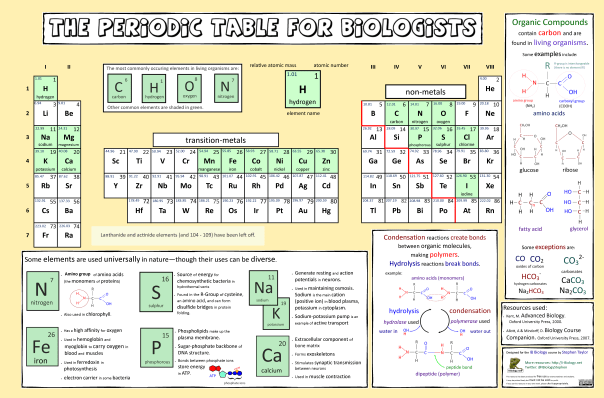
Periodic Table for Biologists poster.
This is designed to address some of the assessment statements for the Chemistry of Life unit, and to provide a clear wall-chart that is free to use and free from advertising. I recently updated it with relative atomic masses and a couple of corrections. Download the full A0 poster here: http://is.gd/iBiologyPTable.
On a related and interesting note, here’s a little video by Periodic Videos on the Japanese discovery of element 113:
Remaining Ethical in the Search for a Cure for HIV [TED Talk]
This is an interesting discussion starter and is only 11 minutes long. Boghuma Kabisen Titanji talks about the ethical dilemmas of HIV research in developing countries. What happens when the trial ends?
Some discussion ideas:
- Discuss the pros/ cons of testing pharmaceuticals in the developing world vs the ‘west’.
- Authorisation of trials
- Risk of litigation
- Willingness of populations to participate
- Potential sample size
- Ethics vs efficiency in data generation
- Cost-benefit ratio
- Outline what is meant by ‘informed consent’ in terms of clinical trials. Discuss the challenges of informed consent in trials in the developing world.
- Evaluate the suggestions Boghuma Kabisen Titanji makes about:
- Informed consent
- Standard of care provided to participants
- Ethical review of research
- Exit plan – what happens to participants once the trial has ended?
10 Amazing Illusions from Quirkology [Video]
Here is a collection of really simple illusions (including the Hermann Grid) from Richard Wiseman at Quirkology. A nice link to E2 Perception of Stimuli and TOK. Can we really trust our senses?
Rotavirus Vaccine: A Great Graph
Another great find from Twitter (follow everyone in this tweet):

Rotavirus Vaccine impact, from Forbes.com
Matthew Herper’s short article in Forbes includes this graph, which is a clear link to the efficacy of the rotavirus vaccine. You can access the full pdf from the New England Journal of Medicine here (also brief, with a better graph).
Some questions to think about, connecting this case to the curriculum (11.1 AHL: Defense Against Infectious Disease):
- How does the rotavirus infect its host?
- Why does diarrhea lead to death?
- What type of vaccine is this and how is it produced?
- What challenges are still to be overcome?
The rotavirus vaccine has been a big part of the Bill Gates Foundation’s work, and they have a short video on it here:




 i-Biology