Category Archives: Uncategorized
Reproduction
Final topic in the Core for SL students! Wednesday we’ll get started on the G4 project and soon begin Neurobiology and Behaviour, our final topic.
All the Core resources are here: 6.6 Reproduction
And the resources for HL students are here: 11.4 Reproduction
……….o0O0o……….
Think about the following questions to make connections across the curriculum:
1. Explain how sexual reproduction leads to infinite variation in a population.
2. Explain hormonal control of the menstrual cycle.
3. Explain the process of meiosis, suitable to your level of study.
……….o0O0o……….
Nobel Prize for Medicine 2010: Robert G. Edwards for IVF!
Welcome to 2011: International Year of Forests and Chemistry!
Happy New Year Scientists!
With the close of 2010, the UN’s International Year for Biodiversity and Rapprochement of Cultures, we welcome in 2011, International Year of Forests (UN) and Chemistry (UNESCO).
So was the International Year of Biodiversity a success?

Shark finning - still a problem in Indonesia. Click for a gallery of biodiversity wins and fails in 2010.
 The official UN page still has lots of resources for biodiversity, including videos and reports. There is a also a good resource of articles and information from the International Institute for Environment and Development. One of the key conservation events last year was COP-10 in Nagoya – the Conference of Parties to the UN Convention on Biological Diversity. There are some good articles on the build-up and outcomes of COP-10 available at Current.com, as well as a summary at Wikipedia. The Guardian’s George Monbiot reviews the conference here, and they also have their own environmental review of 2010.
Eco-wins: new marine parks, recovering waterways, ecosystem pledges in Nagoya, and the hundreds of ground-level conservation and environmental efforts taking place across the globe. Also, 2010-2020 has been declared the decade for biodiversity!
Eco-fails: Deepwater Horizon, we’re still overfishing, forest clearance rampages on and what are we really doing about plastic pollution, water pollution, air pollution, factory farming, habitat destruction and uncontrolled urbanisation?
……….o0O0o……….

Celebrate the forests!
UN International Year of Forests
Celebrate the forests!
Although global deforestation appears to be slowing down, it is still continuing at an alarming rate, according to the UN’s 2010 report on global forest resources. So what can we do about it in the International Year of Forests?
Check out some of these educational resources:
- UN official IYF page
- Greenpeace resources on deforestation
- CIFOR resources
- Rainforest lesson plans, from Mongabay
- Conservation teaching resources from the Environmental Protection Agency
Here is CIFOR‘s (Centre for International Forestry Research) video for 2011:
……….o0O0o……….

Clicky-clicky!
UNESCO International Year of Chemistry
The International Year of Chemistry 2011 aims to celebrate the achievements of Chemistry and its contrbutions to the well-being of mankind. Head on over to chemistry2011.org, the official page, for a growing wealth of resources and ideas.
Choice Chemistry resources:
- Chemistry2011 resource bank
- Chemistry support for teachers, from the RSC
- Chemistry teaching resources, from California State University, Northridge
- Green Chemistry Resources, from the American Chemical Society
- IBChem.com, for IB Chemistry resources and notes
- MYPChem.com, for IBMYP Chemistry resources and notes
- Nikki Juhl’s MYP Science
……….o0O0o……….
 And finally…
Don’t forget that from August 2010 to August 2011 is also the International Year for Youth. Phew – so much to think about and take action on in 2011!
……….o0O0o……….
Have a great and productive 2011, and remember that everything we do in class can be applied to life beyond school and to the global issues we face – and you will have to deal with.
I’ll be trying to postaweek2011 through the year. Why don’t you have a go too?
Jupiter! Amazing amateur astrophotography.
This is a lovely clip of Jupiter – taken from Earth, by an amateur astronomer. Amazing!
To find out how Damian Peach captured the images, read this article from Bad Astronomy. You can also see his “Views of the Solar System” astrophotography collection.

Learn.Genetics needs you…

Learn.Genetics - check it out!
I’ve posted lots of links to Learn.Genetics in the past, and even nominated it, against this site, for an Edublogs Award this year. Now it looks like it needs a bit of help to retain its funding. If you’re a teacher or student who uses the resources there (they are brilliant), then send a quick message of support. The rest of this post is a re-post of an email they sent out.
“We’re writing to urge you to let the NIH know how important the educational materials and resources we provide on Learn.Genetics and Teach.Genetics are to you and your students.–YOUR MESSAGE MUST BE RECEIVED BY MONDAY, DECEMBER 20.–
You can enter a message here: http://feedback.nih.gov/index.php/ncats/ncats-comments/#commentformThe US National Institutes of Health (NIH), which provides major funding for the Genetic Science Learning Center’s Learn.Genetics and Teach.Genetics websites, is discussing a potential reorganization. This could affect the Science Education Partnership Award (SEPA) program that has supported development of many of the materials on our sites, as well as our teacher professional development programs.–We’re asking your help in letting the NIH know immediately how important their funding of the SEPA program (including our programs) is to you, your students, and the public.”–
SMOKE – The Convenient Truth
Here’s the winner of the SlideShare World’s Best Presentation 2010 competition:
Here’s another one I like:
Bean there, done that…
Plant Science is one of my favourite topics for HL students as it is a real opportunity to link many of the core ideas of Biology together. Think of it not just as a series of out-of-context assessment statements to check off, but as a chance to revise everything you have learned so far.
Consider this diagram of germination. How many links across the syllabus can you make? Try pasting the image into the middle of a large sheet of paper and surrounding it with explanations of all the concepts that link to it. It could form the centrepiece of a Prezi or a concept map, or simply a large revision poster.

- Germination – how many links can you make across the curriculum?
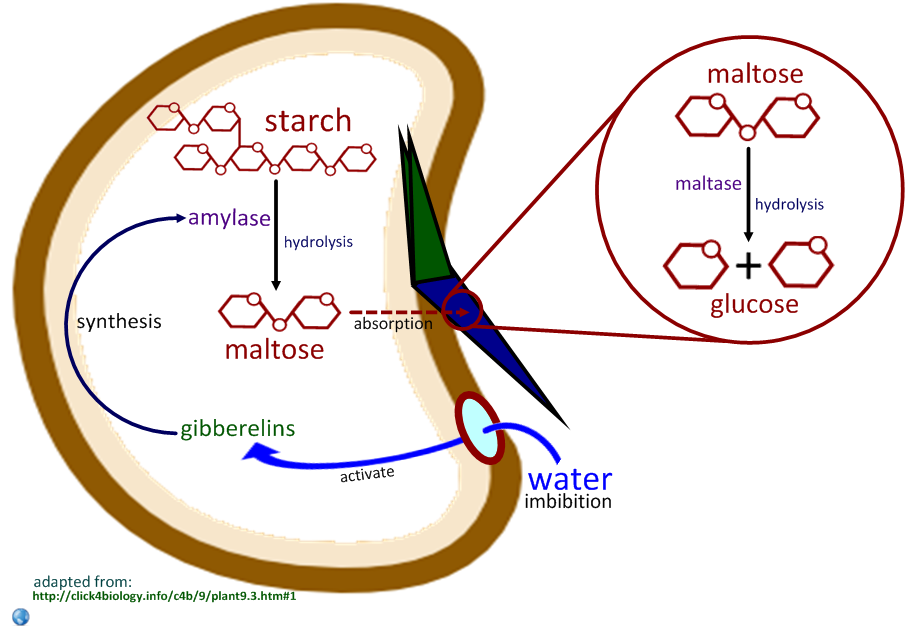
This image is adapted from a diagram at Click4Biology. For some of my suggestions of how this diagram alone represents over 20 links across the curriculum, click here: Bean there, done that…
HeroRATS: Detecting Landmines and TB
 In this TED Talk, Bart Weetjens explains how he and his team from Apopo are using operant conditioning to train African giant pouched rats (Cricetomys gambianus) to sniff out and signal land mines and TB infections:

HeroRAT in action. Go to Apopo
Visit the resources at Apopo’s pages to find out more about why these rats are chosen in favour of other species and how the training programme works. You could also adopt your own rat to support their work. There are more videos from Apopo on their website or on their YouTube channel.
IB Biology Links:
- E3 Innate and Learned Behaviour
- E2 Perception of Stimuli (why are the rats so good at it?)
Arsenic-Based Life! (On Earth) Feel the hype.

Arsenic-based lifeform, from XKCD webcomic. Click to go there.
The world has been all a-twitter with NASA’s news of a new life-form discovery. Putting ‘NASA‘ and ‘life-form‘ together in one sentence seems to have got a lot of people worked up that they have discovered life on other planets and that the invaders are coming, but really it’s all a bit closer to home and rather tamer.

GFAJ-1 bacteria - from NASA (link)
Closer to home, maybe, but still really interesting. These bacteria from Mono Lake in California are able (with a lot of lab-based prodding*) to use arsenic in place of phosphates to build the backbone of their DNA molecules. An interesting link to DNA structure there, and news-worthy in that this species has been able to substitute one fundamental element of living organisms for another, usually more toxic, molecule.
As always, for the best possible write-up of this primary research in the news, head on over to NotExactlyRocketScience. You can also read the original release from NASA.
IB Biology curriculum links:
- 3.3 DNA Structure (and AHL 7.1 here)
- 3.1 Chemical Elements and Water
- 2.2 Prokaryotes
- 2.1 Cell Theory (calculate the magnification)
Helpfully, TED has put together a playlist of related talks to put the discovery, and the search for ET, in perspective. Here’s one from Penelope Boston:
“Life on Mars? Let’s look in the caves.”
Live long and prosper.
*this clause is an edit to clarify.
Wylio: CC images for bloggers (and some synapse action)
 This came from FreeTech4Teachers, but is well worth sharing with everyone here – including students using blogs as a tool in class.

Wylio is a Creative Commons image search tool with a difference – it is designed for bloggers and does the hard work of formatting and citations for you! Skip on over to the search engine and see what I mean. The image of a neuron to the left was found and coded using Wylio. All I had to do was copy the html code and paste it into the html editor for this post. Easy peasy. When you click on the author’s name, it brings you to their page and if you click on ‘more info’, it brings you to the full-size image.
Now this is where you have to do the work…
Consider the diagram of the synapse below and answer these questions:
1. Explain the principle of synaptic transmission
2. Outline the use of four methods of membrane transport in nerves and synapses.
 ……….o0O0o……….
Finally, related to all that, “You are your connectome” (it’s on the network):
World AIDS Day 2010: Universal Access and Human Rights

World AIDS Campaign - click to visit their website
WorldAIDS day is recognised each year on the 1st December. Although in some parts of the world real progress is being made against the epidemic, it doesn’t mean that we can relax and forget about it.

AIDS Ribbons
There are some really interesting datasets on the WHO website related to this theme, including global trends to the present and the current state of HIV infections in the world.
Millenium Development Goal 6 is “Combat HIV and AIDS“. Over past years, World AIDS Campaign slogans have included Keep the Promise and this year they focus on this MDG with their theme of “Universal Access and Human Rights.”
Universal Access means access to prevention, education, treatment and care. The message is spreading, the technologies and medicines are developing and the will is there to change. Now we need to make sure that it gets to the people who really need it.
This reverse-timelapse video of a patient who has access to anti-retroviral medications shows the impact that access can have on a person’s life:

Graph from AVERT.org
Despite the great advances being made in treatment, however, prevention must be the number one focus for efforts and money spent on HIV/AIDS. Programmes such as intervention mapping and education with realistic, achievable and workable methods for each community has to be a real focus for the spending of money raised. Otherwise, infection rates will increase and there’s no way we can afford to treat more and more people each year.
In this enlightening TED Talk, Elisabeth Pisani pays Indonesia a visit and highlights that sometimes there are rational reasons behind the poor decisions that people make, leading eventually to HIV infection. If people are well enough educated to be aware of the risks of HIV and blood-borne infections, then are the systems in place that allow them to make the decisions that are most sensible for them?
So what you can you do about it?
1. Keep yourself safe. Never forget the simple messages of HIV prevention and take care in your activities. Stay healthy, use condoms (or don’t have sex), avoid drug use and insist on new, sterilised needles for tattoos and blood transfusions.
2. Stay aware. Revisit HIV/AIDS education resources and don’t let yourself think that just because some advances are being made, it is OK to forget about the risks.
3. Spread the message. Discuss the risks, find out about the prevalence and risk factors of HIV in your area. Wear a ribbon and use it to start conversations with others.
4. Use reliable, evidence-based health information in your decision-making and encourage others to do the same. Real medicine is based on the scientific method and is rigorous. ‘Alternatives’, quite simply, are not.
……….o0O0o……….
Other posts on this site about HIV/AIDS:
Great documentary following the lives of some HIV patients in the UK.
Defense Against Infectious Disease
Resources for 6.3 and 11.1 of the IB Biology course.
TOK-related resources based on denialist views against the – very well established – link between HIV and AIDS, fuelled by the ‘documentary’ House of Numbers. You really must read Ben Goldacre’s chapter on this topic from his Bad Science book (free link here).




 i-Biology