Force of Nature: The David Suzuki Movie
 I cannot wait to see this movie! David Suzuki is a life-long environmental hero, with a colourful history and a huge impact on environmental-mindedness. Wikipedia has a nice summary of his life so far.
From the website:
“David Suzuki, iconic Canadian scientist, educator, broadcaster and activist delivers a ‘last lecture’ — what he describes as “a distillation of my life and thoughts, my legacy, what I want to say before I die”.
The film interweaves the lecture with scenes from the places and events in Suzuki’s life — creating a biography of ideas — forged by the major social, scientific and cultural events of the past 70 years.”
If you’re a Suzuki fan, ‘like’ his facebook page, too!
Click4Biology Videos
John Burrell from Click4Biology has just started uploading some tutorial videos for Biology on his YouTube Channel. You might find them useful, so check them out!
Group 4 Project 2011: “Our Choice, Our Future”

EARCOS GIN Ning
Based on “High Noon: 20 Global Problems, 20 Years to Solve Them,” by Jean-Francois Rischard. This is the theme of the 2011 EARCOS Global Issues Network Conference, and we will be sending two teams to represent the school at JIS in April. For these teams, the G4 Project will serve as preparation for their student-led workshops at the conference.
For all of us, it will be an interesting trans-disciplinary experience in real-world problem-solving using Science.
Let’s get working!
……….o0O0o……….
The Group 4 Project is a central part of the Group 4 Experimental Sciences. It is a chance to come together as scientists and think about how science can address pressing current issues. Thinking from an interdisciplinary point of view, students research and investigate the latest science and its potential impacts on the world.
The aim of the Group 4 Project is “To encourage an understanding of the relationships between scientific disciplines and the overarching nature of the scientific method” (IB Biology Subject Guide, 2007)
To be successful in tackling current global problems and challenges, we must think from a truly trans-disciplinary point of view: within and beyond the sciences. We must consider the involvement of all stakeholders and make decisions based on reliable and authentic evidence. The role of the scientist is becoming increasingly important in policy decision making and communication to the public – and this is what we aim to model in our approach to the Group 4 Project.
……….o0O0o……….
It is also a great opportunity to develop international mindedness and the following aims of the experimental sciences:
Aim 7: “Develop and apply the students’ ICT skills in the study of science”
Aim 8: “Raise awareness of the moral, social, ethical, economical and environmental implications of using science and technology”
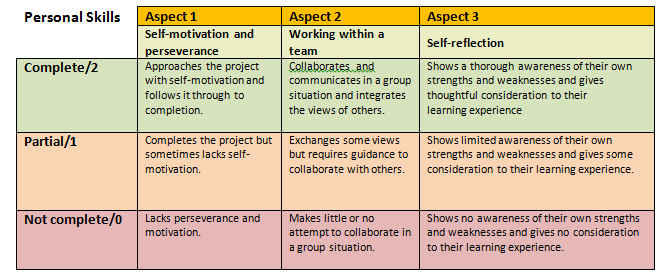
And, of course, it makes up 10 hours of your 4PSOW – which is essential for your Sciences course – and is the only opportunity to be assessed for the fourth internal assessment criterion, Personal Skills:
 ……….o0O0o……….
Guidance
-This project is designed to be evidence-based and to demonstrate the level of your research skills. You must be able to support all information presented with sources. Access to databases will really help you.
– Less is more when it comes to text. Graphics and datasets should form the basis of your presentation, with the factual exposition delivered in the oral presentation. Think about what kind of displays most engage you as the viewer.
– Collaboration is key. For this reason, you will all need to understand and be able to present all aspects of the project. Plan together, share ideas and set targets for your work over two days. In the action phase, come together as a group regularly to share your work with your group, evaluate your progress and set further targets.
– Read up on current science, economical and environmental news beforehand. Think about the theme, choose a good topic and run with it.
……….o0O0o……….
Past themes: (click here for resources)
Each year, we choose a theme which allows for authentic trans-disciplinary links across the sciences and, as far as possible, Economics.
“How can Science help re-build a stable and sustainable economy?”
“How can Science aid progress towards the UN’s Millenium Development Goals?”
“How can Science help combat environmental damage?”
Reproduction
Final topic in the Core for SL students! Wednesday we’ll get started on the G4 project and soon begin Neurobiology and Behaviour, our final topic.
All the Core resources are here: 6.6 Reproduction
And the resources for HL students are here: 11.4 Reproduction
……….o0O0o……….
Think about the following questions to make connections across the curriculum:
1. Explain how sexual reproduction leads to infinite variation in a population.
2. Explain hormonal control of the menstrual cycle.
3. Explain the process of meiosis, suitable to your level of study.
……….o0O0o……….
Nobel Prize for Medicine 2010: Robert G. Edwards for IVF!
Welcome to 2011: International Year of Forests and Chemistry!
Happy New Year Scientists!
With the close of 2010, the UN’s International Year for Biodiversity and Rapprochement of Cultures, we welcome in 2011, International Year of Forests (UN) and Chemistry (UNESCO).
So was the International Year of Biodiversity a success?

Shark finning - still a problem in Indonesia. Click for a gallery of biodiversity wins and fails in 2010.
 The official UN page still has lots of resources for biodiversity, including videos and reports. There is a also a good resource of articles and information from the International Institute for Environment and Development. One of the key conservation events last year was COP-10 in Nagoya – the Conference of Parties to the UN Convention on Biological Diversity. There are some good articles on the build-up and outcomes of COP-10 available at Current.com, as well as a summary at Wikipedia. The Guardian’s George Monbiot reviews the conference here, and they also have their own environmental review of 2010.
Eco-wins: new marine parks, recovering waterways, ecosystem pledges in Nagoya, and the hundreds of ground-level conservation and environmental efforts taking place across the globe. Also, 2010-2020 has been declared the decade for biodiversity!
Eco-fails: Deepwater Horizon, we’re still overfishing, forest clearance rampages on and what are we really doing about plastic pollution, water pollution, air pollution, factory farming, habitat destruction and uncontrolled urbanisation?
……….o0O0o……….

Celebrate the forests!
UN International Year of Forests
Celebrate the forests!
Although global deforestation appears to be slowing down, it is still continuing at an alarming rate, according to the UN’s 2010 report on global forest resources. So what can we do about it in the International Year of Forests?
Check out some of these educational resources:
- UN official IYF page
- Greenpeace resources on deforestation
- CIFOR resources
- Rainforest lesson plans, from Mongabay
- Conservation teaching resources from the Environmental Protection Agency
Here is CIFOR‘s (Centre for International Forestry Research) video for 2011:
……….o0O0o……….

Clicky-clicky!
UNESCO International Year of Chemistry
The International Year of Chemistry 2011 aims to celebrate the achievements of Chemistry and its contrbutions to the well-being of mankind. Head on over to chemistry2011.org, the official page, for a growing wealth of resources and ideas.
Choice Chemistry resources:
- Chemistry2011 resource bank
- Chemistry support for teachers, from the RSC
- Chemistry teaching resources, from California State University, Northridge
- Green Chemistry Resources, from the American Chemical Society
- IBChem.com, for IB Chemistry resources and notes
- MYPChem.com, for IBMYP Chemistry resources and notes
- Nikki Juhl’s MYP Science
……….o0O0o……….
 And finally…
Don’t forget that from August 2010 to August 2011 is also the International Year for Youth. Phew – so much to think about and take action on in 2011!
……….o0O0o……….
Have a great and productive 2011, and remember that everything we do in class can be applied to life beyond school and to the global issues we face – and you will have to deal with.
I’ll be trying to postaweek2011 through the year. Why don’t you have a go too?
Jupiter! Amazing amateur astrophotography.
This is a lovely clip of Jupiter – taken from Earth, by an amateur astronomer. Amazing!
To find out how Damian Peach captured the images, read this article from Bad Astronomy. You can also see his “Views of the Solar System” astrophotography collection.

Learn.Genetics needs you…

Learn.Genetics - check it out!
I’ve posted lots of links to Learn.Genetics in the past, and even nominated it, against this site, for an Edublogs Award this year. Now it looks like it needs a bit of help to retain its funding. If you’re a teacher or student who uses the resources there (they are brilliant), then send a quick message of support. The rest of this post is a re-post of an email they sent out.
“We’re writing to urge you to let the NIH know how important the educational materials and resources we provide on Learn.Genetics and Teach.Genetics are to you and your students.–YOUR MESSAGE MUST BE RECEIVED BY MONDAY, DECEMBER 20.–
You can enter a message here: http://feedback.nih.gov/index.php/ncats/ncats-comments/#commentformThe US National Institutes of Health (NIH), which provides major funding for the Genetic Science Learning Center’s Learn.Genetics and Teach.Genetics websites, is discussing a potential reorganization. This could affect the Science Education Partnership Award (SEPA) program that has supported development of many of the materials on our sites, as well as our teacher professional development programs.–We’re asking your help in letting the NIH know immediately how important their funding of the SEPA program (including our programs) is to you, your students, and the public.”–
SMOKE – The Convenient Truth
Here’s the winner of the SlideShare World’s Best Presentation 2010 competition:
Here’s another one I like:
Bean there, done that…
Plant Science is one of my favourite topics for HL students as it is a real opportunity to link many of the core ideas of Biology together. Think of it not just as a series of out-of-context assessment statements to check off, but as a chance to revise everything you have learned so far.
Consider this diagram of germination. How many links across the syllabus can you make? Try pasting the image into the middle of a large sheet of paper and surrounding it with explanations of all the concepts that link to it. It could form the centrepiece of a Prezi or a concept map, or simply a large revision poster.

- Germination – how many links can you make across the curriculum?
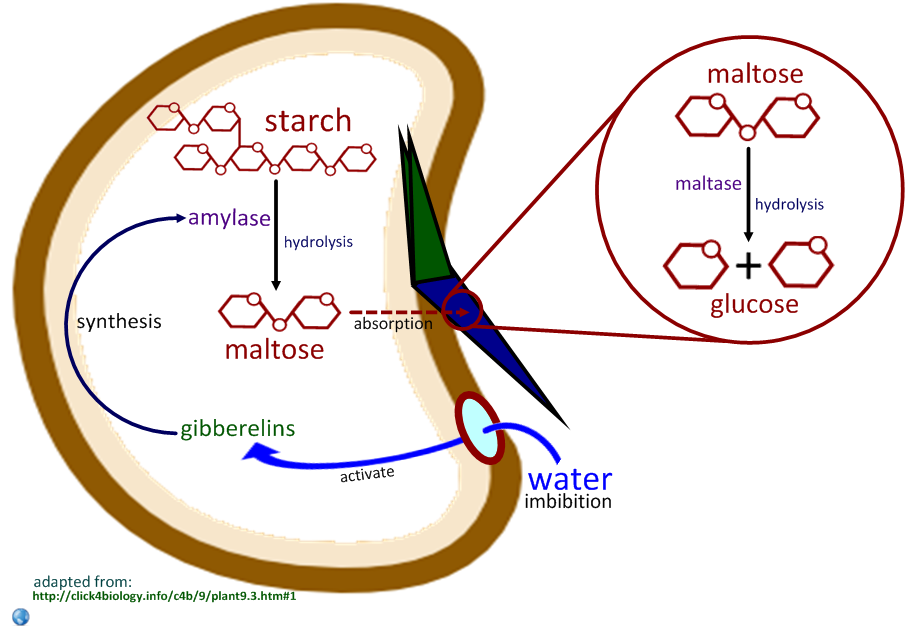
This image is adapted from a diagram at Click4Biology. For some of my suggestions of how this diagram alone represents over 20 links across the curriculum, click here: Bean there, done that…
HeroRATS: Detecting Landmines and TB
 In this TED Talk, Bart Weetjens explains how he and his team from Apopo are using operant conditioning to train African giant pouched rats (Cricetomys gambianus) to sniff out and signal land mines and TB infections:

HeroRAT in action. Go to Apopo
Visit the resources at Apopo’s pages to find out more about why these rats are chosen in favour of other species and how the training programme works. You could also adopt your own rat to support their work. There are more videos from Apopo on their website or on their YouTube channel.
IB Biology Links:
- E3 Innate and Learned Behaviour
- E2 Perception of Stimuli (why are the rats so good at it?)




 i-Biology