Category Archives: CAS
So is the Earth full or is abundance our future? #TED2012
TED 2012 is underway and they have been posting some of the talks to their website. Here is a pair of talks which showcase different views of where we are in the world right now – each of them linking to our units on Environmental Science. You can also follow them on the Guardian’s liveblog.
In the first, Paul Gilding states that “The Earth is full,” but that it takes times of real crisis for us to create solutions and climb out of the hole we have dug for ourselves.
In this one, Peter Diamandis argues that we are living in a time of abundance and that human ingenuity will get us out of our problems.
……….o0O0o……….
EDIT – 4th March
These talks which have also been published are relevant to the issues we are studying in class. Have fun watching them!
Daniel Pauly: The ocean’s shifting baseline
Paul Snelgrove: A census of the ocean
UNICEF Photos of the Year 2011
Each year, UNICEF and GEO Magazine host a photography competition which aims to highlight the living conditions of children around the world. As teachers and students in the privileged setting of international schools and the IB World, we can be isolated from the realities of the lives of those around us. In many cases our schools and communities are oases of luxury, with poverty outside the school gates.
This photo, “Waste Export to Africa” by Kai Löffelbein, was this year’s winner. It links closely to my last post about the story of electronics. Do we ever really think about the final destination of our high-impact goods? In many places children are forced to work on piles of smashed-up and dangerous electronic goods, trying to recover precious metals and components.

"Waste Export to Africa" by Kai Löffelbein. Hosted at the Guardian (click for gallery)
For more photos of children’s situations around the world, visit the UNICEF Photo Essays page. They might inspire you to take your own photos or kick start some action in your own school. They also have a photo of the week page.
Movember 2011 – sponsorship links
 It’s Mo-vember again and the facial foliage is taking shape. It also just happens to be
 mid-way through right after the November 2011 session Biology exams. A perfect time to launch an appeal for sponsorship from teachers and students who have used this site in their studies.

My MoVember page
Movember is simple – grow a mo’ for the month of Movember to raise money and awareness of oft-ignored men’s health issues, such as testicular cancer, prostate cancer and depression.
November sessioners (and others), here is a chance to pay it forwards by giving to something seasonal and topical: please make a donation at my MoSpace page! Please get on board or show your support for all the free resources posted here by making a small donation.
In other appeals so far, i-Biology has raised around GBP300 for various charities through my Biology4Good donations page.
Here’s a curriculum link for good measure: 2.5 Cell Division (tumours and cancer).
Mo yeah.
……….o0O0o……….
Movember videos:
First up – some of the real impacts made by Movember fundraising – with real science.
And here are the rules of Movember:
Thai Floods – Shelterbox appeal

 The recent floods in Thailand have killed many and displaced many more. John Burrell, author of Click4Biology, lives and teaches in Thailand and has posted an appeal for donations to relief charity Shelterbox. If you have taken advantage of his free site over recent years, please pay it forwards – visit the site and make a donation.
Biology4Good – please help make a difference.
 What a week – over 20,000 visitors around the IB Biology exams! I hope it went well for you all, especially my awesome BIS kids!
If you’re a student or teacher who has been using these resources and they have helped you, please consider making a charity donation through my Biology4Good gifts list. Donations are secure and 100% of the value is given to charity.
Please take a couple of minutes to look through this presentation. Pass it on to your friends and teachers and please make these efforts worthwhile. There is more information about Biology4Good here:
Check out this for a post-exam stat-slump:
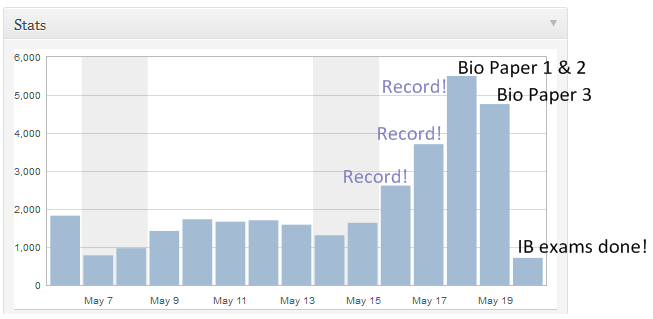 Apologies for two very similar posts in a week – I wanted to catch you before you left and perhaps never came back to the site now that IB exam stress is done!
MrT
Pay It Forwards – Please!
I hope Paper 1 and 2 went well for all you May-sessioners today. I can see from the stats that many have been busy on this site, and I’ve had three record-breaking days in a row. Many of you may never come here again once IB is done, so I wanted to catch you before you left!
Please take a couple of minutes to look through this presentation. Pass it on to your friends and teachers and please make these efforts worthwhile. There is more information about Biology4Good here:
Good luck for tomorrow. Put today out of your brain and look only at your Options work. Pay attention to command terms and don’t foolishly think you can do an Option that you didn’t do in school.
For many of you, tomorrow marks the end of the IB Diploma Programme. I sincerely hope that it has helped you grow into decent human beings – compassionate, knowledgeable and motivated to make a positive impact on the world.
BIS students – I am proud to have been your teacher.
Everyone else – thanks for the comments!
MrT
It’s Movember! Grow a mo and raise awareness of cancer.
Serendipitously timed, Grade 11 are looking at cell division as some of the male teachers are growing their mo’s for Movember:
“Men sporting Movember moustaches, known as Mo Bros, become walking, talking billboards for the 30 days of November* and through their actions and words raise awareness by prompting private and public conversation around the often ignored issue of men’s health.”
From the MoVember website.
*Actually, we’re doing Nov 10th – Dec 10th, due to the holiday and being a bit slow on the uptake.
So what’s it got to do with Biology?
Well, tumours – such as prostate and testicular cancer in men; breast, uterine, cervical and ovarian cancer in women; and cancer of everything else in everyone else – are simply the result of uncontrolled cell division. Through apoptosis (programmed cell death) or damage (necrosis), cells are destroyed. These need to be replaced with other cells. As our cells are eukaryotic, they need to go through mitosis to ensure that complete copies of all the chromosomes make it into both daughter cells.
As with other cell processes, this is controlled by genes and, importantly, terminated when the cells have grown appropriately. If there is a mutation or problem with a tumour-suppressor gene, such as TP53, the process of cell division is not stopped and the cells grow out of control. This is a tumour. Alternatively, mutations can affect other genes (oncogenes), which encourage further growth.
Click here for a good 11-minute documentary on cancer development, from CancerQuest.
Tumours can start out benign – growths of cells that are not harmful. If these cells become malignant and invade other cells and damage tissues, this is known as cancer. Damage to other cells and tissues leads to illness and can be fatal if not treated early. As tumours grow, they can recruit blood vessels – called angiogenesis. Now you run the risk of metastasis – cells from the tumour breaking off, flowing through the blood and starting a new aggressive tumour in a different part of the body.
Environmental factors can encourage mutations in key cell-cycle-controlling genes. We all know, for example, that smoking can cause lung cancer, UV radiation can lead to skin cancer and the HPV virus can cause cervical cancer.
So why all the fuss about Movember?
Simply, men’s cancers receive less media attention and men tend to be less willing to talk openly about their health problems (unless, of course, they’re trying to get sympathy with a case of man-flu). As guys tend to put off going to the doctor and generally live a lifestyle that is higher-risk for cancer (high fat, high meat, alcohol, smoking, lack of exercise…), tumours can go unnoticed. Men are less likely to survive a cancer diagnosis than their more health-conscious lady friends.
Through cultivating the moustache, we can start conversations about these issues, raise money for education, prevention, research and treatment and promote anti-cancer behaviours:
- Healthy lifestyle choices and awareness of risk
- Self-checking and regular screening for at-risk groups
- Early diagnosis of and treatment for tumours, should they arise (animation)
So get mo-tivated and join the mo-alition of the willing. Take a mo-ment to think about cell division. And mo-an at the men in your life to make healthy choices. Ladies too can get involved – by becoming Mo-Sistas and also raising awareness. The BIS Team are called the BIS Upper Lips!
In the video above, he talks about how genome mapping can lead to giving an indicator of risk to men. Great technology, based on the Human Genome Project (link to 4.4 Genetic Engineering and Biotechnology).
For the class resources on 2.5 Cell Division, click here. Interestingly, and obviously, hair growth itself is a product of cell division. Something to think about as you grow the mo, yo.
Merapi Eruption and Mentawais Tsunami

Guardian Slideshow
Volcanic eruptions and earthquakes are no rarity here in Indonesia. The Indonesian archipelago is a series of thousands of volcanic islands which emerged from the ocean millions of years ago. These islands are the product of the convergence of the Indo-Australian and Eurasian tectonic plates. It is our home.
The trade-off for the fertile lands, natural resources and wonderful seas around the area is the ever-present risk of disaster. The price of these disasters, when they occur, is usually paid in the lives of the poor.
Since the tsunami of 2004 an early-warning system has been developed and implemented in many locations in the Indian Ocean. In 2006, it appears that early-warning messages were not relayed appropriately, costing more lives in Pangandaran. No early warning existed for the recent Mentawais tsunami, as it was not considered cost-effective to install the system for such a small population. At least 430 people were killed.

Click to donate
The Mentawais are an internationally-renowned spot for high-class surf, and SurfAid International are leading fund-raising and relief operations in the area. Through the Surf-Aid schools project, you can access free resources and teaching materials to help students learn about global issues, the oceans and citizenship.To make a donation to the Mentawais relief efforts, please visit their site. Here is a video report on the affected area from their website:
Edit: You can see a recording of a presentation given by Milton Brown as part of the Global Education Conference 2010 by clicking here. You will need Elluminate installed.
Another ongoing story is the eruption of Gunung Merapi in central Java. This is a little closer to home for us here in Bandung, though our city is not directly affected. However, thousands have been displaced and many lives lost, with a high demand still for aid and support. For a gallery of hard-hitting images from the Guardian, click on the photo below:

Click on the image to see a stunning slideshow from the Guardian. Photo by Clara Prima/AFP/GettyImages

CLick to Donate
Among those affected are SOS Children’s Villages in the region. These are orphanages and community projects which provide homes and education for hundreds of children. They are in real need of basics – clothes, nappies, baby needs and more. If you wish to donate directly to SOS in Indonesia, please follow the link here. If you wish to make a donation to the international organisation, please visit their international website here. Tax advantages are applicable in some countries and you get some say over where your money goes.
BIS students are aiming to help the Merapi SOS Children’s Villages that were affected by raising money through the annual Talent Show and collecting materials and resources needed . Good luck!
Here’s some AP video footage of Merapi in action:




 i-Biology