Cell Respiration – linklist
 Here’s a good one for an opener: no narration, just an action-packed graphic.
It comes from Dr. Meyer at Queensborough Community College.
–
–
– Here’s a cracking step-through animation – from John Burrell at Patana
Slideshare.net has collections of slideshows that can be viewed online:
Download the editable version here: cell_respiration_hl.ppt
Here’s another:
–
OK, here are some more animations:
Respiration is not breathing! – Tim and Moby (Brainpop)
Good tutorial with questions – University of Wisconsin
Simple overview – Herriot Watt
Flash Overview – UC Davis biosciences
Windows Media overview (very flashy, above HL) – Virtual Cell Animation Collection
Stage-specific animations after the jump (glycolysis, Kreb’s cycle and ETC, oxidative phosphorylation)
150 years since ‘On the Origin of Species’
 Darwin’s theory of natural selection was finally published (and sold-out) in November 1859. The idea had been in his head, and a talking point of others, for years before. We’re still talking about it today.
Here’s a clip from a BBC documentary called Legacy about the impact of Darwin’s ideas:
The Guardian newspaper has a great page devoted to Darwin, including key excerpts from ‘On the Origin of Species…‘ and an article by Richard Dawkins.
 You can download the full text of the first edition in pdf format from the University of New South Wales, or read it online at Talk Origins.
Neurons and Synapses: linklist
Here’s a jazzy introduction from Discovery Channel, with a soundtrack inspired by Tubular Bells:
And now for the serious animations.
Neurons and Action Potentials:
Excellent Flash from Children’s Hosital Boston
Good introduction from Harvard
Excellent comprehensive tutorial (Harvard Outreach)
Another good AP tutorial (can’t be saved) (Jordan Kerr University)
Generating Action Potential (MRothery, Watford Girls’ Grammar)
Comparing continuous and saltatory transmission (Matthews/Neurobiology)
Propagating an AP (McGraw Hill) (More from this source)
Synaptic Transmission:
Nice clear intro (McGraw Hill)
Another clear one (though missing the post-transmission ‘cleanup’) (BishopStopford)
Some Chemsketches of neurotransmitters (Harvey Project)
Neuromuscular Junction:
Neuromuscular junction step-through (Sinauer Associates)
Simple line-drawing animation (Harvey Project)
Muscle Contraction:
Nice animation of sliding filaments (Matthews/Neurobiology)
A good interactive diagram (Thomson/Brooks/Cole)
Neurotransmitters and Drugs:
Excellent, accessible overview from Jellinek, a Dutch drug education website
Good powerpoint from HHMI
Excellent overview of effects of drugs (Harvard)
Amphetamines, Cocaine, Nicotine as excitatory psychoactives (McGill ‘The Brain’)
Benzodiazepines, Cannabis, Alcohol as inhibitory psychoactives (McGill ‘The Brain’)
Parkinson’s Disease:
Short Introduction (from UPenn/ADAM)
Simple interactive – effects of lesions on inhibitory or excitatory ganglia (San Diego State College of Science)
Sample Questions: have a go at these NeuroBioHL_Qs
North Harris College – loads of animation links
 The Biology department at North Harris College have posted links to many animations online. They are divided into general Biology and Anatomy & Physiology.
Gene Almanac – a resource of good animations and simulations
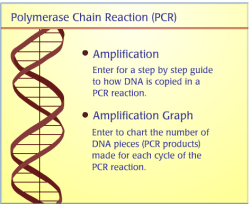 From the Dolan Learning Centre, this collection of animations and simulations can be downloaded easily for PC and MAC.
Clicking the image on the left should bring you directly to an animation about the polymerase chain reaction.
Simulations and Help with ICT in IB Biology
David Mindorrf, author of the IB Biology Course Companion and online faculty member for the IBO, has produced a website to assist teachers and students in the use of ICT to cover Aim 7 of the new subject guide. Of particular relevance to this blog is the page on the use of simulations (including some links) – though it is all worth reading.
Imaging Technology Group’s Virtual Microscope – Amazing free software
 This is an unbelievable free, open-source piece of software. It basically emulates a scanning electron microscope and allows you all kinds of fuctionality, including: wide range of magnifications of super-high quality images; mass spec analysis with false colouring of different elements present; control over colour, brightness and image position; a very nifty measurement/line tool that is just perfect for the the IB Cells statements on magnifications.
The download is 128MB for the package including three images ready to mount. When opened, you can download many more images (around 25-30MB each – huge and great quality).
It’s brilliant – stop reading this and go play with it.

Well, if you’re still reading…
Their excellent website also includes a series of animations on the basics of microscopy, videos on preparing mounts and even a section on careers in microscopy.
Social Behaviour
Attenborough and the eusocial naked mole rat. Good to see him get stuck in with a shovel.
Here’s a clip of chimpanzees grooming from www.arkive.org:
I couldn’t find a good clip of ant social behaviour that explained colony structure. Instead, here’s Vicky Pollard doing her thing as an example of anti-social behaviour:
“Where’s the baby?”
“Swapped it for a westlife CD.”
“How could you do that?”
“I know, they’re rubbish!”
Honey to the Bee
Here’s a Nature video podcast special on bees and their social structure:
Here’s a focus on the waggle dance as a means to locate food:
Here’s a focus on the waggle dance, though embedding has been disabled.
Nature again, with their importance to science and agriculture:
DNA Replication: linklist
There are stacks of DNA replication animations on the internet. Here are a few good ones.
John Kyrk (HL, very detailed and good)
New Century College (simple, clear) This school sounds interesting.
Biology 7th edition from McGraw Hill
Bioteach (cartoony, but has it all)
Remember – DNA replication is NOT Protein Synthesis – it doesn’t involve transcription and translation!




 i-Biology