California Academy of Sciences Channel

Here’s a good YouTube channel from California Academy of Sciences: Science in Action with over 100 videos covering a diverse range of topics. To tie into GRade 12’s Neurobiology and Behaviour unit, here’s a clip on intelligent crows!
There are also loads of interviews, science news stories and general interestingness. Check it out!
E2 Perception of Stimuli
Class presentation:
–
Essential Biology: E2 Perception of Stimuli
–

- Hermann Grid Illusion
Sight:
Collection of animations from North Harris College
Eye structure tutorial from Sumanas
Simple how-the-eye-works from BiologyMad
The Sense of Sight from Wisconsin Online
How many megapixels is the human eye? from Brainiac.
–
Hearing:
How the Ear Works, from NobelPrize.org
The Sense of Hearing from Wisconsin Online
Neat Ear Tutorial from University of Alaska Fairbanks
McGraw Hill Effect of Sound Waves on Cochlear Structures
Test your hearing range (carefully) from the University of New South Wales
–

- Mantis Shrimp: Awesome Vision
Interesting reading:
The peer-iodic table of illusions, from NewScientist.com
The Mantis Shrimp’s amazing visual capabilities, from NotExactlyRocketScience
–
The eye is not irreducably complex – it is the product of natural selection
Evolution of vertebrate eyes from Pharyngula
Owl monkey example of eye evolution, from NotExactlyRocketScience
Video, The Evolution of the Eye, from PBS:
E1 Stimulus and Response
Class Presentation:
Essential Biology: E1 Stimulus and Response
–
For Reflex Arcs (including the pain reflex):
Start with this tutorial from Sumanas
And this animation from the University of Minnesota
Lots more CNS animations from North Harris College
–
Some good readers from Not Exactly Rocket Science for the effect of natural selection on response to stimulus:
E4: Neurotransmitters and Synapses
Review Nerves content from the Core before completing this topic.
Class presentation:
–
Essential Biology E4: Neurotransmitters and Synapses
–

The New Science of Addiction: Genetics and The Brain
From Learn.Genetics
Fantastic resources available from Utah, including the mouse party, neuron and synapse animations and an interactive involving pedigree charts and the role of genetics in addiction.
Spend some time here to really read around the subject of drugs and addiction – you’ll be glad you did and it really helps answer the ‘discuss the causes of addiction’ question!
–
Drugs and The Brain
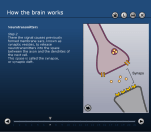
Jellinek is a Dutch drugs education website that has some great, accessible resources for neurobiology of drugs and the brain. Animations are available in multiple languages – why can’t more organisations be as internationally-minded as this?
Be patient though -it needs a lot of bandwidth.
–
Neurotransmitters and Drugs:
Good powerpoint from HHMI
Excellent overview of effects of drugs (Harvard)
Amphetamines, Cocaine, Nicotine as excitatory psychoactives (McGill ‘The Brain’)
Benzodiazepines, Cannabis, Alcohol as inhibitory psychoactives (McGill ‘The Brain’)
–
TOK and Biology: The Nutt-Sack Affair
Leader of advisory panel on drug safety sacked for disagreeing with UK government:
http://www.badscience.net/2009/11/the-nutt-sack-affair-part-493/
Read around the topic, and then answer these questions:

Nutt's Scale of Drugs
- How does this story show the conflict between science and politics?
- What do you feel the respective roles of science and politics should be in the government of a country?
- Suggest reasons why some drugs which are clearly very harmful, such as tobacco and alcohol, are still legal in many countries.
- If you were to form a new country and write a whole new set of drug laws, which would you make illegal or legal and why? Upon which sources of evidence would you rely in order to make your decisions? How would you balance political pressures with scientific evidence?
Find out more about drug laws and the rationale behind them in your own country and the countries you visit or live in.
Remember – regardless of your own opinion on drug laws, if you are caught breaking the law wherever you are, penalties can be very severe.
Nerves, Hormones and Homeostasis
The final topic for Standard Level (if you don’t need to go onto the Neurobio unit)
As usual, click on the shadowed images to see an animation.
– Essential Biology 6.5: Nerves, Hormones and Homeostasis
–
Introduction to the nervous system
Loads of useful resources from Neuroscience for Kids
Reflex arc animation from msjensen.
–
Nerve impulses: resting potential and action potential
Cool tutorial from the Harvey Project
McGraw Hill nerve impulse animation
Nice and simple from mrothery
Another good one from Alberta Psychology
Propagation on myelinated and non-myelinated nerves from Blackwell Publishing
–
Synaptic Transmission
Great animation from McGraw Hill
Good tutorial from Harvard Outreach
Another WHS Freeman tutorial (lifewire)
–
The Endocrine System
Good visual introduction from Delmar Learning
Really good animation – lots of info – from e-learning for kids
–
Homeostasis
Tutorial and game from think-bank
Detailed tutorial from the University of New South Wales
Homeostasis in Newfoundland from Memorial University
Another good Freeman tutorial
–
Blood Glucose and Diabetes
–
Link to Neurobiology and Behaviour: E4 – Neurotransmitters and Synapses
–
Cool music video from the Stanford students- Put some ACh into it:
If you can understand that, you’re doing well…
2010: International Year of Biodiversity

2010 is the United Nations’ International Year of Biodiversity. With conservation targets failing to be met and the loss of species and biodiversity ever increasing, it is an opportune time to take action: on both small and large scales.
Here is the Secretary General, Ban Ki Moon, introducing the International Year of Biodiversity:
The action website Countdown2010.net list the objectives of the IYB as to:
- Raise awareness of the importance of conserving biodiversity for human well-being and promote understanding of the economic value of biodiversity
- Enhance public knowledge of the threats to biodiversity and means to conserve it
- Encourage organizations (and through them individuals) to take direct or indirect biodiversity conservation activities
- Celebrate the achievements of Countdown 2010 partners and other stakeholders
- Reporting on the possible failures for not achieving the Target
- Prepare the ground for communicating the post-2010 target(s)
–
To find out more about what is going on and what you can do, visit the main two websites:
– Official International Year of Biodiversity website
– Countdown2010: Save Biodiversity
How can this event tie in with the IB Biology course?
Could it be a focus for future Group4 or Extended Essay projects?
Cell Respiration 2010
Cell Respiration for Core, AHL and the SL Option C.
Here is the class presentation on SlideShare – a 100 slide monster for Spaced Learning!
– Complete all the questions on Essential Biology: Cell Respiration
There are loads of links and videos on the main page for respiration, so please click here.
Here’s one of my favourite cell biology videos: ATP Synthase
What’s The Worst That Could Happen?
Based on the excellent book “What’s the worst that could happen? A rational response to the climate change debate” and the accompanying videos on YouTube, this is a great foundation for some Biology and TOK linking. It fits nicely with topic 5.2 The Greenhouse Effect, and is a good introduction to the precautionary principle (though not explicitly named that way) as well as a solid, readable (watchable) and entertaining introduction to the scientific method and critical thinking.
In the video below, science teacher, author and YouTube star Greg Craven presents a refined outline of his original idea (The Most Terrifying Video You’ll Ever See), How It All Ends:
–
I’ll expand on this resource in the TOK & Biology section over time, but here are some guiding questions to start:
1. What leads us to believe in authority figures and why do we give them credence? How do we distinguish reliable source from unreliable sources?
2. What is confirmation bias and how is it dangerous in the mind of the true scientific thinker?
3. How could the decision grid be used in any risk-related decision?
4. How could we apply the credibility spectrum to our decision making and assigning credibility to sources of information?
5. Is it as important to determine who is ‘right’ as it is to make a decision on the best possible action to take?
–
There is stacks of information and support on Greg Craven’s website: http://www.gregcraven.org/
For a nice graphic distinguishing warmers from skeptics, head on over to Information Is Beautiful.
Happy New Year – And A Partial Lunar Eclipse!
Happy New Year!
There was a partial lunar eclipse last night. Here is some footage from India:
 For more eclipses in 2010, visit Eclipse.org.uk. There are four this year, including a total solar eclipse on July 11th and a total lunar eclipse on December 21st. If you look at each event on eclipse.org, you can see animations of what to expect where you are.
–
NewScientist also have a review of the top ten space stories of 2009, with The Guardian making predictions for the year ahead.
Have a great year!
Virgin Galactic Goes Live – with cool soundtrack
Start saving those pennies for a trip to space, courtesy of Richard Branson’s Virgin Galactic SpaceShip Two – whichwas rolled out on a chilly unveiling in the Mojave desert this week. Here’s a short video showing a simulation of what one of the trips would be like, with what looks like some footage of SpaceShipOne’s journey to the edge of the atmosphere in 2004, as well as some dodgy camera-phone footage of this unveiling, apparently from Arnie’s phone.
Watch out for The Fuse in 2010 – the band whose music is featured on the video – they rock!
One might question the tactfulness of the unveiling of the spaceship so close to the Copenhagen Climate Summit. Is it really appropriate to encourage the super-wealthy to burn up fuel and money (US$200,000 a ticket!) on a joyride to space? There is a section on their official website that deals with the environmental issues, claiming that the carbon footprint per passenger is less than a London-New York flight.
On the other hand, given the chance would you turn it down? This project represents the cutting-edge of engineering and design, and there will be a lot to learn from their industrial experiences. It is also good to see some human ingenuity and adventure make the headlines, too.
Here’s a tour of SpaceShipTwo with Richard Branson, from Associated Press:
And an old (2008) video from Wired.com talking about the project:
So what do you think? Do you think it’s a good idea? Would go if you were given the chance? How do you feel about this kind of high-profile project? Would it inspire you to take on science or engineering as a career?
–
For more information on the The Fuse and their music, check out their website: http://www.thefusemusic.com/




 i-Biology