Guardian and Wellcome Trust Science Writing Prize
 If you’re in the UK, have a go at this science writing prize from the Wellcome Trust and the Guardian. The winners will have their work printed in the ‘Guardian’ or the ‘Observer’, receive a £1000 cash prize and benefit from a science writing workshop at the ‘Guardian’.
One category is for non-professionals and undergraduate students – that includes you, super-smart IB Biologists. The closing date is 20th May, so it’s perhaps not the best idea for students in their exams!
For the full introduction, go to the competition page. There is also a good piece, as well as some tips, on the Guardian.
Some resources that might help:
Scitable’s Scientific Communication Library
Peter Clarks’ Quick 50 Writing Tips
“The science of scientific writing” from American Scientist
Simple ‘eye’ grown from stem cells
A Japanese team of researchers have turned embryonic mouse stem cells into a very basic eye, or ‘optic cup’. This video shows a time-lapse of the cells self-organising into the structure:
As you watch the video and read the article, think about the following curriculum links:
- How do cells ‘organise’ and how do stem cells become differentiated?
- What might be the therapeutic uses of this in the future?
- What functionality does this ‘eye’ have compared to ours?
“Remarkably, the rudimentary eye and the different types of cells it contained took shape spontaneously from a floating cluster of embryonic stem cells the scientists had cultured.”
The Guardian has a good article on the story. The original paper was published in Nature (paywall), but their Scitable area has a very good focus on stem cells.
Genetics Case Study: Diagnose the Patient
By completing this task, we will learn about chromosomes, genes, alleles and mutations, as well as some theoretical genetics. It serves as a review of transcription and translation, as well as protein structure. In the final stages, we will also access the Entrez Gene database (ICT requirement 4 on the 4PSOW).
This task is heavily based on the work of others and is credited at the end.
For more excellent case study resources for science, visit the National Center for Case Study Teaching in Science.
Scitable – Authentic Science Learning from Nature Education
 Nature Education’s Scitable project is a free, collaborative online project which opens up lots of peer-reviewed, high-quality Nature content to students, teachers and learning groups.
The goal was to put high-quality Science information onto the web, and to give control and flexibility over learning. Having signed-up and looked at some of the brilliant readers and resources there, I will surely be using it in future! Scitable represents an authentic, evolving and engaging alternative to science textbooks, one of the reasons I started this blog in the first place. Check out some of the student blogs, too!
Here’s a quick video overview, but there is more information after the jump.
Manipulative Skills self-assessment
Word 97-2003 version here.
This is only formally assessed once at the end of the course, but can be a good exercise in student self-assessment. I have unpacked the aspects into some skills and indicators in the second table. Feel free to download and edit to suit your own needs.
Awesome Random Reviews

View my Profile
Here are two quizzes which you can take online and will give you 50 randomly-selected questions from my Quia questionbank each time.
Higher Level Random Review (Topics 1-11)
Standard Level Random Review (Topic 1-6)
You do not need to log in.
IB Biology Teachers – your subject needs you
You may be aware that the curriculum review for Biology is currently underway and feedback from IB Bio teachers is very useful in the process. The curriculum review team posted a report on their meeting from October in 201o onto the OCC (login needed). There is a survey on the OCC for teachers to complete.
To find the report and complete the survey, please log in to the OCC and go the Biology area:
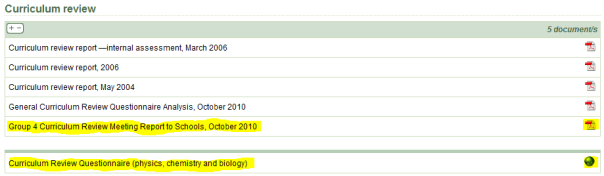
Click here to log in to the OCC and scroll down a bit to complete the questionnaire.
Please note that I am not part of the review team, but do feel that this is an important role for teachers to play. This is where we get the chance to have input into content and internal assessment. There are also discussion threads on the OCC dedicated to this review.
What’s Your Water Footprint?
Visualizing.org had a competition for best visualisation for World Water Day (22nd March), and the winner is this interactive world map by Joseph Bergen and Nicki Huang, from Harvard:

What's your water footprint? Joseph Bergen and Nicki Huang's interactive visualisation.
It’s going to get pretty quiet around here…
…find out why after the page break.
……….o0O0o………..
Click to donate
First off, my students’ and my thoughts are with all those affected by the recent disasters in both New Zealand and Japan. We are following all stories closely and wish everyone the best possible outcome, despite such horrible circumstances.
We should also consider those in Egypt, Libya and other regions of instability. We must think ourselves fortunate compared to those whose access to education, especially the quality of education you get in international schools, is limited.
It may look like doom and gloom in the world right now, but you guys – IB students – can be the change that needs to happen. When you graduate, do something useful. Science can help build a sustainable and stable future.

……….o0O0o………..
With exams looming, it is time for some real, self-directed review and study. Search the internet and you’ll find loads of ideas, but here are some specific tips for my students and others involved in IB Biology.

Practice!
1. Practice. Get the QuestionBank CDRom, past papers and practice questions from the textbooks and use them extensively.
2. Get used to writing for extended periods of time, and under timed conditions. Think ‘a mark a minute’ and you’ll be fine. If your handwriting’s rubbish, get working on it ASAP.
3. Audit your knowledge using the subject guide. Remove all the pages for topics you do not need to cover (e.g. Options that are not yours, AHL content if you are in SL), and you will find it more manageable. Then work through each one – do you feel like you could answer an exam question for each?
4. Understand the Command Terms.
5. Pay attention to the number of marks available. For the 6-8 mark questions, write at least that much, and take care of structure and logic in your answers. Lay it out clearly and don’t waffle.

Writing about exam stress
6. Practice the data questions. Can you make your own from graphs and charts in works that you have read?
7. Write about your exam stress. Ed Yong tells us why.
8. Use whiteboarding to practice diagrams, annotations, explanations and so on. Teaching others clarifies the ideas and explanations in your own mind.
9. Know your way around the calculator and practice means, standard deviations, percentage changes and calculating sizes and magnifications.
10 Sleep, eat well and keep fit. All night cramming is no good for you – if it’s not in your brain by the day before, it won’t be, so stop stressing and get to sleep. Decaffeinate yourself, get some exercise and stay healthy so that you don’t risk getting sick in the exam session. Find out more about Brain Compatible Education at Derek Pugh’s website (Derek was my predecessor at BIS).
Some more techniques my students have used:
- Making the SlideShares into tiny flashcard sets
- Mind-mapping or concept mapping
- Some online study tools here.
- Using Quia Quizzes for review (teachers with accounts, you can copy these quizes to your own account. Keep a log with this spreadhseet).
You could also record podcasts or vodcasts (like at Click4Biology).
Always think about how effective your use of time is when you are carrying out a task. Some students may spend hours copying out their notes, but to what extent does it have a positive impact on exam grades?
Good luck,
MrT
Untangling the Brain – Nature Video
Another great video from the NatureVideoChannel, posted just in time for the end of the IB Biology course for our HL students.
For more brain resources, head over to the main topic page (E5 The Human Brain).
Also check out the excellent resources from the NewScientist: The Human Brain

3D Brain App: It's Free!
PBS has a great site called The Secret Life of the Brain (with 3D animation), and there’s Slate’s special issue on The Brain.
If you have an iPod Touch, iPhone or iPad, get this cool free app: 3dBrain.




 i-Biology