Category Archives: Uncategorized
Half a million views – so who are you all?
Another busy week at BIS, and a great Unity in Diversity Day!
This site just passed the 500,000 views mark, which is not something I expected when I started it as an experiment in blogging, ‘Science Teachers’ Video Resources,‘ a few summers ago. It’s morphed into a resource-bank for IB Biology and Science in general, and grows as I find more and more great links for learning about the scientific world.
The resources posted here are first and foremost for my own students – to help them go deeper into Biology and to open the door to the trans-disciplinary realms of Science. It’s great that it has become a useful tool for other students and teachers, and I hope that this is a sign that the resources here are useful. It is great to receive emails and comments from people using the site – especially when they spot a mistake and then I can get it fixed!
I don’t really know who is using this site beyond my students, so please leave a comment below to let me know who you are and what you do here. Even better – tag yourself or your school on this map!
Thank-you for your support!
Stephen
PS – because this is a video site and the post is about statistics, here is my TED Talk hero, Hans Rosling, spreading his good news of the decade:
Now go the the best website ever: GapMinder!
My Edublog awards nominations

Make your nominations
The Edublog Awards are coming up, which is a chance to share and recognise some of the best online educational resources out there. To find out more about how these awards work, please visit the Edublog Awards website.
Here are my nominations:
Best resource sharing blog: Free Tech 4 Teachers (regular and useful updates on techy teacher stuff, often with suggestions for how to use it and with some really useful Google documents).
Best individual blog: NotExactlyRocketScience (making real science readable and accessible. I love it.)
Best educational use of audio: Tom McFadden’s YouTube channel (The best Lyrical Science songs ever made)
Best educational use of video/visual: Learn.Genetics (hours of quality resources for genetics and biochemistry and stacks of high-quality free resources)
Best teacher blog: Mr Robbo, PEGeek. (Technology in PE, with bonus points for Movember youtube video)
Best educational tech support blog: The WhiteBoard Blog (good site for links, tips and tricks)
Best school administrator blog: TheThinkingStick, Jeff Utecht
Best educational podcast: Guardian Science Weekly. (Science news is educational, right?)
Best PLN: Global Education Conference (on right now, for the first time and with a really extensive list of speakers, topic and its own social network. Good going!)
Lifetime achievement: Hans Rosling, Gapminder. (My favourite TED Talker and a website which is just fantastic. So rich for linking across disciplines.)
If you have a blog, don’t forget to post your own nominations. The rules are here. Big thanks to Danny Nicholson for nominating this blog for Best educational use of video – I’ll be really happy if it gets shortlisted!
It’s Movember! Grow a mo and raise awareness of cancer.
Serendipitously timed, Grade 11 are looking at cell division as some of the male teachers are growing their mo’s for Movember:
“Men sporting Movember moustaches, known as Mo Bros, become walking, talking billboards for the 30 days of November* and through their actions and words raise awareness by prompting private and public conversation around the often ignored issue of men’s health.”
From the MoVember website.
*Actually, we’re doing Nov 10th – Dec 10th, due to the holiday and being a bit slow on the uptake.
So what’s it got to do with Biology?
Well, tumours – such as prostate and testicular cancer in men; breast, uterine, cervical and ovarian cancer in women; and cancer of everything else in everyone else – are simply the result of uncontrolled cell division. Through apoptosis (programmed cell death) or damage (necrosis), cells are destroyed. These need to be replaced with other cells. As our cells are eukaryotic, they need to go through mitosis to ensure that complete copies of all the chromosomes make it into both daughter cells.
As with other cell processes, this is controlled by genes and, importantly, terminated when the cells have grown appropriately. If there is a mutation or problem with a tumour-suppressor gene, such as TP53, the process of cell division is not stopped and the cells grow out of control. This is a tumour. Alternatively, mutations can affect other genes (oncogenes), which encourage further growth.
Click here for a good 11-minute documentary on cancer development, from CancerQuest.
Tumours can start out benign – growths of cells that are not harmful. If these cells become malignant and invade other cells and damage tissues, this is known as cancer. Damage to other cells and tissues leads to illness and can be fatal if not treated early. As tumours grow, they can recruit blood vessels – called angiogenesis. Now you run the risk of metastasis – cells from the tumour breaking off, flowing through the blood and starting a new aggressive tumour in a different part of the body.
Environmental factors can encourage mutations in key cell-cycle-controlling genes. We all know, for example, that smoking can cause lung cancer, UV radiation can lead to skin cancer and the HPV virus can cause cervical cancer.
So why all the fuss about Movember?
Simply, men’s cancers receive less media attention and men tend to be less willing to talk openly about their health problems (unless, of course, they’re trying to get sympathy with a case of man-flu). As guys tend to put off going to the doctor and generally live a lifestyle that is higher-risk for cancer (high fat, high meat, alcohol, smoking, lack of exercise…), tumours can go unnoticed. Men are less likely to survive a cancer diagnosis than their more health-conscious lady friends.
Through cultivating the moustache, we can start conversations about these issues, raise money for education, prevention, research and treatment and promote anti-cancer behaviours:
- Healthy lifestyle choices and awareness of risk
- Self-checking and regular screening for at-risk groups
- Early diagnosis of and treatment for tumours, should they arise (animation)
So get mo-tivated and join the mo-alition of the willing. Take a mo-ment to think about cell division. And mo-an at the men in your life to make healthy choices. Ladies too can get involved – by becoming Mo-Sistas and also raising awareness. The BIS Team are called the BIS Upper Lips!
In the video above, he talks about how genome mapping can lead to giving an indicator of risk to men. Great technology, based on the Human Genome Project (link to 4.4 Genetic Engineering and Biotechnology).
For the class resources on 2.5 Cell Division, click here. Interestingly, and obviously, hair growth itself is a product of cell division. Something to think about as you grow the mo, yo.
Retinal implant restores sight!*

ScienceDaily Article
Through the use of diodes as retinal implants, researchers have restored partial sight to patients with retinal dystrophy – a progressive degenerative disorder. Science Daily has a good short article on this breakthrough, and you can see the research paper on the Royal Society’s Biological Sciences journal page. Check out this video from AP for an outline of how it works:
We will look at this in much more detail in the Neurobiology and Behaviour unit – but if you’re interested, go ahead and read all about it! You might get inspired…
*partially
Food for thought – why might this technology not work for someone who is already blind?
Good Luck, November-Session Students!

Exams, from FlickrCC
November-session IB exams start today. Good luck to all students taking part, and here are some exam tips to help you out.
1. Pay attention to the Command Terms! Answer the actual question, not what you think the question might be.
2. Make good use of your five-minutes reading time to pace yourself and settle down. Think about which optional questions you will score most highly in.
3. Write clearly and concisely – it is not a Creative Writing exam. Get to the point, get the points (check how many points the answer is worth).
4. Use the correct biological terms. Markschemes are very prescriptive, so tighten up on your explanations. If you’re having a last-minute cram session, explain to others.
5. Most importantly – SLEEP (and sleep) and stay healthy. I know it’s easier said than done, but all-nighters will not do you much good.
Finally, once you’ve finished the exam, obey the IBO’s 24-hour rule. Do not discuss the paper with anyone else, and especially do not go online to facebook or tweet your stress.
Image: ‘Exams_by_Majeed‘
http://www.flickr.com/photos/38126668@N02/4312740974
Design Lab Training: Osmosis
Consider this basic sketch graph of an experiment and its results:
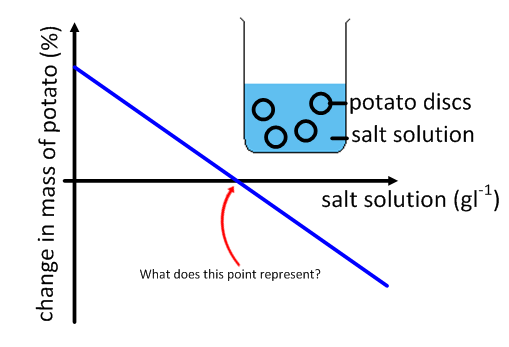 Answer these questions as a group:
1. Explain the significance of the point labeled in red.
2. Explain the blue line.
3. Deduce the experimental method used to generate this graph.
4. Discuss how the dependent variable was recorded and calculated.How would the researcher ensure that data were sufficient, relevant and reliable?
5. Discuss the variables that needed to be controlled in the investigation. What could be the impact of each of them? How could they be controlled?
Using this basic investigation, you are going to work through the stages of a good Design write-up and then carry out this lab. Complete this sheet as a group:
– Design group discussion sheet and self-assessment rubric
Tips:
- Refer to the self-assessment rubric and checklist on a regular basis.
- Start with the end in mind. Design the results table that will allow you to produce the most appropriate graph and get sufficient, relevant and reliable data. Then work backwards to create your Design.
Although we cannot submit this lab for IA to the IB, it will be good opportunity to think about what goes into a good Design.
Great contributions come in little petri-dishes
Two new books are going into the school library, and both are well worth the extra-credit reading time. In their own different ways, they investigate the history of experimental Biology, looking at the contributions of individuals and groups and some of the surprising discoveries made over the last century.

Buy on Amazon
“Fly: An Experimental Life” by Martin Brookes, does not at first glance look like the kind of book you’d want to pick up and read. However, it is a well-written, funny and IB-relevant text that looks at some of the characters of the fruit fly world and the great contributions this tiny species has made to scientific understanding. These contributions include gene mapping, experimental genetics and evolutionary biology, as well as studies of gene interactions and relationships, learning and sexual warfare.
Thousands of scientific papers have been published based on fruit fly research, and through reading this book, you will get a real appreciation for how Biology works, how paradigms and attitudes have shifted over the last hundred years and how the dedication of the few has led to advances for us all.
This choice passage gives you a good idea of the writing style:
“It has always been convenient, if sometimes simplistic, to divide biologists into two distinct camps, namely the experimentalists, as exemplified by Morgan, and the natural historians, as exemplified by Darwin. The legacy of this divide can still be seen today. Modern biologists, like belly-buttons, tend to fall into one of two categories, ‘innies’ or ‘outies’. ‘Innies’, the modern descendants of the experimental tradition, spend their entire lives working indoors. They are most comfortable sitting at the computer or laboratory bench and develop acute migraines when exposed to direct sunlight. To this group belong the biochemist, molecular biologists, geneticists and mathematical modellers. Most of these people will not own a pair of binoculars.
In contrast, ‘outies’, the modern-day naturalists, are laboratory illiterate. They understand how to open the fridge door but that’s about as far as their indoor knowledge extends. None of this matters to an outie, of course. Outies are more interested in devoting all their energy to prodigious beard growth and memorizing the Latin names of a thousand different bird species. All outies own a pair of extremely expensive binoculars, which are worn at all times, with the maker’s name facing outwards. To this category belong the ecologists and, well, that’s about it.
Occasionally, however, you come across a third category of biologist, someone who is neither an ‘innie’ or an ‘outie’ but an ‘in-betweenie’…”
Once you’ve read this book, you will really understand how Sarah Palin got the scientific establishment wound up with this gaffe:
……….o0O0o……….

Buy it at Amazon
Next up is “The Immortal Life of Henrietta Lacks” by Rebecca Skloot. A decade in the making and almost a sure-thing to top many science book of the year lists, Skloot digs up the murky history of HeLa cells, the discoveries that have arisen from research based on them and the lasting effects this work has had on her family.
This book is incredibly well-crafted, balancing science and emotion in a moving tale. Skloot jumps between the near-present and the 1940’s-50’s, writing about the discovery of the world’s first immortal cell line, taken from a biopsy of an aggressive cervical tumour of Henrietta Lacks, the descendant of a tobacco-farming slave family. As the cells grow and the biotechnology industry is built on discoveries yielded by research on them, Henrietta’s family lives in near-poverty.
Skloot has written this book in such a way as to give credence to the genius, creativity and good intentions of post-war researchers, while considering the human benefits and costs of this kind of scientific discovery. Encouragingly, it is to be made into a HBO film project, which should get the story out to many more people – especially with Oprah behind it!
Here’s CBS Sunday Morning giving an overview of the book:
As debates on gene patents and ownership of genetic information rage on, Skloot takes part in a discussion on TVO’s The Agenda with Steve Paikin:
Update: Amazon editors have announced that The Immortal Life of Henrietta Lacks is the best book in their top 100 – of all categories – for 2010. Wow.
Tom McFadden on the news – BooYah!
MrT’s Lyrical Science hero makes a splash in New Zealand:
Get inspired – get writing: head on over to the Lyrical Science page. I can’t wait to hear the girls’ Classification version of Dynamite.
Mobile apps for SlideShare – iPhones and iPads

SlideShare Mobile Apps
Here’s a quick post for students with iPads or iPhones. Do your pre-reading or revision (or just read for fun) on the way home using these applications for SlideShare.
SlideBySlide is a free app for the iPad which allows you browse and access SlideShare presentations. SlideShare’s m.slideshare.com mobile apps should also work on phones. If you have an iPad or iPhone, try them out and let me know how it goes.
Can you use these apps on BlackBerries and other mobile phones? If not, you can get pdf readers and ppt apps that will allow you to save the presentations from the network to your devices. Have fun playing with these ideas – how could we make better use of the technologies that you have in class?
Conservation Inspiration
The world doesn’t have to be in the mess it is in.
This week, the HL students will be working on G4 (Conservation of Biodversity) and G5 (Population Ecology). The videos below link to these topics, but the issues are of such current global importance right now, I encourage all students to watch them.
We all know that we need to make changes and take action, but the seeming hopelessness of the situation is a barrier to many.What possible difference could some individuals make?
Quite a lot, as it turns out.
In this TED Talk, John Kasaona describes how activation of some the biggest stakeholders on the land in Namibia – the poachers – turned a huge problem into an effective in-situ conservation effort that acts as a role model for active management to the rest of the world. Inspiring and true, this is well worth 18minutes of your time:
In this TED Talk, Willie Smits tells the inspiring story of their project to revive some devastated Borneo rainforest made great use of local people in active management and has provided a habitat for the orang-utans to return. You can also read about it here.
Dan Barber: How I Fell In Love With A Fish (sustainable fisheries). Watching this, think about the following questions:
- In what ways is this an example of active management in conservation?
- What are the measures of ecological health being used here?
And if you’re up for some doom and gloom, swim on over to the population ecology page, where there are clips about how we wrecked the oceans, including some clips from the EndOftheLine. Head on over to their official webpage (with video excerpts). They have a very useful what-you-can-eat widget on their website, which can also be used in pdf format.
……….o0O0o………..
BIS students – the TED talks are saved on the network, so you can put them on your iPods or laptops and watch them when you’re stuck in traffic on the way home.




 i-Biology