Category Archives: IBDP Biology
BioNinja: App & Website

Click to visit BioNinja
BioNinja is website and app for review in IB Biology that you might find useful. It has some summary notes, tutorials and songs and quizzes on the free app.
For other review resources for the IBBio exams:
- This site (i-Biology.net) has presentations, links and review sheets.
- Click4Biology.info has good summary notes, with depth
The Great Barrier Reef: An Obituary
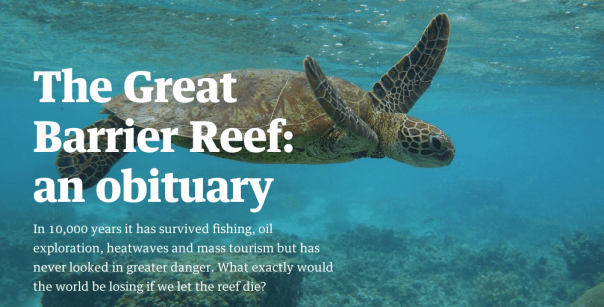
The Great Barrier Reef: An Obituary. This haunting multimedia Guardian piece could be a perfect provocation for a unit.
In the current age of environmental destruction it can be difficult to keep paying attention to the news. But some stories stand out as being real alarm bells, and this very sad piece on the iconic barrier reef highlights a lot of purely human-caused issues. To add to the misery, now the reef is under further threat from destructive dredging and dumping… to make way for shipping lanes for coal mining in Australia. #EpicFail.
MrT’s students: note the image above has a caption and links back to the original source, not to an image hosted on my WordPress. Make sure your writing does the same.
Ed Yong’s TED Talk: Suicidal crickets, zombie roaches and other parasite tales
“Are there any parasites that are influencing our behaviour without us knowing it?”
When I started this blog back in 2007, Ed Yong was a fledgling science writer gaining an audience with his Not Exactly Rocket Science wordpress blog; clear and engaging online articles that opened up primary research to a wider audience. You’ll find many links to his writing throughout this site, connecting the concepts of the IB Biology course to current science and ‘the wow beat’. He has since had a book and is resident at NatGeo’s Phenomena Salon, after moving through Science Blogs and Discover.
He continues to inspire me as a writer and this week he gave his TED Talk, a funny and fact-packed tour of the sinister side of parasites. Enjoy! You will even be able to find some links out to further reading and references.
If you don’t already, you should subscribe to the Phenomena blogs, and if you’re a teacher or student whose schedule are as packed a mine, I highly recommend Ed’s weekly ‘Missing Links‘ roundup of science news and writing – they make for my Sunday morning reading!
30-Minute Inquiry: Base-substitution mutations
This has worked well (and been fun) as a topic review, way to make use of databases (ICT in IBBio requirement) and make connections as we.
Question: What do HBB, PAH, PKD1, NF1, CFTR, Opn1Mw and HEXA have in common?
Concepts: Structure vs Function; Universality & Diversity.
The set-up:
- Assign groups by handing out cards with the codes above (we had already studied HBB, so didn’t include it) and asking them to find each other.
- Give them the instructions – to produce a simple poster & 1-minute overview of their disorder, using the guidance in the image below.
- Go. Lots of discussion, lots of questioning. If students get stuck, they need to look it up, evaluate their sources and keep on going.
- Students will need to use the NCBI gene database to get going: http://www.ncbi.nlm.nih.gov/gene
Check they’re on the right track: HBB (sickle cell), PAH (PKU), PKD1 (polycystic kidney disease), NF1 (neurofibromatosis), CFTR (cystic fibrosis), Opn1Mw (medium-wave sensitive colour-blindness), HEXA (Tay-Sachs disease). They are all disorders causes by base-substitution mutations.
After 30 minutes:
- Groups present to the class what they have found.
- As the class sharing continues, ask questions based on connections:
- What similarities and differences do we see?
- What are the normal functions of these genes and how does this connect to our understanding of proteins, channels, pumps, etc.

Amazing T. rex Illusion
This illusion rocks. See if you can work out how they did it before you see the ‘reveal’.
For more amazing illusions, see the archive of winners and entries in the ‘illusion of the year‘ contest.
Hattie & Yates: Visible Learning & the Science of How We Learn
This is my review of John Hattie’s new book, Visible Learning and the Science of How We Learn. If you’re interested, head over to my personal blog to read more.

Samudra, mini-me, having a good think about cognitive load.

This brief review of John Hattie and Gregory Yates’ Visible Learning & the Science of How we Learn (#HattieVLSL) is written from the multiple perspectives of a science teacher, IB MYP Coordinator and MA student. I have read both Visible Learning and Visible Learning for Teachers, and regularly refer to the learning impacts in my professional discussions and reflections. While reading the book, I started the #HattieVLSL hashtag to try to summarise my learning in 140 characters and to get more people to join in the conversation – more of this below.
EDIT: March 2017
This review was written right after the release of VLSL, in late 2013. Since then, the ideas of ‘know they impact‘ and measurement of learning impacts have really taken off in education, particularly in international schools. Critics of Hattie (largely focused on mathematics or methodology) are also easy to find, though the
View original post 2,409 more words




 i-Biology