Category Archives: Uncategorized
Optogenetics & the Brain – watch this video!
Thanks, once again, to Ed Yong for his fantastic NotExactlyRocketScience blog. This video is a must-watch for students, especially those taking HL and the Neurobiology option. Once you’ve seen it, go over to Ed’s blog and read the article “Shedding light on sex and violence in the brain“, which is a really interesting look at the balance between sex and aggression in mouse brains, using this method.
You can see why it is the winner of Nature Methods’ 2010 Method of the Year (click for lots of articles).
Although it is way ahead of the syllabus, there are links to:
- taxis
- membrane proteins, channels and ions
- depolarisation and hyperpoloarisation of nerves
- transgenics (using viruses as a vector for delivering new genes)
- transcription and translation
- regions of the brain
Embed Plus – and the Plants Talk to Us
 Tay from EmbedPlus pointed me to their free tool to allow greater control over YouTube videos, so here is my first attempt at using it to annotate and take over this TED talk from Wade Davis.
EDIT – it doesn’t work properly on WordPress.com, but here is a link to the edited video (the embedded version below is the original from YouTube). It works great on GoogleSites and Moodle, though.
The second ‘chapter’ (about 11.40 in) links to a brilliant example of an amazonian shaman who makes a powerful psychoactive preparation of Ayahuasca, from a vine. Tryptamines are the active component and are similar to tryptophan (our famous amino acid/ end product inhibition example).
They act as neurotransmitters and include serotonin, which regulates mood. It is broken down by enzymes bound to the plasma membrane of cells in the digestive tract called monoamine oxidase (MAO), so can’t be taken orally. The amazing thing is the shaman uses a preparation from another plant that inhibits this enzyme, so that the potion can be ingested and is effective. This is amazing knowledge, gleaned from a totally alternative scientific method to the one we are used to, and demonstrates an advanced naturalistic intelligence.
When he asked how they knew this and were able to combine these two extracts from the thousands available, they answered “The plants talk to us.”
Can you link this to the AHL enzymes content and represent it diagrammatically?
Once you’re done flicking through, watch the whole talk. Then become an ethnobotanist and do something useful!
For more questions and TOK links, see the full post here.
Perception of Stimuli
Close your left eye and stare at the +. Move your head closer to the screen and keep staring at the +, but pay attention to the dot. What happens? Explain why.

- Explain it yourself first, then check at Serendip’s great website.
You need to know the structure of the eye to succeed! This eye structure tutorial from Sumanas might help.
The solution and loads more perception demonstrations can be found at Serendip’s playground.
Your biggest challenge is this one: “Explain the processing on visual stimuli, including edge enhancement and contra-lateral processing“.
So here are our class notes:
There are many more resources on the main page for this topic:
E2 Perception of Stimuli (including some cool links to illusions)
Here is Pawan Sinha talking about how the brain learns to see, and how we can help the children who are born blind in India. Find out more about Sinha’s work and Project Prakash at his university website (MIT).
Updated IA Self-Assessment Sheets
Tip: to print your completed rubric, first save as a pdf file- it doesn’t confuse the printers. For the same document as 4 portrait A4 pages, which can be easily copy-pasted onto your write-up, click here.
BIS Students: make sure that you use this in all stages of your experimental work, from design to the final write-up. Use it to:
- Check your work as you plan and carry out the investigation
- Self-assess your write-up as you go through the process
- Reflect on the feedback given via Moodle/Turnitin
For more IA help, click here.
The codes on the checklist correspond to those that appear on your marked work via Moodle/Turnitin. Other teachers – you can download these comments here, to be used or adapted as long as your school uses the full Turnitin WriteCycle package.
A breathing lung live on stage…

Click for more TEDMED videos
Check out this entertaining TEDMED 2010 Talk in which Shaf Keshavjee brings a breathing lung onto stage and explains how the process of transplantation works. Plenty of links to the human health and physiology topics here:
Early in the talk he refers to Charity Tilleman-Dick, an opera singer who can sing again after a double lung transplant! It’s also funny to see Martha Stewart get on like a high-schooler with her camera-phone.
Fore more excellent anatomy and physiology resources, GetBodySmart is a great website.
Force of Nature: The David Suzuki Movie
 I cannot wait to see this movie! David Suzuki is a life-long environmental hero, with a colourful history and a huge impact on environmental-mindedness. Wikipedia has a nice summary of his life so far.
From the website:
“David Suzuki, iconic Canadian scientist, educator, broadcaster and activist delivers a ‘last lecture’ — what he describes as “a distillation of my life and thoughts, my legacy, what I want to say before I die”.
The film interweaves the lecture with scenes from the places and events in Suzuki’s life — creating a biography of ideas — forged by the major social, scientific and cultural events of the past 70 years.”
If you’re a Suzuki fan, ‘like’ his facebook page, too!
Click4Biology Videos
John Burrell from Click4Biology has just started uploading some tutorial videos for Biology on his YouTube Channel. You might find them useful, so check them out!
Group 4 Project 2011: “Our Choice, Our Future”

EARCOS GIN Ning
Based on “High Noon: 20 Global Problems, 20 Years to Solve Them,” by Jean-Francois Rischard. This is the theme of the 2011 EARCOS Global Issues Network Conference, and we will be sending two teams to represent the school at JIS in April. For these teams, the G4 Project will serve as preparation for their student-led workshops at the conference.
For all of us, it will be an interesting trans-disciplinary experience in real-world problem-solving using Science.
Let’s get working!
……….o0O0o……….
The Group 4 Project is a central part of the Group 4 Experimental Sciences. It is a chance to come together as scientists and think about how science can address pressing current issues. Thinking from an interdisciplinary point of view, students research and investigate the latest science and its potential impacts on the world.
The aim of the Group 4 Project is “To encourage an understanding of the relationships between scientific disciplines and the overarching nature of the scientific method” (IB Biology Subject Guide, 2007)
To be successful in tackling current global problems and challenges, we must think from a truly trans-disciplinary point of view: within and beyond the sciences. We must consider the involvement of all stakeholders and make decisions based on reliable and authentic evidence. The role of the scientist is becoming increasingly important in policy decision making and communication to the public – and this is what we aim to model in our approach to the Group 4 Project.
……….o0O0o……….
It is also a great opportunity to develop international mindedness and the following aims of the experimental sciences:
Aim 7: “Develop and apply the students’ ICT skills in the study of science”
Aim 8: “Raise awareness of the moral, social, ethical, economical and environmental implications of using science and technology”
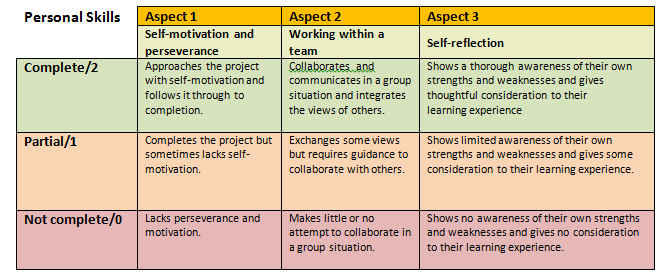
And, of course, it makes up 10 hours of your 4PSOW – which is essential for your Sciences course – and is the only opportunity to be assessed for the fourth internal assessment criterion, Personal Skills:
 ……….o0O0o……….
Guidance
-This project is designed to be evidence-based and to demonstrate the level of your research skills. You must be able to support all information presented with sources. Access to databases will really help you.
– Less is more when it comes to text. Graphics and datasets should form the basis of your presentation, with the factual exposition delivered in the oral presentation. Think about what kind of displays most engage you as the viewer.
– Collaboration is key. For this reason, you will all need to understand and be able to present all aspects of the project. Plan together, share ideas and set targets for your work over two days. In the action phase, come together as a group regularly to share your work with your group, evaluate your progress and set further targets.
– Read up on current science, economical and environmental news beforehand. Think about the theme, choose a good topic and run with it.
……….o0O0o……….
Past themes: (click here for resources)
Each year, we choose a theme which allows for authentic trans-disciplinary links across the sciences and, as far as possible, Economics.
“How can Science help re-build a stable and sustainable economy?”
“How can Science aid progress towards the UN’s Millenium Development Goals?”
“How can Science help combat environmental damage?”




 i-Biology