Design Lab Training: Osmosis
Consider this basic sketch graph of an experiment and its results:
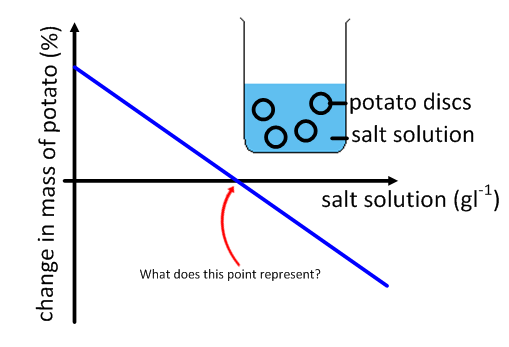 Answer these questions as a group:
1. Explain the significance of the point labeled in red.
2. Explain the blue line.
3. Deduce the experimental method used to generate this graph.
4. Discuss how the dependent variable was recorded and calculated.How would the researcher ensure that data were sufficient, relevant and reliable?
5. Discuss the variables that needed to be controlled in the investigation. What could be the impact of each of them? How could they be controlled?
Using this basic investigation, you are going to work through the stages of a good Design write-up and then carry out this lab. Complete this sheet as a group:
– Design group discussion sheet and self-assessment rubric
Tips:
- Refer to the self-assessment rubric and checklist on a regular basis.
- Start with the end in mind. Design the results table that will allow you to produce the most appropriate graph and get sufficient, relevant and reliable data. Then work backwards to create your Design.
Although we cannot submit this lab for IA to the IB, it will be good opportunity to think about what goes into a good Design.
Digestion (Core) and Flip Thinking
Digestion – something you only want to go in one direction. But learning about digestion doesn’t have to go one way. As we are trying to reduce the burden of homework and to make any time spent working outside class as effective as possible, we’re going to try Flip Thinking.
Essentially, your homework takes place before class and you complete only the objective 1 command terms (the bits you don’t need me for). With that out of the way and a foundation in the language and diagrams of the topic, we can focus on the more complex items together.
Come to class with the objective 1 command terms completed in the Essential Biology for Digestion (Core). I have highlighted them in yellow. This should take no more than one of your study periods. If it takes longer, stop and let me know how far you got, as well as how effectively you were working.
Come to classes prepared with your laptop and don’t forget the resources we have available.
Here goes:
Further resources:
Essential Biology 6.1 Digestion (Core)
Key question: How many links can you make from Digestion to the others topics we have already studied in IB Biology?
……….o0O0o……….
I cannot take credit for this idea. Check out these resources:
- Flip Thinking from John Burrell (Click4Biology)
- Eric Mazur’s Science education research group
- Flip Thinking from Daniel Pink
- The Homework Myth by Alfie Kohn
If, however, you find that this helps or hinders your progress, be sure to let me know.
Great contributions come in little petri-dishes
Two new books are going into the school library, and both are well worth the extra-credit reading time. In their own different ways, they investigate the history of experimental Biology, looking at the contributions of individuals and groups and some of the surprising discoveries made over the last century.

Buy on Amazon
“Fly: An Experimental Life” by Martin Brookes, does not at first glance look like the kind of book you’d want to pick up and read. However, it is a well-written, funny and IB-relevant text that looks at some of the characters of the fruit fly world and the great contributions this tiny species has made to scientific understanding. These contributions include gene mapping, experimental genetics and evolutionary biology, as well as studies of gene interactions and relationships, learning and sexual warfare.
Thousands of scientific papers have been published based on fruit fly research, and through reading this book, you will get a real appreciation for how Biology works, how paradigms and attitudes have shifted over the last hundred years and how the dedication of the few has led to advances for us all.
This choice passage gives you a good idea of the writing style:
“It has always been convenient, if sometimes simplistic, to divide biologists into two distinct camps, namely the experimentalists, as exemplified by Morgan, and the natural historians, as exemplified by Darwin. The legacy of this divide can still be seen today. Modern biologists, like belly-buttons, tend to fall into one of two categories, ‘innies’ or ‘outies’. ‘Innies’, the modern descendants of the experimental tradition, spend their entire lives working indoors. They are most comfortable sitting at the computer or laboratory bench and develop acute migraines when exposed to direct sunlight. To this group belong the biochemist, molecular biologists, geneticists and mathematical modellers. Most of these people will not own a pair of binoculars.
In contrast, ‘outies’, the modern-day naturalists, are laboratory illiterate. They understand how to open the fridge door but that’s about as far as their indoor knowledge extends. None of this matters to an outie, of course. Outies are more interested in devoting all their energy to prodigious beard growth and memorizing the Latin names of a thousand different bird species. All outies own a pair of extremely expensive binoculars, which are worn at all times, with the maker’s name facing outwards. To this category belong the ecologists and, well, that’s about it.
Occasionally, however, you come across a third category of biologist, someone who is neither an ‘innie’ or an ‘outie’ but an ‘in-betweenie’…”
Once you’ve read this book, you will really understand how Sarah Palin got the scientific establishment wound up with this gaffe:
……….o0O0o……….

Buy it at Amazon
Next up is “The Immortal Life of Henrietta Lacks” by Rebecca Skloot. A decade in the making and almost a sure-thing to top many science book of the year lists, Skloot digs up the murky history of HeLa cells, the discoveries that have arisen from research based on them and the lasting effects this work has had on her family.
This book is incredibly well-crafted, balancing science and emotion in a moving tale. Skloot jumps between the near-present and the 1940’s-50’s, writing about the discovery of the world’s first immortal cell line, taken from a biopsy of an aggressive cervical tumour of Henrietta Lacks, the descendant of a tobacco-farming slave family. As the cells grow and the biotechnology industry is built on discoveries yielded by research on them, Henrietta’s family lives in near-poverty.
Skloot has written this book in such a way as to give credence to the genius, creativity and good intentions of post-war researchers, while considering the human benefits and costs of this kind of scientific discovery. Encouragingly, it is to be made into a HBO film project, which should get the story out to many more people – especially with Oprah behind it!
Here’s CBS Sunday Morning giving an overview of the book:
As debates on gene patents and ownership of genetic information rage on, Skloot takes part in a discussion on TVO’s The Agenda with Steve Paikin:
Update: Amazon editors have announced that The Immortal Life of Henrietta Lacks is the best book in their top 100 – of all categories – for 2010. Wow.
Tom McFadden on the news – BooYah!
MrT’s Lyrical Science hero makes a splash in New Zealand:
Get inspired – get writing: head on over to the Lyrical Science page. I can’t wait to hear the girls’ Classification version of Dynamite.
Mobile apps for SlideShare – iPhones and iPads

SlideShare Mobile Apps
Here’s a quick post for students with iPads or iPhones. Do your pre-reading or revision (or just read for fun) on the way home using these applications for SlideShare.
SlideBySlide is a free app for the iPad which allows you browse and access SlideShare presentations. SlideShare’s m.slideshare.com mobile apps should also work on phones. If you have an iPad or iPhone, try them out and let me know how it goes.
Can you use these apps on BlackBerries and other mobile phones? If not, you can get pdf readers and ppt apps that will allow you to save the presentations from the network to your devices. Have fun playing with these ideas – how could we make better use of the technologies that you have in class?
Conservation Inspiration
The world doesn’t have to be in the mess it is in.
This week, the HL students will be working on G4 (Conservation of Biodversity) and G5 (Population Ecology). The videos below link to these topics, but the issues are of such current global importance right now, I encourage all students to watch them.
We all know that we need to make changes and take action, but the seeming hopelessness of the situation is a barrier to many.What possible difference could some individuals make?
Quite a lot, as it turns out.
In this TED Talk, John Kasaona describes how activation of some the biggest stakeholders on the land in Namibia – the poachers – turned a huge problem into an effective in-situ conservation effort that acts as a role model for active management to the rest of the world. Inspiring and true, this is well worth 18minutes of your time:
In this TED Talk, Willie Smits tells the inspiring story of their project to revive some devastated Borneo rainforest made great use of local people in active management and has provided a habitat for the orang-utans to return. You can also read about it here.
Dan Barber: How I Fell In Love With A Fish (sustainable fisheries). Watching this, think about the following questions:
- In what ways is this an example of active management in conservation?
- What are the measures of ecological health being used here?
And if you’re up for some doom and gloom, swim on over to the population ecology page, where there are clips about how we wrecked the oceans, including some clips from the EndOftheLine. Head on over to their official webpage (with video excerpts). They have a very useful what-you-can-eat widget on their website, which can also be used in pdf format.
……….o0O0o………..
BIS students – the TED talks are saved on the network, so you can put them on your iPods or laptops and watch them when you’re stuck in traffic on the way home.
The Greenhouse Effect
Although just a few short assessment statements, this topic is one we could investigate for weeks. Key to understanding this is thinking about how we evaluate the precautionary principle with regard to anthropogenic environmental impacts:
“The theory that an action should be taken when a problem or threat occurs, not after harm has been inflicted; an approach to decision- making in risk management which justifies preventive measures or policies despite scientific uncertainty about whether detrimental effects will occur“. From Dictionary.com.
(Includes some slides from G3 Human Impacts, related to Ozone Layer)
Essential Biology 5.2 The Greenhouse Effect —— Click4Biology:The Greenhouse Effect
While working through all of the resources, think about how you distinguish between the following:
- natural and enhanced greenhouse effect
- anthropogenic vs natural causes
- global warming vs climate change vs climate destabilisation
In this TED Global 2010 talk, Lee Hotz describes the work of researchers in the Antarctic, studying the history of our planet’s climate, through drilling ice-cores that go back in thousands of years.
For all the rest of the resources (and stacks of video clips), click on over to the main page for 5.2 Greenhouse Effect.
Ctrl-A Del: Sorting out the flowers
Interesting news today from the Guardian: “Scientists prune list of world’s plants“. 600,000 species of flowering plants have been deleted from the records in an impressive piece of international cooperation.
And no, that’s not because 600,000 have gone extinct (although so many are rapidly disappearing)- it’s because so many were duplicates with different names. By sorting out the list, botanists hope to make it easier for ecologists to keep track of genuinely newly discovered species, as well as more effectively monitor species over time.
 This is a nice link to the Classification unit, and highlights the importance of international cooperation in the sciences. It was part of an effort for the Convention of Biological Diversity, which meet this October in Japan. It also links to the Ecology and Conservation option.
Here is a short interview with Dr Ahmed Djoghlaf, Executive Secretary of the Convention on Biological Diversity, discussing why all of the member countries have failed to reach their targets, and why it is important to engage all stakeholders in the process of conservation:
G2 Ecosystems and Biomes
Essential Biology: G2 Ecosystems and Biomes
Biomes:
Biomes of the world animation, from McGraw Hill
Terrestrial biomes animation, from Freeman LifeWire
Succession:
Primary succession on a glacial moraine, from Freeman LifeWire
Forest succession, from Wiley
Forest succession, from Ecoplexity
Collection of succession animations, from Nodvin Environmental Science
Energy Flow
Basic pyramids, from Harcourt Schools
—————————————————–
Next lesson, we will will start with some past-paper questions on this topic. Think about these:
- Explain why gross production of an ecosystem is always higher than net production (2 marks)
- Explain the low biomass and low numbers in higher trophic levels (3 marks)
- Outline the changes in gross production of an ecosystem throughout ecological succession (2 marks)
- Explain how living organisms affect the abiotic environment through succession (4 marks)
- Distinguish between primary and secondary succession (2 marks)
—————————————————–
Here’s a short TED Talk from Graham Hill of Trehugger.com on why he’s a weekday vegetarian. When you watch it, think about how it related to issues of energy flow and the land needed to produce for a meat-eating diet.




 i-Biology