Design Lab Training: Osmosis
Consider this basic sketch graph of an experiment and its results:
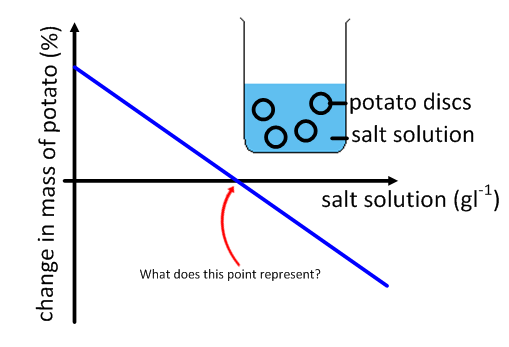 Answer these questions as a group:
1. Explain the significance of the point labeled in red.
2. Explain the blue line.
3. Deduce the experimental method used to generate this graph.
4. Discuss how the dependent variable was recorded and calculated.How would the researcher ensure that data were sufficient, relevant and reliable?
5. Discuss the variables that needed to be controlled in the investigation. What could be the impact of each of them? How could they be controlled?
Using this basic investigation, you are going to work through the stages of a good Design write-up and then carry out this lab. Complete this sheet as a group:
– Design group discussion sheet and self-assessment rubric
Tips:
- Refer to the self-assessment rubric and checklist on a regular basis.
- Start with the end in mind. Design the results table that will allow you to produce the most appropriate graph and get sufficient, relevant and reliable data. Then work backwards to create your Design.
Although we cannot submit this lab for IA to the IB, it will be good opportunity to think about what goes into a good Design.

Posted on November 2, 2010, in Uncategorized and tagged design, ia, labs. Bookmark the permalink. Leave a comment.




 i-Biology
Leave a comment
Comments 0